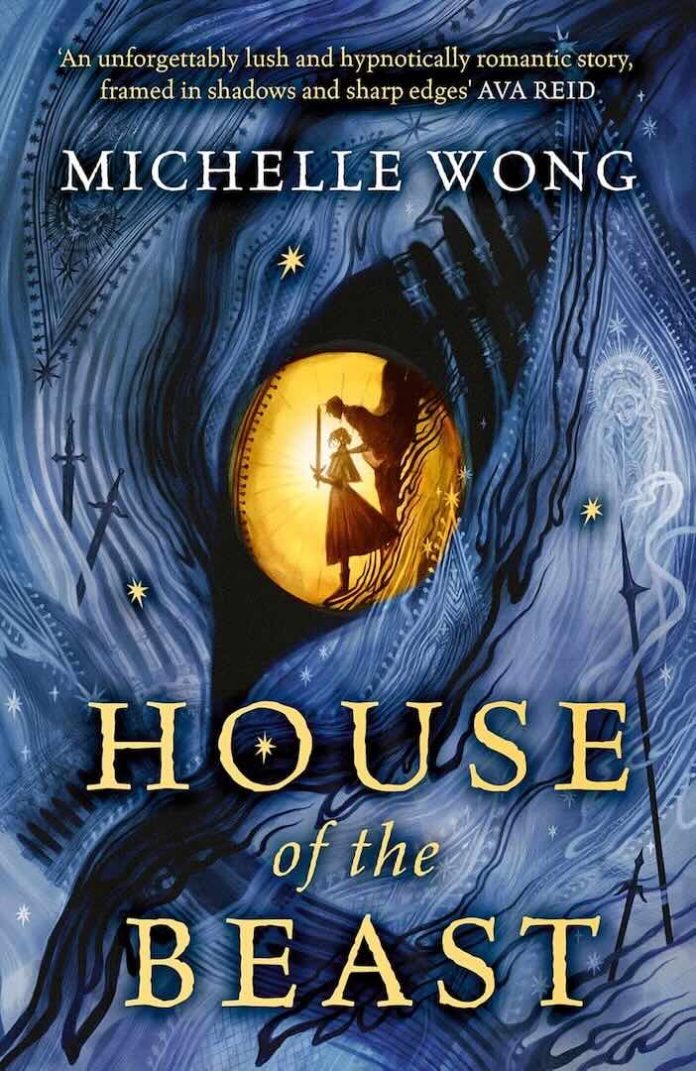
Michelle Wong’s debut novel, House of the Beast, arrives like a sword thrust through the heart of traditional fantasy romance—sharp, unforgiving, and utterly intoxicating. This dark fantasy weaves together elements of gothic horror, divine mythology, and twisted romance in a way that feels both familiar and startlingly original. Wong, known for her work as an illustrator on The Legend of Korra graphic novels, brings a visual artist’s eye to her prose, creating a world so vividly rendered that readers can almost feel the cold marble of temple floors and taste the metallic tang of blood in the air.
The story follows Alma, a bastard daughter of the noble House Avera, who sacrifices her left arm to the terrifying Dread Beast in exchange for her dying mother’s medicine. When her mother dies anyway, Alma finds herself trapped in a world of aristocratic cruelty, bound to a god who appears to her as a beautiful young man with starlit hair. Eight years later, driven by an all-consuming need for revenge, Alma embarks on a perilous journey to destroy the very house that enslaved her—guided by her divine companion, Aster, whose true nature may be far more complex than she realizes.
The Anatomy of Revenge
Wong’s exploration of vengeance operates on multiple levels throughout the narrative. Alma’s quest isn’t merely about personal satisfaction; it’s about reclaiming agency in a world that has systematically stripped her of power. The author skillfully demonstrates how revenge can become both a driving force and a poison, sustaining Alma through years of abuse while simultaneously corrupting her sense of self.
The relationship between Alma and her father, Lord Zander, serves as the emotional core of this revenge narrative. Wong refuses to soften the edges of their dynamic—Zander is calculating, manipulative, and utterly without redemption. His treatment of Alma as both a tool and a disappointment creates a tension that crackles throughout every interaction. The author’s decision to make Zander irredeemably cruel rather than complex serves the story well, providing a clear target for both Alma’s hatred and the reader’s disdain.
What makes Alma’s journey particularly compelling is how Wong explores the cost of revenge. The protagonist’s transformation from a grieving daughter to a calculating instrument of destruction is gradual and disturbing. The author doesn’t shy away from showing how Alma’s quest makes her complicit in violence and cruelty, particularly in her relationship with characters like Sevelie, her cousin’s fiancée, who becomes both ally and victim of Alma’s machinations.
The Divine and the Monstrous
Perhaps the most striking aspect of House of the Beast is Wong’s portrayal of Aster, the Dread Beast who takes the form of a beautiful young man. The author walks a delicate line between making him genuinely appealing and maintaining the underlying horror of what he represents. Aster’s character embodies the book’s central tension between beauty and monstrosity, love and obsession.
The romance between Alma and Aster is deeply unsettling in the best possible way. Wong understands that the most compelling dark romances aren’t simply about dangerous men, but about the seductive nature of power and the way trauma can reshape our understanding of love. Aster’s devotion to Alma is both touching and terrifying—he genuinely cares for her, yet his very nature as an ancient god of death makes their relationship fundamentally unequal.
The author’s handling of the power dynamic between mortal and divine is particularly sophisticated. Aster may appear as a teenager, but his true nature as an ancient entity creates layers of complexity that Wong explores without ever fully resolving. The question of whether Aster’s feelings are genuine or simply a reflection of Alma’s own desires adds psychological depth to their relationship.
World-Building and Atmosphere
Wong’s background as a visual artist is evident in every aspect of her world-building. The nation of Kugara, with its four noble houses serving different gods, feels both ancient and immediate. The author creates a sense of history and mythology that extends far beyond the immediate narrative, making the world feel lived-in and authentic.
The magical system, centered around vessels who channel divine power through sacrificed limbs, is both original and thematically resonant. The physical cost of divine connection reinforces the book’s themes about sacrifice and the price of power. Wong’s descriptions of the umbral plane and the divine realm are particularly effective, creating a sense of otherworldly beauty that conceals terrible truths.
The political intrigue surrounding the four houses provides a solid foundation for the personal drama. The Pilgrimage system, where young nobles must prove themselves worthy of their divine patrons, creates natural tension and conflict. Wong uses these political machinations to explore themes of legacy, worthiness, and the corruption of power.
Strengths and Sophisticated Storytelling
Wong’s prose is one of the book’s greatest strengths. She writes with the precision of a skilled illustrator, each scene carefully composed and vividly rendered. Her dialogue feels natural and period-appropriate without being archaic, and she has a particular gift for writing emotional scenes that feel raw and honest.
The pacing of the novel is expertly managed, with Wong building tension gradually while providing enough action to keep readers engaged. The structure, divided into three parts focusing on different aspects of Alma’s journey, allows for character development while maintaining narrative momentum.
Character development is another area where Wong excels. Alma’s transformation throughout the novel feels organic and earned, never rushed or forced. Supporting characters like Sevelie and Kaim are given enough depth to feel like real people with their own motivations and conflicts.
Key Strengths:
- Complex protagonist: Alma’s journey from victim to avenger is nuanced and psychologically compelling
- Atmospheric world-building: Wong creates a vivid, gothic fantasy world that feels both beautiful and dangerous
- Original magic system: The concept of divine vessels and the physical cost of power is both creative and thematically relevant
- Sophisticated romance: The relationship between Alma and Aster is disturbing, compelling, and emotionally complex
- Strong prose: Wong’s writing is evocative and precise, with excellent dialogue and scene construction
Areas for Improvement
While House of the Beast is a strong debut, it’s not without its flaws. The middle section of the book, focusing on Alma’s time in the capital, occasionally feels slower than the opening and closing acts. Some of the political intrigue, while well-constructed, can feel secondary to the personal drama between Alma and her family.
The book’s length sometimes works against it, with certain scenes feeling extended beyond their narrative purpose. Wong’s commitment to showing rather than telling, while generally a strength, occasionally results in sequences that could have been more efficiently handled.
Areas for Growth:
- Pacing inconsistencies: The middle section lacks the urgency of the opening and climax
- Supporting character development: Some secondary characters could use more depth
- Exposition balance: Occasionally heavy-handed in delivering background information
- Tonal shifts: Some transitions between horror and romance elements feel abrupt
Comparisons and Context
House of the Beast fits well within the current landscape of dark fantasy romance, sharing DNA with works like Stephanie Meyer’s darker material and the gothic romance traditions of earlier literature. However, Wong’s approach feels distinctly her own, particularly in her handling of divine horror and the psychological complexity of her protagonist.
Readers who enjoyed books like The Song of Achilles by Madeline Miller or The Priory of the Orange Tree by Samantha Shannon will find much to appreciate in Wong’s debut. The book also shares thematic elements with works like The Goblin Emperor by Katherine Addison, though Wong’s tone is considerably darker.
For fans of gothic romance, House of the Beast offers a fresh take on familiar themes, while fantasy readers will appreciate the original world-building and magic system. The book’s exploration of power, revenge, and the cost of divine connection places it in conversation with classical mythology while maintaining a distinctly modern sensibility.
Final Verdict
House of the Beast is a remarkably accomplished debut that announces Michelle Wong as a talent to watch in the dark fantasy genre. While it has minor pacing issues and could benefit from some tightening, the book’s strengths far outweigh its weaknesses. Wong has created a world that feels both ancient and immediate, populated with characters who are complex, flawed, and utterly human despite their divine connections.
The book succeeds both as a revenge story and as a dark romance, never sacrificing one element for the other. Wong’s willingness to explore the psychological complexity of her protagonist, combined with her skilled world-building and atmospheric prose, creates a reading experience that is both entertaining and thoughtful.
This is a book that will appeal to readers who appreciate psychological complexity in their fantasy, who enjoy morally ambiguous protagonists, and who are drawn to the intersection of horror and romance. It’s a confident debut that suggests even greater things to come from Wong as she continues to develop as a novelist.
Recommended for Readers Who Enjoyed:
- The Song of Achilles by Madeline Miller
- The Priory of the Orange Tree by Samantha Shannon
- The Ten Thousand Doors of January by Alix E. Harrow
- The Goblin Emperor by Katherine Addison
- The Invisible Life of Addie LaRue by V.E. Schwab