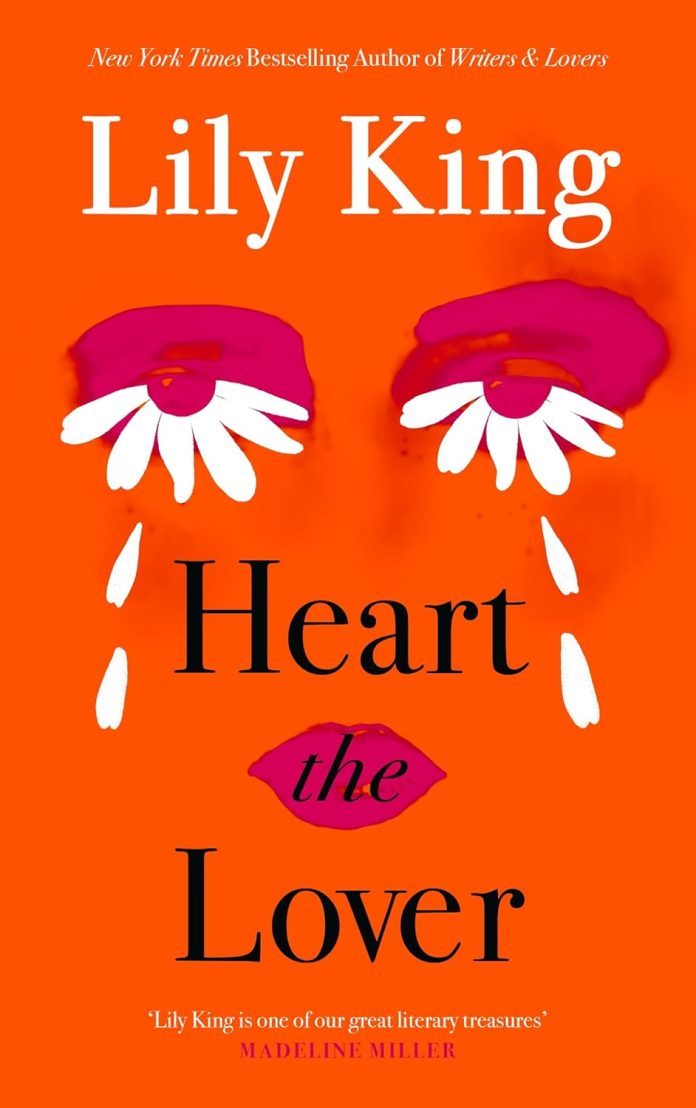
Lily King’s latest novel arrives with the quiet devastation of a long-held secret finally spoken aloud. In Heart the Lover, King returns to territory she’s mapped with devastating precision in previous works like Writers & Lovers and Euphoria—the fraught terrain where intellectual ambition collides with emotional vulnerability, where the choices made in youth reverberate through decades. But this time, she’s crafted something even more intimate: a novel that asks not whether we can forgive others, but whether we can forgive ourselves for the people we were when we knew less about the world and even less about our own hearts.
The narrative architecture King employs here is deceptively simple. We meet our unnamed narrator—later christened “Jordan” by her college friends—at a moment of recognition in her senior year. Two brilliant young men, Sam and Yash, invite her into their rarefied world of academic discourse and card games, transforming a struggling student into someone who discovers her own intellectual power. What unfolds is less a conventional love triangle than an excavation of how we build our lives around the absences we create, how we protect ourselves from the very connections we most desperately need.
The Architecture of Memory and Desire
King’s greatest strength has always been her ability to render the texture of lived experience with microscopic precision, and here she operates at the height of her powers. The novel moves between past and present with the fluidity of memory itself—not in neat chronological order, but in the way we actually remember: triggered by sensory details, colored by our current emotional state, revised and reinterpreted by time. The college sections shimmer with possibility and naiveté, capturing that particular intensity of late adolescence when everything feels simultaneously profound and performative. King doesn’t romanticize this period; she shows us how her narrator Jordan both participates in and observes the intellectual posturing of her peers, how she’s simultaneously drawn to and intimidated by Sam and Yash’s easy erudition.
The prose style King adopts for these sections is deliberately immediate, filled with the sensory details that make a specific time and place come alive. We feel the heat of bodies pressed together on a couch during card games, smell the percolating coffee that Sam drinks obsessively, sense the electric charge when Yash’s hand brushes Jordan’s. But King never lets us forget we’re experiencing these memories through the filter of Jordan’s older, wiser consciousness. There’s a melancholy undertone even to the most joyful moments, the knowledge that all this brightness is already lost.
The Complications of Connection
Where Heart the Lover distinguishes itself from typical romance or coming-of-age narratives is in its refusal to simplify its characters’ motivations or judge their choices harshly. Sam, with his religious convictions and sexual anxiety, could easily become a caricature of repression. Instead, King renders him with sympathy and complexity—a young man genuinely struggling with competing desires and inherited beliefs. Yash, the brilliant, funny center of gravity who eventually cannot show up for the narrator in her moment of greatest need, is neither villain nor tragic hero. He’s simply young, scared, and unable to see beyond his own immediate needs until it’s far too late.
The novel’s middle section, which follows Jordan through pregnancy, adoption, graduate school, and eventually into her life with Silas and their two sons, operates at a different register. Here King’s prose becomes more compressed, covering years in pages, giving us the sense of how life accelerates once we’ve made our major choices. This structural choice is deliberate and effective—these years matter less because they’re the life Jordan built in response to what she lost, the life she created when Yash failed to appear at that airport. They’re rich and meaningful, but they exist in the shadow of what might have been.
When the Past Returns
The novel’s final movement, when Jordan receives word that Yash is dying and travels to Atlanta to see him, represents King at her most emotionally daring. The hospital scenes could easily devolve into sentimentality or melodrama, but King keeps her focus laser-sharp on the specificities of experience: the smell of hospitals, the awkwardness of reunion, the way grief makes time feel elastic and strange. The revelation that comes between Jordan and Yash—the daughter they never knew they had together—carries enormous emotional weight precisely because King has earned it through the careful accumulation of detail and feeling across hundreds of pages.
What makes these sections so powerful is King’s refusal to offer easy resolutions. Jordan and Yash cannot recapture what they had; too much time has passed, too much damage has been done. But they can, finally, speak honestly to each other. They can acknowledge what was real and what was lost. The novel suggests that this—simply bearing witness to another person’s truth, even when it arrives decades late—might be its own form of grace.
The Craft of Emotional Truth
King’s technical mastery is evident throughout, but never showy. Her dialogue captures the rhythms of actual speech without becoming tedious; her descriptions evoke without overwhelming. She has a particular gift for rendering the experience of intellectual awakening—that moment when a young person discovers they have something valuable to contribute to the conversation. The scenes in Dr. Gastrell’s seminar, where Yash and Jordan spar over Aristotelian hamartia, crackle with the excitement of ideas genuinely mattering.
The novel’s structure, with its three distinct sections separated by decades, allows King to explore how we revise our own histories, how the stories we tell ourselves about our lives shift depending on where we stand when we’re telling them. The first section is told with the immediacy of experience; the second is deliberately compressed, almost summary; the third expands again as Jordan must reckon with everything she’s avoided confronting. This isn’t a gimmick but a deeply felt exploration of how memory and narrative shape identity.
A Few Reservations
If “Heart the Lover” has weaknesses, they lie primarily in its middle section. While the compression serves a thematic purpose, some readers may wish for more detail about Jordan’s life with Silas and their children before Jack’s illness. The relationship with Silas, in particular, sometimes feels more told than shown—we understand intellectually that it’s good and solid, but we don’t always feel its texture the way we feel every moment Jordan spent with Yash. This may be intentional—a demonstration of how our great early loves can overshadow even our most successful later ones—but it slightly unbalances the novel’s emotional architecture.
Similarly, Sam’s character, so vivid in the opening section, fades somewhat from view. While his reappearance at Yash’s deathbed is moving and thematically appropriate, some readers may wish for more of his perspective across the years. The novel belongs so completely to Jordan’s consciousness that other characters occasionally feel more like satellites than fully realized presences.
A Novel of Moral Complexity
What Heart the Lover ultimately offers is something rare in contemporary fiction: a novel genuinely interested in moral complexity without being morally relativistic. King doesn’t excuse Yash for abandoning Jordan, but she helps us understand the terror that drove him away. She doesn’t diminish Jordan’s pain, but she shows us how that pain coexisted with other loves, other joys. The novel suggests that we are all simultaneously the heroes and villains of our own stories, that the same person can be both profoundly loved and deeply hurt us, that forgiveness doesn’t require forgetting and sometimes arrives too late to change anything except how we carry the weight of what happened.
The book’s engagement with Jack’s illness adds another layer of moral weight. King draws careful parallels between Jordan’s inability to control her son’s suffering and her inability to change what happened with Yash. Both situations require her to sit with uncertainty, to love fiercely while accepting she cannot protect the people she loves from pain. These parallel narratives never feel forced; instead, they illuminate each other, showing how we learn—or fail to learn—from our experiences of powerlessness.
The Verdict on Affairs of the Heart
Heart the Lover confirms Lily King as one of our most emotionally intelligent novelists, someone capable of rendering the full complexity of human connection without flinching from its difficulties or indulging in easy sentiment. The novel moves with the rhythm of actual experience—sometimes slow, sometimes rushing forward, always attentive to the small moments that accumulate into a life. It understands that our greatest loves don’t always look like we expect them to, that the person who matters most may not be the person we end up with, and that living well means accepting these contradictions rather than resolving them.
Heart the Lover is a novel for readers who appreciate emotional precision, who want their fiction to grapple with difficult questions rather than provide comforting answers. It’s a book about friendship and romance, yes, but also about intellectual awakening, about parenthood, about how we build lives from the rubble of our mistakes. King has given us a story that respects the intelligence of its readers and the complexity of human experience. It’s a novel that will likely haunt you long after you’ve turned the final page, not because it’s unresolved, but because it feels so achingly, completely true.
For Readers Who Loved
If Heart the Lover resonates with you, consider these similarly nuanced explorations of love, loss, and the lives we build:
- The Interestings by Meg Wolitzer—follows a group of friends from adolescence through middle age, examining how youthful promise intersects with actual achievement
- On Beauty by Zadie Smith—a contemporary reworking of Howard’s End that explores intellectual life, family dynamics, and the complicated nature of love
- The Great Believers by Rebecca Makkai—alternates between 1980s Chicago during the AIDS crisis and present-day Paris, exploring how we survive devastating loss
- Department of Speculation by Jenny Offill—a fragmented, brilliant examination of marriage, motherhood, and creative ambition
- Normal People by Sally Rooney—traces an on-again, off-again relationship from adolescence through young adulthood with psychological precision
Each of these novels, like King’s, refuses to simplify the messiness of human connection or offer false comfort about the choices we make. They understand that love—romantic, familial, platonic—always contains multitudes, always asks more of us than we think we can give.