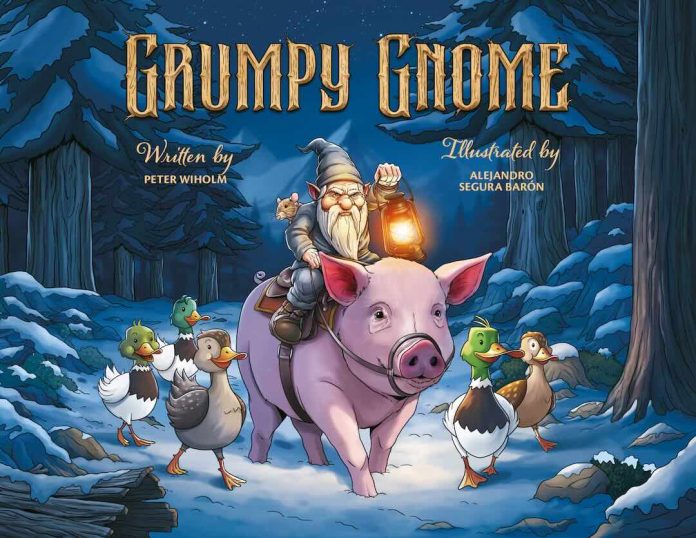
In an age where children’s literature often leans heavily on fast-paced action or obvious moral lessons, Peter Wiholm‘s debut picture book arrives like a breath of crisp winter air—refreshing, contemplative, and deeply satisfying. Illustrated with stunning detail by Alejandro Segura Barón, Grumpy Gnome offers young readers and their families something increasingly rare: a story that trusts its audience to find meaning in subtlety while delivering genuine entertainment through wit, warmth, and visual splendor.
A Story That Earns Its Heart
What makes Grumpy Gnome remarkable is how it refuses to take the easy path. This isn’t a tale where a cranky protagonist instantly transforms through a single act of kindness or learns an obvious lesson spelled out in capital letters. Instead, Wiholm crafts a narrative that understands how real change happens—gradually, grudgingly, and often despite our best efforts to resist it.
The story centers on a house gnome who has been enjoying retirement for over a century, content in his solitude until a flock of persistently chatty ducks begin reporting disasters at the farm he once tended. The new human occupants, a father and daughter facing their own struggles, have inadvertently created chaos through their well-intentioned but clumsy attempts at farm management. What unfolds is neither a simple tale of rescue nor a predictable journey toward friendship, but rather a nuanced exploration of what it means to find purpose when you thought your useful days were behind you.
Wiholm demonstrates a sophisticated understanding of narrative pacing throughout the book. The disasters escalate organically, each building on the previous one while revealing more about both the gnome’s character and the humans he observes from afar. The tension between the gnome’s desire to remain uninvolved and his deep connection to the farm creates a compelling emotional throughline that keeps pages turning.
Characters Who Feel Lived-In
The gnome himself is a masterclass in character development for a picture book. At 433 years old—a wonderfully specific age that Wiholm chose deliberately rather than settling for a round number like 300 or 400—he carries the weight of centuries, literally complaining about his foggy eyes, cold fingers, and creaky back. His grumpiness stems from genuine disillusionment. He left his life’s work because new inventions made his contributions feel obsolete and because humans stopped believing in his kind altogether.
What Wiholm captures beautifully is that the gnome’s perspective on modernization makes sense given who he is and what he’s experienced. Rather than imposing a message about technology, the author simply allows his character to have authentic reactions. The gnome’s bewildered interpretation of a cell phone as “a freshly baked cookie that needs cooling” and his description of an inflatable Santa as “a crazy, bearded clown in fuzzy, red pyjamas” provide both humor and insight into a worldview shaped by centuries of traditional life.
The father and daughter at the story’s heart are equally well-drawn. The father, a delivery driver trying desperately to give his daughter a better life, represents real economic struggles that ground the magical elements in authentic human experience. His willingness to take on farm caretaking work he doesn’t fully understand, his transparent vulnerability when apologizing to his daughter about not being able to afford toys—these details create a portrait of modern parenthood that feels genuine and deeply moving.
The daughter’s quiet wisdom and unshakeable belief in magic provide beautiful counterweight. Her line “When something magical happens, we should just be very grateful” captures the story’s heart in a single breath, suggesting that sometimes wonder deserves acceptance rather than rationalization.
Even the supporting cast of ducks—Ethel, Gary, Brenda, Carlos, and Sven—have distinct personalities that emerge through their interactions. Their persistent quacking of “House Gnome! House Gnome!” becomes both comic refrain and narrative engine, their loud but goofy nature reflecting the birds Wiholm observes in Vancouver that “couldn’t care less about our feelings” yet somehow manage to be endearing.
Themes That Resonate Across Generations
What elevates Grumpy Gnome beyond a simple children’s tale is its willingness to engage with themes that matter to readers of all ages. The book explores what it means to be seen and valued in ways that speak directly to contemporary anxieties. The gnome’s experience of having his work attributed to “blind luck” rather than skill mirrors feelings many adults carry about their own contributions going unrecognized. His hundred-year retirement born of this disappointment creates space for conversations about purpose, dignity, and the need to feel useful.
Parental love weaves through the narrative with particular poignancy. The father’s determination to create a better life for his daughter, even when facing repeated setbacks, demonstrates love through action rather than words. The parallel between his efforts and the gnome’s reluctant help creates thematic resonance that rewards careful reading.
Wiholm has a particular gift for capturing what he calls “that dynamic between the crusty shell and the warm heart underneath.” The gnome’s repeated refrain “I suppose I could stay a little bit longer” while secretly becoming more invested exemplifies this perfectly. As the author notes, people who are like this “think they’re being very discreet about it” when their internal struggle is obvious to everyone else—a dynamic that is both funny and deeply endearing.
Illustrations That Tell Their Own Story
Alejandro Segura Barón’s artwork deserves extended discussion, as it elevates the text to create something truly special. This collaboration between Vancouver-based Wiholm and Barcelona-based Barón represents intercontinental artistry at its finest. According to Wiholm, their communication was remarkably smooth, with mutual respect flowing throughout the creative process.
Wiholm would send extensive instructions for each page, detailing vision, colors, expressions, depth, and perspective. Barón would then create sketches that were “often vastly better than most professional illustrators’ finished work,” coming up with details and nuances that made Wiholm exclaim “YES!” This collaborative back-and-forth through various stages resulted in work where both creators felt they’d been “pulling in the same direction all along.”
The color palette shifts purposefully throughout the book, moving from cool blues during moments of isolation and struggle to warmer golds and ambers when connection emerges. The winter setting, rather than feeling harsh, is imbued with magical possibility. Character expressiveness stands out particularly—the gnome’s face conveys decades of experience through subtle details, while even the ducks display personality through body language and positioning.
The decision to show much of the gnome’s help from a distance—making readers piece together his involvement—creates visual storytelling that complements the text’s restraint. This approach honors Scandinavian folklore traditions where mystical beings maintain separation from the human world, never allowing themselves to be seen directly.
A Deliberately Crafted Journey
The path to publication involved careful creative choices. Wiholm’s first draft was written in verse with lines 1 and 3 rhyming, lines 2 and 4 rhyming, but he ultimately abandoned this approach, feeling it made the text “too opaque and gimmicky.” The prose version that emerged went through several passes of trimming “unnecessary fat” until reaching its lean, precise final form.
Grumpy Gnome spans 40 pages rather than the standard 32—a deliberate choice when the story simply couldn’t be compressed further. The illustrations took approximately nine months to complete, a gestation period that felt appropriate for what Wiholm describes as a “labor of love, but still very much labor.”
One detail that stands out is the copyright page declaration: “This book was 100% human made. No artificial intelligence (AI) was used.” This statement matters deeply to Wiholm, who wants readers to understand the book emerged from “a writer and an illustrator working hard to craft and polish their work” rather than someone lazily feeding prompts into a computer. The human creative output has “something unique and special” that maintains value in an increasingly automated world.
Personal touches add layers of meaning. Wiholm’s daughter Evelina contributed the hand-written sign that appears on the book’s final page—a detail she “points out to anyone who will listen” with understandable pride. The dedication to her (“Mitt största hjärta och varmaste solsken”—My biggest heart and warmest sunshine) reveals the inspiration behind creating this story, even as Wiholm notes he doesn’t write autobiographically. For him, storytelling’s wonder comes from imagining worlds and characters different from himself.
Who Will Love This Book
While marketed as a children’s picture book, Grumpy Gnome offers rewards for readers across age ranges. Young children will enjoy the adventure elements, the magical premise, and the satisfying resolution. The humor—grumpy characters, persistent ducks, snowy mishaps—provides entertainment that holds attention.
Elementary-aged readers will grasp additional layers: the gnome’s character arc, the father-daughter relationship dynamics, and themes about helping others and finding purpose. This age group can also appreciate the detailed illustrations more fully, discovering new elements with each reading.
Adult readers will find surprising depth. The gnome’s experience of obsolescence, his struggle with relevance, and his gradual rediscovery of meaning through service offer reflection points that resonate beyond childhood. The story creates natural opportunities for discussions about aging, tradition versus progress, and what we owe to others.
Books That Share Similar Magic
Readers who appreciate Grumpy Gnome will find kindred spirits in several other contemporary picture books:
For character-driven narratives about grumpy protagonists finding connection:
- The Old Truck by Jarrett Pumphrey and Jerome Pumphrey explores themes of obsolescence and renewed purpose
- The Koala Who Could by Rachel Bright presents a character resistant to change who discovers new possibilities
For stories about magical creatures and folklore with depth:
- The Storm Whale by Benji Davies offers quiet magic and emotional resonance
- Julian Is a Mermaid by Jessica Love celebrates imagination and acceptance
And for books with exceptional illustrations that enhance narrative:
- The Journey trilogy by Francesca Sanna uses artwork to carry emotional weight
- Wisp: A Story of Hope by Zana Fraillon pairs powerful illustrations with meaningful text
- Belonging by Jeannie Baker creates stunning collage art that tells stories through visual detail
A Debut Worth Celebrating
Grumpy Gnome announces Peter Wiholm as a picture book creator with distinctive voice and genuine insight into what makes stories resonate across generations. His background in articles, short stories, screenplays, reviews, short films, documentaries, music videos, and photographs brings cinematic quality to his prose and understanding of pacing that comes from diverse creative experience.
His partnership with Alejandro Segura Barón (whose previous work includes El Castillo de los Siete Ojos) results in a book where text and image work in true harmony, each enriching the other to create something greater than either could achieve alone. For families seeking books that reward repeated readings, for educators wanting material that sparks meaningful discussion, and for anyone who appreciates craftsmanship in children’s literature, this debut offers riches worth discovering.
The book’s ending demonstrates particular care in its construction. The wooden figure that the girl discovers in the snow was established on the very first page where the gnome is shown carving it, then shown dropping from his belt during his journey. This careful setup allows for a subtle, confident conclusion that trusts readers to make connections rather than spelling everything out. As Wiholm notes, this approach required establishing not just the figure but also the girl’s belief in gnomes through details like the “Trolls and Gnomes” book visible in her bedroom. After all the gnome’s grumpiness, the final image of him smiling provides “a joyous payoff” that feels earned rather than imposed.
Like the gnome himself, Grumpy Gnome may appear gruff and weathered on the surface, but beneath lies a heart of surprising warmth and wisdom—a testament to what human creativity, collaboration, and careful craftsmanship can achieve.







