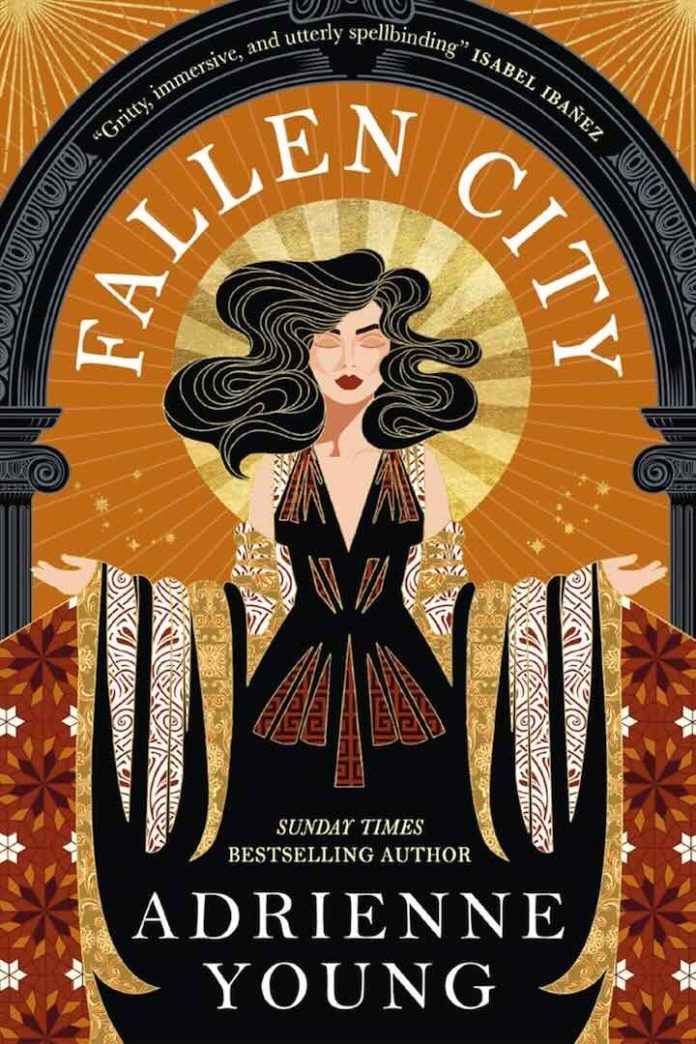
Adrienne Young ventures into new territory with Fallen City, trading the windswept seas of her Fable duology for marble corridors and political machinations reminiscent of ancient Rome. This departure from her previous young adult works presents readers with a more complex narrative structure—a dual timeline that demands attention while rewarding patience. The question is whether Young’s signature atmospheric prose and character-driven storytelling can elevate what might otherwise feel like familiar fantasy romance territory.
A City Built on Stolen Magic
The world of Isara stands as one of Young’s most ambitious creations to date. Unlike the straightforward Viking-inspired setting of Sky in the Deep or the maritime adventure of Fable, this walled city pulses with layers of political intrigue, religious mythology, and moral ambiguity. Young constructs a society that thrives on godsblood—magic stolen from the conquered city of Valshad a century prior. This isn’t merely window dressing; the godsblood becomes a physical manifestation of corruption, literally woven into the fabric of jewels, weapons, and the very stones of the Citadel District.
The city itself divides along class lines that feel visceral rather than abstract. The Citadel District, where Magistrates debate in marble forums while adorned in silk and gold, sits separated by the Sophanes River from the Lower City, where citizens struggle under an increasingly inadequate dole. Young doesn’t shy from the brutality of this divide, and readers witness how easily political decisions translate to suffering on both sides of the river. The world-building succeeds most when Young allows small details to illuminate larger truths—the way godsblood jewelry glints in lamplight, how judgment stones turn in the Forum, the sight of bodies hanging from bridges as warnings.
Star-Crossed Lovers Caught in Revolution’s Tide
At the heart of this political turmoil stands Maris Casperia and Luca Matius, two young people whose romance becomes inextricably tangled with revolution. Maris, daughter of a powerful Magistrate and former novice to the Priestess Ophelius, possesses the sharp intelligence and political acumen readers have come to expect from Young’s female protagonists. She understands the games played in the Forum better than most adults, yet she harbors genuine idealism beneath her pragmatic exterior. Her journey from dutiful daughter to someone willing to betray her entire class structure feels earned, driven by both personal conviction and her love for Luca.
Luca presents a more complex figure—a young man plucked from the Lower City to serve as heir to his uncle Kastor’s Magistrate seat, studying philosophy under the radical thinker Vitrasian. Young crafts his internal conflict with careful attention, showing how someone can exist between two worlds while truly belonging to neither. His romance with Maris begins with stolen moments and forbidden attraction, but transforms into something that threatens the foundations of their society. When the two decide to marry and merge their family seats to dismantle the faction system, their personal rebellion mirrors the larger uprising brewing in the streets.
The supporting cast enriches rather than clutters the narrative. Vale, the Consul’s son who becomes Commander of the rebel New Legion, adds layers of tragedy as he stands opposite his own father. The dying Priestess Ophelius serves as both mentor and harbinger of doom, her cryptic warnings carrying weight because Young has established her as formidable rather than simply mysterious. Even antagonists like Consul Saturian and the scheming Magistrates feel motivated by believable self-interest rather than pure villainy.
The Dance Between “Now” and “Before”
Young employs a dual timeline structure that alternates between “Now” (during the siege) and “Before” (the events leading to revolution). This narrative choice proves both the novel’s greatest strength and its most frustrating element. At its best, the structure creates devastating dramatic irony—we watch Luca and Maris plan their future together while knowing their separation looms. The technique also allows Young to control information flow, revealing key plot points at moments of maximum impact.
The structure succeeds when:
- It creates emotional resonance by contrasting hope with despair
- Readers gradually understand how specific decisions led to catastrophic consequences
- The pacing allows natural revelation of complex political machinations
- Past and present scenes mirror each other thematically
The structure falters when:
- Momentum breaks at crucial moments, particularly in the middle section
- Readers must work harder than necessary to track which faction supports which agenda in which timeline
- Some “Before” chapters feel like they exist primarily to explain “Now” plot points rather than advancing their own narrative
For readers accustomed to Young’s more straightforward chronological storytelling in works like The Girl the Sea Gave Back, this demands more active engagement. The payoff justifies the effort, but younger or less patient readers might find themselves confused or frustrated during the densest political sections.
Themes That Cut Deeper Than Romance
Young explores power’s corrupting influence with unflinching honesty. The Magistrates aren’t cartoonish villains—they’re people who’ve convinced themselves that maintaining their privilege serves the greater good. Maris’s mother, Magistrate Casperia, believes she protects the city even as her decisions starve its poorest citizens. This moral complexity elevates Fallen City by Adrienne Young above simple “evil empire vs. plucky rebels” narratives. The rebels themselves aren’t purely righteous; their methods grow increasingly brutal, and Young forces both characters and readers to reckon with how revolution devours its children.
The question of fate versus free will winds through every chapter. Both Luca and Maris struggle against the sense that their story was written by the gods long before they met. The godsblood gifts, the prophecies whispered by dying Priestesses, the mythological parallels—all suggest cosmic forces at play. Yet Young never provides easy answers about whether the characters are truly bound by divine will or simply trapped by their own choices and the systems they were born into.
The romance itself serves as the emotional anchor without overwhelming the political narrative. Young writes physical intimacy with the same lyrical quality she brings to sea-swept battles in her previous work, but here the sensuality carries additional weight—every stolen moment between Luca and Maris is an act of defiance against their society. Their love feels genuine because it costs them everything.
A Writing Style Steeped in Atmosphere
Young’s prose remains her greatest asset. She constructs sentences that feel weighty yet never purple, describing the “godsblood in her jewelry glinting like tiny sparks” or how “the river ran below their feet, the water whitecapped and quick.” Her writing shines brightest in intimate moments—the scene where Luca and Maris first kiss by the sea carries the same visceral immediacy as her description of bodies hanging from bridges at dawn.
The pacing, however, proves uneven. The opening hundred pages establish the world with deliberate care that some readers might find slow. The final act rushes toward its conclusion with breathless intensity. Young excels at atmosphere and character interiority but occasionally struggles to balance these strengths with the demands of political thriller plotting. Scenes in the Forum, while essential for world-building, sometimes drag when we’re eager to return to Luca and Maris’s storyline.
Where the Foundation Shows Cracks
Fallen City by Adrienne Young stumbles most noticeably in its middle section, where the weight of dual timelines, large cast, and complex political maneuvering creates confusion more than intrigue. Several plot threads—particularly involving the mysterious messages to Valshad and various Magistrates’ schemes—could have been streamlined without losing narrative impact. The book occasionally falls into the trap of telling rather than showing political machinations, relying on characters explaining faction allegiances rather than demonstrating them through action.
The ending, while emotionally satisfying in some respects, leaves key questions frustratingly unresolved. This is clearly designed as the first book in a duology, but the conclusion feels less like a strategic pause and more like an abrupt stop. Readers expecting closure on certain character arcs or political situations will find themselves immediately reaching for the sequel.
Some secondary characters remain underdeveloped despite their importance to the plot. The various Magistrates beyond Maris’s mother blur together, and even allies like Théo serve functions more than embodying fully realized personalities. This stands in contrast to Young’s previous work, where even minor characters felt distinctly drawn.
How It Compares to Young’s Bibliography
For readers familiar with Adrienne Young’s body of work, Fallen City represents both evolution and comfortable territory. Like Sky in the Deep, it features a protagonist caught between two cultures during wartime. Like Fable, it centers a romance that develops against life-threatening obstacles. But this novel attempts something more ambitious structurally and thematically than either.
The book shares DNA with Young’s adult novels Spells for Forgetting and The Unmaking of June Farrow in its willingness to embrace darker themes and more complex narrative techniques, while maintaining the character-driven focus of her YA work. Fans of The Last Legacy will appreciate the political intrigue, while readers who loved The Girl the Sea Gave Back for its mystical elements will find similar threads here with the godsblood magic and prophecy.
For Readers Who Enjoyed
If you loved Fallen City by Adrienne Young, consider these similar reads:
- An Ember in the Ashes by Sabaa Tahir: Features similarly complex world-building with ancient Roman influences and a romance between characters on opposite sides of a brutal regime
- The Poppy War by R.F. Kuang: Offers political intrigue, morally complex characters, and warfare with mythological underpinnings, though skews darker
- Serpent & Dove by Shelby Mahurin: Another forbidden romance between enemies with magic, political intrigue, and dual perspectives
- The Shadows Between Us by Tricia Levenseller: Political scheming meets romance in a fantasy setting with similar atmospheric prose
- Fireborne by Rosaria Munda: Class warfare, political revolution, and romance between characters from different social strata
The Final Verdict: A Flawed but Compelling Addition to Young’s Work
Fallen City succeeds as an ambitious expansion of Adrienne Young’s storytelling range, even as it occasionally buckles under the weight of its own complexity. The dual timeline structure, while sometimes frustrating, ultimately serves the emotional core of Luca and Maris’s doomed romance. Young’s atmospheric prose remains as evocative as ever, and her willingness to explore moral ambiguity in both her protagonists and antagonists elevates this beyond typical YA fantasy romance.
The book works best for readers willing to engage actively with non-linear storytelling and patient enough to untangle political machinations. Those seeking the straightforward adventure of Fable or the visceral immediacy of Sky in the Deep might find themselves occasionally lost in Forum debates and factional politics. But readers who appreciate character-driven fantasy with genuine stakes, complex world-building, and romance that feels earned rather than inevitable will find much to love.
Yes, the middle drags. Yes, certain plot threads feel unnecessarily tangled. And yes, the ending demands a sequel. But Adrienne Young has created characters worth following through these flaws, a world that feels lived-in despite its fantastical elements, and a love story that resonates precisely because it cannot save either protagonist from the consequences of their choices. Fallen City may not be perfect, but it confirms Young’s position as a writer unafraid to challenge both herself and her readers—and that ambition deserves recognition.







