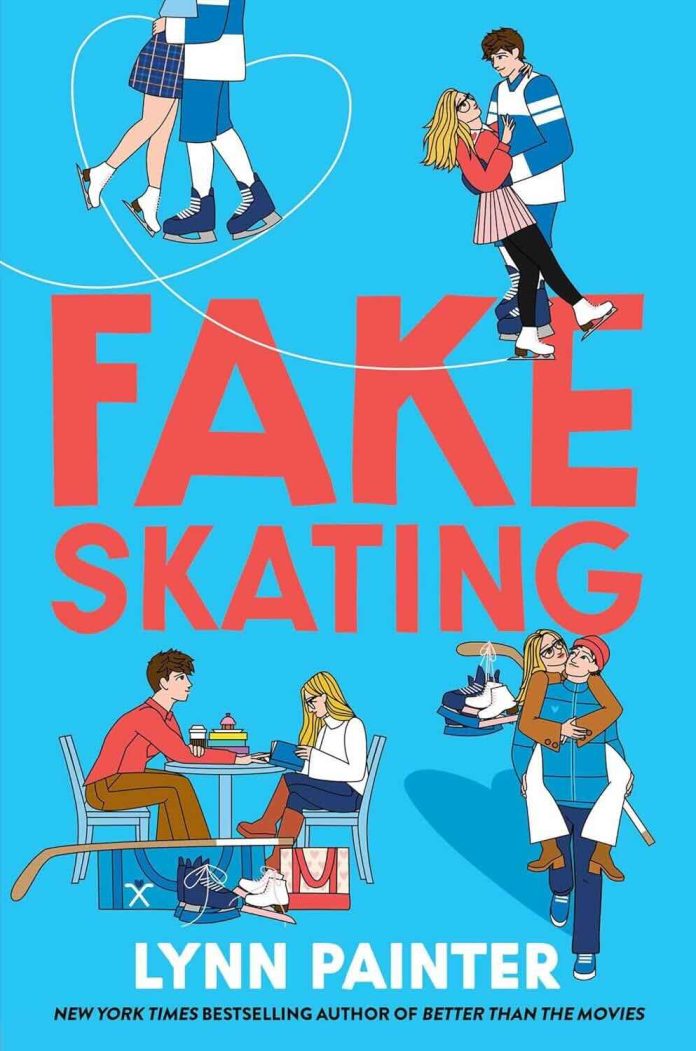
There’s something quietly devastating about returning to a place where memories still breathe in every corner, where your childhood best friend has transformed into someone unrecognizable, and where the ghost of who you used to be haunts you at every turn. Lynn Painter’s latest offering, Fake Skating, delivers exactly this kind of emotional complexity wrapped in the guise of a sports romance, proving once again why she’s become one of young adult contemporary’s most reliable voices.
The Setup: More Than Just Fake Dating
Dani Collins arrives in Southview, Minnesota with baggage that extends far beyond the suitcases from her latest military family move. Deferred from Harvard—the dream she’s clung to like a lifeline through multiple schools and her parents’ messy divorce—she’s desperate for an extracurricular activity to strengthen her reapplication. Enter Alec Barczewski, formerly her adorable, clumsy childhood companion, now transformed into Zeus: the hockey god who apparently forgot she ever existed.
What follows isn’t your typical fake dating setup. Painter sidesteps the usual meet-cute formula by grounding their arrangement in mutual necessity rather than pure convenience. Alec needs to rehabilitate his reputation after an unfortunate bong photo threatens his hockey future, while Dani requires the manager position on the hockey team to impress Harvard admissions. Their childhood connection becomes both the foundation for their ruse and the emotional minefield they must navigate.
The brilliance of Lynn Painter’s approach lies in how she interrogates the very premise of fake dating. Rather than treating it as a lighthearted rom-com device, she explores the ethical murkiness and emotional vulnerability required to convincingly pretend feelings that may or may not be genuine. Every hand-hold becomes a question mark, every staged kiss a potential landmine.
Character Work That Transcends Type
Dani Collins represents a refreshing departure from the typical YA protagonist. She’s neither effortlessly confident nor painfully insecure—instead, she exists in that realistic middle ground where most teenagers actually live. Her Harvard obsession reads as both admirable ambition and concerning avoidance mechanism, a way to focus on something concrete when her family life spirals beyond her control. Painter captures the particular anxiety of being the perpetual new kid with painful accuracy, from Dani’s strategic library lunches to her careful avoidance of cafeteria politics.
Her relationship with reading serves as more than character decoration. Books become her sanctuary, her escape hatch from social situations that threaten to expose her vulnerability. The way she loses herself completely in stories while Alec watches her, fascinated by her ability to disappear into fiction, reveals volumes about both characters without a word of direct exposition.
Alec’s transformation from childhood klutz to athletic powerhouse could have felt like pure wish fulfillment, but Painter grounds his character in the pressure-cooker reality of being the hometown hero. His nickname—Zeus—becomes both armor and prison, a persona he’s expected to maintain while simultaneously dealing with a shoulder injury he can’t reveal without jeopardizing everything he’s worked toward. The physical pain he endures becomes a metaphor for the emotional compartmentalization required to perform as the person everyone expects him to be.
The supporting cast refuses to fade into background noise. Grandpa Mick, the legendary hockey player with a gruff exterior hiding genuine care, provides unexpected emotional depth. His journey from distant grandfather to Dani’s boot hockey instructor parallels her own opening up to this hockey-obsessed town. Sarah, Alec’s mother, and Dani’s mom represent different versions of maternal support—one established in community, one fighting to rebuild.
The Hockey Culture: Atmospheric World-Building
In Fake Skating, Lynn Painter demonstrates impressive research into Minnesota hockey culture, capturing the particular intensity of a town where high school hockey isn’t just a sport but a religion. The descriptions of game days, the reverence for the Xcel Energy Center (the X), the rituals around boot hockey—these details create a lived-in world that never feels like tourism.
The sport itself becomes narrative framework rather than mere backdrop. Painter uses hockey’s physicality and teamwork dynamics to explore themes of masculinity, vulnerability, and the pressure to perform. The locker room scene where Dani accidentally enters forbidden territory pulses with both comedic tension and genuine stakes, revealing how quickly reputations can be damaged in this fishbowl environment.
Yet “Fake Skating by Lynn Painter” never requires hockey knowledge to engage emotionally. Dani’s perspective as an outsider to the sport mirrors the reader’s potential unfamiliarity, allowing Painter to explain without condescending. The boot hockey scenes where Dani learns to play while bonding with her grandfather provide some of the novel’s most charming moments, capturing that particular joy of attempting something new with people who care about you.
Where the Ice Gets Thin
Despite its considerable strengths, “Fake Skating by Lynn Painter” occasionally stumbles under the weight of its own ambitions. The pacing becomes uneven in the middle section, where repetitive scenes of Dani and Alec navigating their fake relationship occasionally feel more obligatory than organic. Painter cycles through similar beats—public displays of affection followed by private confusion about real feelings—without always advancing the emotional stakes.
The Harvard subplot, while thematically important to Dani’s character, sometimes feels like a MacGuffin rather than a fully integrated element. Her obsession with the school serves the narrative by creating urgency and stakes, but the actual mechanics of her deferred admission and reapplication receive less attention than the emotional weight it carries. Readers hoping for detailed exploration of the college application process may find this aspect underserved.
Secondary conflicts occasionally emerge and resolve with surprising swiftness. The photograph that threatens Alec’s reputation gets addressed relatively quickly, and while Benji Worthington functions as an effective antagonist, his motivations remain somewhat surface-level. The fight scene, though dramatically rendered, arrives and concludes without fully exploring the psychological aftermath of violence, particularly for Dani who witnesses it.
The resolution of Dani’s family drama, particularly regarding her father’s ultimatum about moving to Omaha, feels slightly rushed given how much emotional real estate the conflict occupies throughout the novel. Her decision-making process could have benefited from more page time, allowing readers to fully understand her reasoning beyond the obvious romantic implications.
The Prose: Painter’s Signature Style
Painter writes with a contemporary ease that makes her prose feel effortless, though careful readers will notice the craft behind the casualness. Her dialogue sparkles with authentic teenage banter—quick, clever, occasionally cruel in that way young people test boundaries. The first-person dual perspective alternates between Dani and Alec’s viewpoints, providing insight into how differently they interpret identical moments.
The internal monologues capture that particularly teenage quality of simultaneous self-awareness and self-delusion. Dani’s constant reminders that “it’s just pretending” even as her feelings deepen, Alec’s attempts to convince himself he doesn’t care about his childhood friend while cataloging every detail of her appearance—these contradictions feel true to the messy reality of developing feelings.
Physical description serves character revelation. The repeated mentions of Dani’s glasses, cherry lips, and apple juice smell become Alec’s fixation points, while Dani notices his height, his surprising grace on ice, and the way pain tightens his jaw. These observations accumulate meaning beyond mere attraction, revealing what each character values and notices in the other.
“Fake Skating by Lynn Painter” includes a soundtrack list, and readers who engage with it will find that Painter has thoughtfully selected songs that enhance the emotional landscape. From Taylor Swift’s “exile” to newer artists, the musical choices reflect both the characters’ contemporary sensibilities and the novel’s thematic preoccupations with past connections and present complications.
Themes That Resonate Beyond Romance
Beneath the fake dating framework, Painter explores substantive themes about identity construction and performance. Both protagonists struggle with the gap between who they are and who they’re expected to be. Dani’s careful management of her public persona, learned through years of being the new kid at multiple schools, contrasts with Alec’s performance of Zeus, the confident hockey star who can’t show weakness.
“Fake Skating by Lynn Painter” interrogates the cost of ambition, particularly for young people pressured to have their entire futures mapped out. Dani’s single-minded focus on Harvard has protected her from dealing with her parents’ divorce but also isolated her from authentic connection. Alec’s hockey trajectory, while impressive, leaves little room for exploring other interests or possibilities.
Family dynamics receive nuanced treatment. Painter avoids simplistic villain casting in Dani’s parents’ divorce, instead showing how two people can genuinely love their child while making choices that hurt her. The exploration of military family life, with its constant relocations and enforced adaptability, adds depth to Dani’s character without becoming the entire story.
Friendship as foundation for romance gets genuine exploration. The novel suggests that the best romantic relationships build on established trust and shared history, even when that history includes hurt and misunderstanding. The way Dani and Alec must excavate and re-evaluate their childhood connection before building something new feels psychologically realistic.
The Verdict: Solid Rather Than Spectacular
This latest offering, Fake Skating, demonstrates Lynn Painter’s continued growth as a writer while also revealing certain predictable patterns in her work. Readers familiar with her previous novels will recognize the bones of this story—the contemporary setting, the dual perspective romance, the protagonist dealing with family upheaval while navigating relationship complications. Yet the hockey culture specificity and the childhood friends element provide enough freshness to distinguish it from her earlier work.
“Fake Skating by Lynn Painter” succeeds most completely when focusing on the small, specific moments between Dani and Alec—her making him a terrible Spam sandwich, him carrying her after boot hockey, their shared reading time in the library. These scenes capture something genuine about connection that transcends the artifice of their fake relationship. When the plot mechanics intrude with external conflicts and forced separations, the emotional authenticity occasionally suffers.
For readers seeking a sports romance that actually engages with athletic culture beyond using it as aesthetic backdrop, this delivers. For those wanting complex exploration of family dysfunction and identity formation wrapped in romantic comedy, it provides satisfaction. And for anyone hoping to recapture the magic of Painter’s earlier work while exploring new territory, the results prove mixed but ultimately rewarding.
Perfect For Readers Who Love
- Better Than the Movies by Lynn Painter – Readers who loved Painter’s previous work will find familiar emotional beats with new sports-specific flavoring
- Check & Mate by Ali Hazelwood – Another story featuring a teenage prodigy navigating high-stakes competition and unexpected romance
- Icebreaker by Hannah Grace – College hockey romance with similar attention to sport culture and fake relationship dynamics
- The Summer of Broken Rules by K.L. Walther – Family dysfunction meets summer romance with similar emotional complexity
- The Scoring Chance series by Avon Gale and Piper Vaughn – For readers aging up who want more hockey romance with comparable emotional stakes
Final Thoughts
Lynn Painter has crafted a competent, emotionally engaging sports romance that explores the complicated territory between performance and authenticity. While it occasionally relies too heavily on familiar beats and doesn’t always fully develop its secondary plotlines, the central relationship between Dani and Alec provides enough emotional resonance to carry the narrative. The Minnesota hockey culture gives the story distinctive flavor, and the childhood friends foundation adds depth to the romance.
This isn’t Painter’s strongest work, but it demonstrates her consistent ability to create characters readers care about and relationships that feel earned rather than manufactured. The novel recognizes that second chances require not just proximity but genuine work—understanding how people change, acknowledging past hurts, and choosing to be vulnerable despite the risk. That insight alone makes the journey worthwhile, even when the path occasionally becomes predictable.
For young adult readers seeking contemporary romance with substance beyond the relationship mechanics, this delivers enough emotional complexity and cultural specificity to satisfy. Just don’t expect revolutionary innovation in either the sports romance or fake dating subgenres—instead, expect solid execution of familiar elements with moments of genuine emotional truth.







