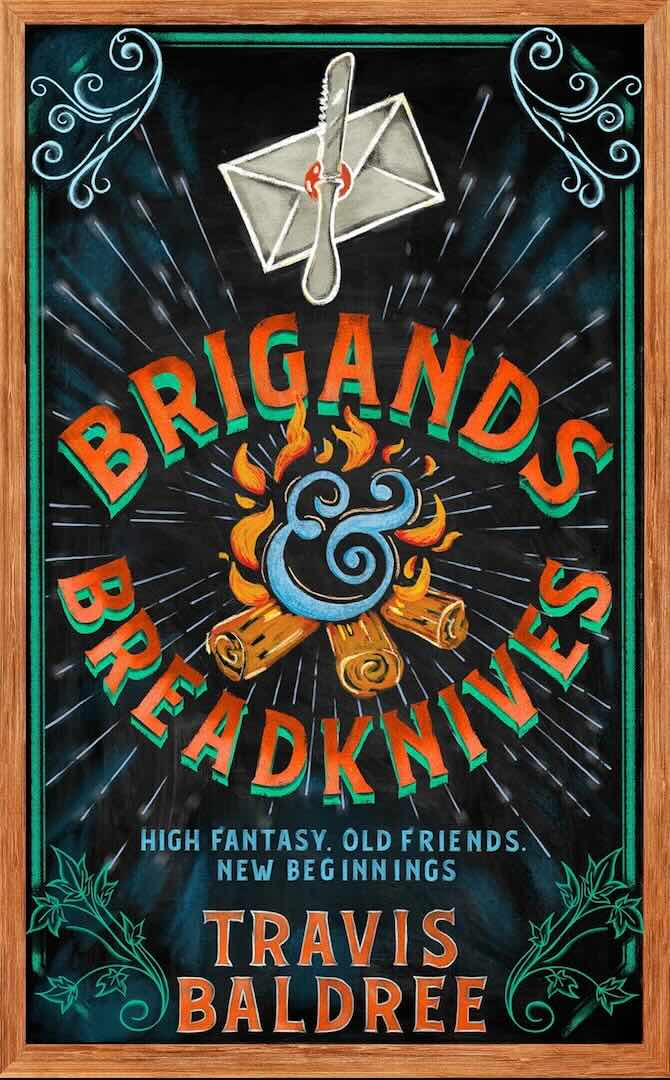
Travis Baldree returns to his beloved Legends & Lattes universe with a sophomore effort that deliberately refuses to play it safe. In Brigands & Breadknives, the second installment in the series, readers familiar with the cozy comfort of caffeinated contentment might find themselves clutching their coffee mugs a bit tighter as Baldree interrogates a question his first book only whispered: what happens when the “fix” stops working?
The Weight of Whiskers and Words
Fern, the foul-mouthed rattkin bookseller who charmed readers in Bookshops & Bonedust (the prequel set decades before the original Legends & Lattes), takes center stage in a story that feels less like a warm hug and more like an honest conversation with a friend who’s struggling. After relocating to Thune to open a bookshop next door to Viv’s successful coffee establishment, Fern discovers that geographic solutions rarely cure existential maladies. The shop opens beautifully, customers flood through the door, and the dream materializes exactly as planned—except the hollowness inside her yawns wider than ever.
This is where Baldree demonstrates real courage as a writer. Rather than retreating to the formula that made his first book a phenomenon, he leans into discomfort. Fern’s crisis isn’t easily diagnosed or neatly resolved. She’s not depressed in the clinical sense, nor is she facing external obstacles. She’s simply reached that terrifying middle point where everything looks right on parchment but feels utterly wrong in practice.
Enter one spectacularly ill-advised night of drinking, a wrong wagon, and Astryx One-Ear—the legendary Oathmaiden whose thousand-year career of heroism has calcified into routine. What follows is a road trip narrative that pairs a crisis-addled bookseller, an emotionally exhausted elf, a chaos-goblin named Zyll with a fondness for silverware, and a sentient breadknife who won’t shut up. If that sounds absurd, it is—but it’s also deeply purposeful.
The Road as Mirror
The journey to deliver Zyll becomes a crucible for examining what happens when purpose fossilizes into mere habit. Astryx, despite centuries of accomplishment, moves through her legendary life with the enthusiasm of someone filing tax forms. Her most exciting moment? Dry socks. This juxtaposition—Fern desperately seeking meaning while traveling alongside someone who’s found it and lost it across an incomprehensible timeline—creates the book’s emotional engine.
Baldree writes their evolving friendship with remarkable subtlety. There are no dramatic declarations or tearful embraces. Instead, we get Fern reading aloud to an injured Astryx, the elf’s rare laughter emerging like pebbles in a clay pot. We witness quiet moments of recognition between two people trapped in different prisons of their own construction. The prose during these scenes carries the weight of genuine connection forming through shared vulnerability rather than shared adventure.
The supporting cast enriches rather than distracts. Zyll, who could easily devolve into comic relief, instead serves as a peculiar mirror—someone who’s made peace with being misunderstood and operates entirely on her own chaotic wavelength. Breadlee, the diminished Elder Blade trapped in breadknife form, provides necessary levity while also embodying themes of identity divorced from purpose. Even Nigel, Astryx’s pompous greatsword, functions as a voice for the rigid thinking both protagonists need to escape.
Structure and Style: The Messier Side of Cozy
Baldree’s prose remains accessible and often beautiful, particularly in his descriptions of the natural world. The Territory feels lived-in, from monastery kitchens fragrant with root vegetables to moonlit roads where cricket-song fills the spaces between hoofbeats. His dialogue crackles with personality—Fern’s profanity-laced observations feel earned rather than performative, while Astryx’s measured responses reveal volumes through what she doesn’t say.
However, the pacing occasionally stumbles. The novel’s middle section, while thematically rich, sometimes circles the same emotional territory without quite landing. Fern’s internal monologues about her crisis, though relatable, occasionally repeat themselves. The book would benefit from tighter editing in these stretches, where readers might find themselves wanting the story to either deepen the exploration or move forward.
The action sequences, when they arrive, feel oddly perfunctory—which may be intentional given Astryx’s weary expertise, but leaves certain confrontations feeling less urgent than they should. A climactic bridge collapse, for instance, receives less narrative weight than it warrants, processed through Fern’s bewildered perspective rather than given its full dramatic due.
Themes That Refuse Easy Answers
What elevates Brigands & Breadknives beyond typical fantasy fare is its willingness to sit with discomfort. Baldree doesn’t pretend that friendship solves everything, that finding your purpose is a one-time achievement, or that change of scenery equals change of self. Fern’s journey doesn’t conclude with triumphant clarity but with something more honest: the recognition that discovering who you are when stripped of professional identity is terrifying, ongoing work.
The book interrogates the cozy fantasy genre itself. In his acknowledgments, Baldree openly worries whether readers want a story about “the grief of disappointing your friends, and the agony of saying ‘no.'” This self-awareness permeates the narrative. Yes, there’s still warmth, humor, and found family—but it’s served alongside the acknowledgment that books aren’t weapons against loneliness if you’re the one feeling lonely despite doing everything “right.”
The relationship between Fern and Viv, mostly conducted through unsent letters, captures the specific pain of disappointing someone who believed in you. These epistolary interludes provide some of the book’s most affecting moments, showcasing Baldree’s growth as a writer tackling complex emotions.
Where the Story Stumbles
The novel’s greatest weakness lies in its unwillingness to fully commit to its darker impulses. While Baldree deserves credit for adding conflict and messiness to the cozy formula, he occasionally pulls punches. Certain confrontations resolve too cleanly, and the book’s climactic revelations, while satisfying, arrive with slightly less impact than their buildup promises.
Additionally, readers seeking the warm, low-stakes comfort of Legends & Lattes may feel blindsided. This is intentional—Baldree explicitly doesn’t want to write the same book repeatedly—but it creates tonal whiplash for those expecting pure comfort reading. The title’s promise of adventure delivers, but at the cost of coziness.
Some side characters, particularly the bard Staysha and the solicitor Mister Delvyn, feel underutilized. They arrive with intriguing possibilities that don’t quite materialize into meaningful arcs, leaving threads that could have been woven more tightly into the narrative tapestry.
The Series Context
For those new to the Legends & Lattes series, here’s the reading order: Legends & Lattes introduces Viv’s coffee shop and established the template; Bookshops & Bonedust serves as a prequel showing how Viv and Fern first met decades earlier in Murk; and Brigands & Breadknives catches up with Fern in the present day. Each book can theoretically stand alone, but reading them in publication order enriches the emotional resonance, particularly understanding Fern’s relationship with Viv.
Baldree has crafted something rare—a fantasy series that matures alongside its characters rather than simply expanding its world. Each installment interrogates different life stages and questions, making the series feel like a genuine exploration of identity across time rather than mere sequels.
Final Thoughts: A Book That Chooses Honesty Over Comfort
Brigands & Breadknives succeeds as an evolution even where it occasionally stumbles as entertainment. Baldree has written a book that prioritizes emotional truth over genre expectations, creating something that feels essential despite—or because of—its refusal to provide easy answers. The prose occasionally meanders, the pacing sometimes lags, and the tonal balance doesn’t always hold, but these feel like growing pains rather than fatal flaws.
Brigands & Breadknives is a book about the terrifying freedom of admitting you don’t know who you are anymore. About friendships that survive absence and disappointment. About the difference between existing and living. It’s messier than its predecessors, more conflicted, and occasionally frustrating—which makes it more honest about the actual experience of being alive and uncertain.
Readers seeking pure escapism might find Brigands & Breadknives too close to the bone. But those willing to sit with Fern’s discomfort might discover something valuable: the reassurance that feeling lost doesn’t mean you’ve failed, that changing course doesn’t invalidate your past, and that sometimes the bravest thing is admitting you need to find a new story to tell about yourself.
If You Loved This, Try These:
Similar in spirit and theme:
- The House in the Cerulean Sea by TJ Klune – Another cozy fantasy that grapples with purpose and found family
- Psalm for the Wild-Built by Becky Chambers – Contemplative journey featuring a tea monk questioning their path
- A Wizard’s Guide to Defensive Baking by T. Kingfisher – Cozy fantasy with unexpected depth about ordinary people in extraordinary circumstances
- The Very Secret Society of Irregular Witches by Sangu Mandanna – Finding belonging and purpose later in life
- Sorcery and Small Magics by Maiga Doocy – Road trip fantasy with banter and deeper emotional undercurrents







