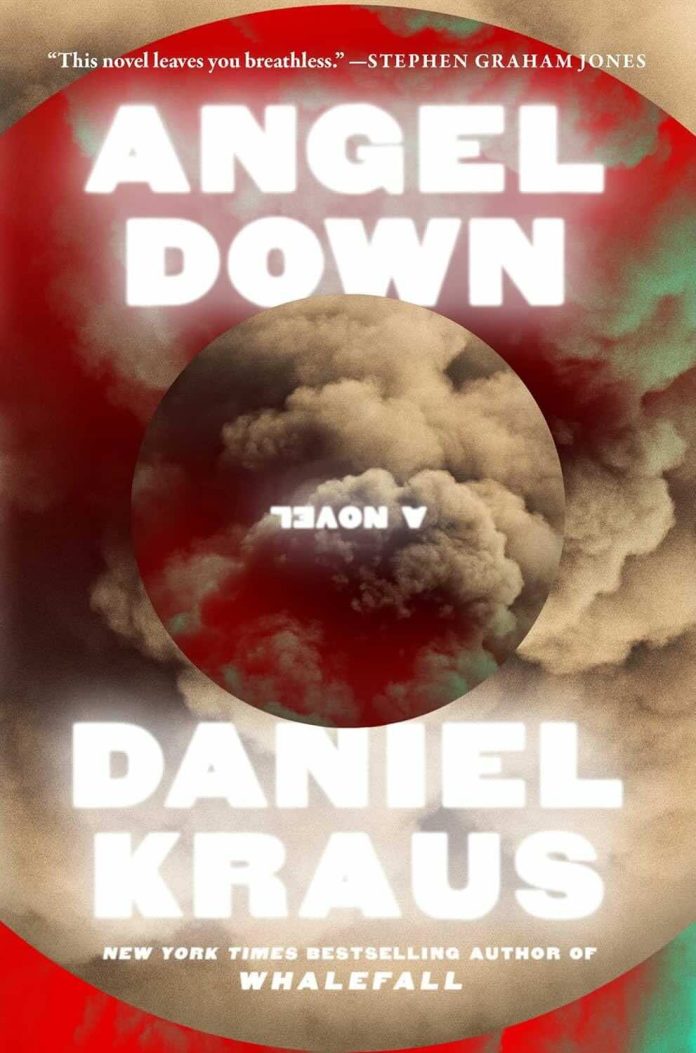
Daniel Kraus has carved out a distinctive niche in contemporary horror literature, from his Bram Stoker Award-winning works to his collaborations with Guillermo del Toro on The Shape of Water and George A. Romero on The Living Dead. Daniel Kraus’ latest offering, Angel Down, represents perhaps his most ambitious undertaking yet—a visceral journey into the trenches of World War I that transforms historical horror into something transcendently apocalyptic.
Set in the waning days of the Great War’s Meuse-Argonne Offensive, the novel follows Private Cyril Bagger, a consummate con artist whose survival depends not on heroism but on cunning deception. When he and four fellow soldiers—the adolescent Lewis Arno, the shell-shocked Ben Veck, the brutish Hugh Popkin, and the opportunistic Vincent Goodspeed—are dispatched to mercy-kill a screaming wounded man in No Man’s Land, they discover something that defies every assumption about divine intervention in human conflict.
The Machinery of War and Wonder
Kraus demonstrates remarkable mastery in his depiction of trench warfare’s psychological and physical brutality. His prose carries the weight of mud, blood, and cordite, creating an atmosphere so suffocating that readers can practically taste the metallic tang of fear. The author’s research into WWI weaponry, tactics, and soldier vernacular creates an authentic foundation that makes the supernatural elements all the more jarring when they emerge.
The angel herself—if angel she truly is—becomes a mirror reflecting each soldier’s deepest desires and fears. To young Arno, she appears as the mother he never had; to Popkin, she embodies his distant girlfriend; to Veck, she manifests as his beloved daughter. This shapeshifting quality transforms her from a simple deus ex machina into something far more complex and morally ambiguous.
Kraus excels at showing how desperate men project their needs onto the divine, creating their own gods in their own image. The angel’s true nature remains tantalizingly obscure—is she humanity’s salvation or its judgment? The author wisely resists providing easy answers, instead allowing the question to fester like an infected wound.
Character Development in the Crucible
The five-man squad functions as a microcosm of humanity under extreme duress. Bagger emerges as one of literature’s most compelling anti-heroes—a man whose survival instincts have been honed to razor sharpness through a lifetime of small-scale grifting and large-scale cowardice. His arc from selfish survivor to reluctant protector feels earned rather than forced, grounded in Kraus’s careful attention to psychological detail.
The supporting characters avoid stereotype through specific, lived-in details. Arno’s desperate search for family connection, Veck’s struggle with both racial prejudice and shell shock, Popkin’s toxic masculinity masking deep insecurity—each man carries wounds that extend far beyond the battlefield. Kraus understands that war doesn’t create monsters; it reveals the monsters already lurking within ordinary people.
What makes these characterizations particularly effective is how Kraus allows each soldier’s interaction with the angel to expose their fundamental nature. The angel doesn’t change them—she simply strips away the pretenses that civilization uses to mask human brutality and need.
Biblical Horror and Literary Technique
The novel’s structure mirrors its thematic concerns about cycles of violence and redemption. Kraus employs a tripartite structure—”Élan,” “The Gaff,” and “Mercy Seat”—that evokes both military terminology and religious imagery. The progression from French enthusiasm to American cunning to divine judgment creates a narrative arc that feels both inevitable and surprising.
Kraus’s prose style adapts to match the increasing supernatural elements. Early chapters employ the clipped, urgent syntax of war fiction, but as the angel’s influence grows, the language becomes more lyrical and biblical. The author’s background in young adult fiction serves him well here—he can shift between visceral action sequences and moments of profound spiritual questioning without losing narrative momentum.
The book’s horror elements work precisely because they emerge from a foundation of historical authenticity. The trenches of WWI were already hellish enough; Kraus simply reveals the literal hell that such human-created suffering might actually summon.
Technical Mastery and Minor Flaws
Kraus demonstrates impressive technical skill in managing multiple narrative threads and maintaining tension across the novel’s considerable length. His ability to balance individual character arcs with the overarching supernatural plot showcases the experience gained from his previous works like The Death and Life of Zebulon Finch and Whalefall.
However, the novel occasionally suffers from its own ambitions. Some readers may find the middle section’s pacing uneven as Kraus works to establish each character’s relationship with the angel. The book’s length—necessary for its thematic development—may test the patience of readers expecting more straightforward horror action.
The ending, while thematically appropriate, may frustrate those seeking clearer resolution. Kraus prioritizes emotional and spiritual truth over plot mechanics, which serves the novel’s deeper purposes but may leave some plot threads feeling incomplete.
Historical Context and Contemporary Relevance
Angel Down by Daniel Kraus arrives at a time when questions about divine intervention, human nature, and the machinery of war feel particularly urgent. Kraus uses the historical setting not as mere backdrop but as active commentary on how violence perpetuates itself across generations. The angel’s true nature—whether savior or destroyer—reflects contemporary anxieties about salvation and judgment in an increasingly chaotic world.
The author’s exploration of how desperate people create their own versions of the divine speaks to current religious and political polarization. Each soldier sees in the angel exactly what he needs to see, a phenomenon that resonates with how different groups interpret the same events in radically different ways.
Final Verdict
Angel Down by Daniel Kraus succeeds as both historical fiction and supernatural horror, though it transcends both genres to become something uniquely unsettling. Kraus has created a work that honors the complexity of human nature while questioning the very foundations of divine justice. The novel’s unflinching examination of war’s psychological toll, combined with its supernatural elements, creates a reading experience that lingers long after the final page.
Angel Down by Daniel Kraus is not comfortable horror designed for easy consumption. Instead, Kraus offers a challenging meditation on faith, survival, and the price of salvation that demands active engagement from readers. Those willing to follow Bagger and his companions into their particular vision of hell will find a work of genuine literary merit wrapped in the compelling package of historical horror.
Similar Reads for Angel Down Enthusiasts
For Historical War Fiction with Supernatural Elements:
- The Poppy War by R.F. Kuang
- Rivers of London by Ben Aaronovitch
- The Book Thief by Marcus Zusak
For Biblical Horror and Religious Themes:
- Mexican Gothic by Silvia Moreno-Garcia
- The Seventh Moon by Jesse Bullington
- Between Two Fires by Christopher Buehlman
And for Character-Driven War Narratives:
- All Quiet on the Western Front by Erich Maria Remarque
- The Things They Carried by Tim O’Brien
- Regeneration by Pat Barker







