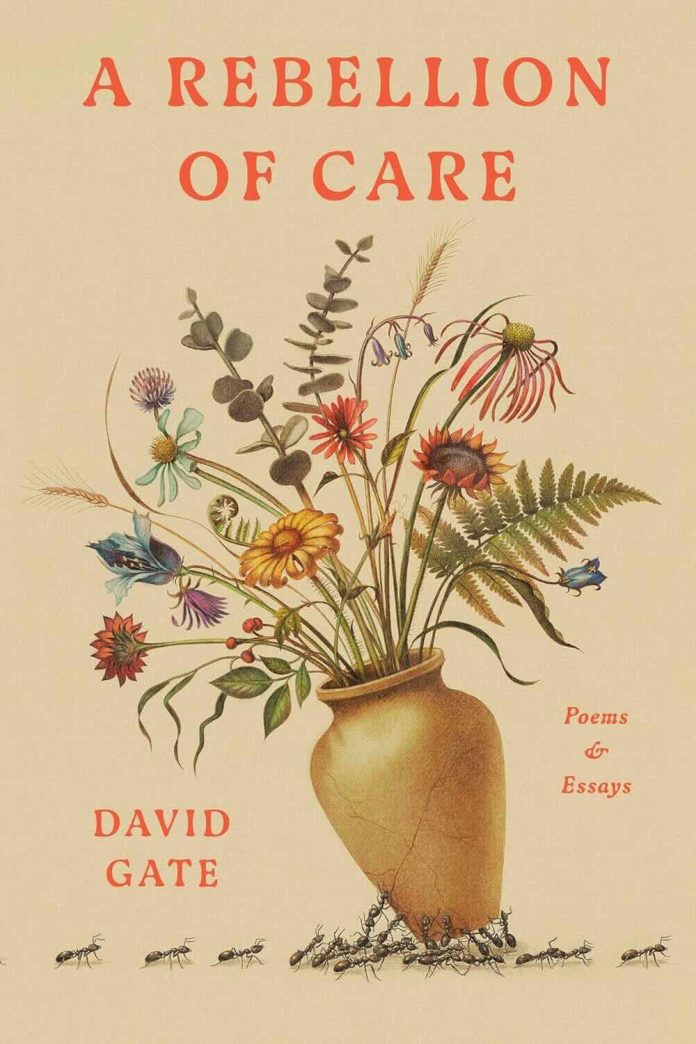
In an era where poetry often retreats into academic isolation or Instagram-friendly platitudes, David Gate emerges with something altogether more dangerous: a collection that dares to make poetry matter. A Rebellion of Care is Gate’s debut offering, a sprawling manifesto disguised as verse that challenges readers to “radicalize us into a different kind of life—the kind of life you actually value most.” This isn’t poetry as decoration; it’s poetry as demolition and reconstruction.
Gate, who began sharing his work on Instagram in 2021, has crafted a collection that spans ten thematic sections, each building toward his central thesis: that caring deeply in our current system is inherently subversive. The book reads like a fever dream of modern anxiety filtered through the lens of someone who refuses to accept that this is simply how things must be.
The Architecture of Awakening
Structural Brilliance and Thematic Unity
The collection’s organization reveals Gate’s strategic mind at work. Beginning with “A Rebellion of Care,” which functions as both title section and mission statement, the book moves through increasingly personal territories before expanding back to systemic critique. The progression feels intentional and earned, moving from manifesto through the intimate spaces of body, friendship, and family, before confronting institutional failures and returning to a call for collective action.
Gate’s “Manifesto for a Rebellion of Care” establishes the collection’s ambitious scope with lines like “Make art & music / because music & art / are love letters to the living / addressed to us all.” This isn’t merely poetic sentiment; it’s a blueprint for resistance against what he identifies as the dehumanizing effects of late-stage capitalism.
Language as Weapon and Balm
Gate’s linguistic choices reflect his dual background in religious contexts and contemporary social media culture. He seamlessly weaves theological language with internet slang, creating a dialect that feels both ancient and urgently contemporary. When he writes “I cannot positive-mental-attitude myself into a more equitable society,” he captures the exhaustion of individual solutions to systemic problems while maintaining the rhythmic intensity that makes his work so compelling.
The poet’s voice shifts between prophetic declaration and intimate confession, sometimes within the same piece. In “Joy Is an Act of Rebellion,” he moves from political analysis (“Though the system takes all it can / From our tired bodies”) to spiritual proclamation (“It will never, not ever, / Ransack our hallelujahs”) with a fluidity that suggests these aren’t separate concerns but facets of the same struggle.
The Personal as Political Landscape
Bodies, Relationships, and Radical Acceptance
Gate’s exploration of embodiment in the “Human Becoming” section demonstrates poetry’s unique capacity to address the political through the personal. Rather than offering body-positive platitudes, he presents acceptance as a form of resistance against capitalist consumption of our insecurities. “Your body is more than gains / & losses / you are a whole being— / a poem / whose every word / makes meaning” transforms self-acceptance from self-help into social critique.
The friendship section, “Friendship Will Save Us,” might be the collection’s most radical proposition. Gate argues that chosen family and intentional community represent genuine alternatives to the nuclear family isolation that capitalism requires. His poem “Mutual Sanctuary” reframes vulnerability as strength: “make no attempt to get it together for me / we are together and that is all I need.”
Masculinity Reimagined
In “I Must Also Feel It as a Man,” Gate tackles masculine conditioning with particular insight. Drawing from Macduff’s response to tragedy in Macbeth, he argues for emotional competence as revolutionary act. The section’s exploration of male socialization feels both personal and analytical, suggesting that patriarchal emotional stunting serves systemic rather than individual interests.
Spiritual Rebellion and Institutional Critique
Faith Beyond Institution
Gate’s wrestling with Christianity in “Haunted & Exhausted” represents some of the collection’s most complex territory. As someone with pastoral experience, he writes from intimate knowledge of institutional religion’s failures while maintaining connection to its transformative possibilities. His poem “White Jesus Must Die” exemplifies this tension: “kill that man dead / no comebacks” demonstrates his willingness to destroy false idols even within his own tradition.
The spiritual content never feels divorced from political analysis. Gate consistently connects personal faith practices with collective liberation, suggesting that genuine spirituality must address systemic injustice or risk becoming mere comfort for the comfortable.
Environmental and Economic Consciousness
Connecting Earth and Economy
Gate’s environmental awareness emerges most clearly in “Soft Fascination,” where he argues for attention to natural cycles as resistance to capitalist time. His exploration of seasonal eating and gardening connects individual practice with larger ecological consciousness without falling into lifestyle-solution thinking.
The economic critique throughout the collection avoids both despair and naive optimism. Gate acknowledges complicity while insisting on possibility: “While you cannot break a system on your own, you can certainly weaken it. You can pull at its seams.”
Critical Considerations
Strengths and Limitations
Gate’s strength lies in his ability to make abstract political concepts emotionally resonant without sacrificing intellectual rigor. His background in both religious and digital communities provides him with unusual linguistic resources and audience awareness.
However, the collection occasionally suffers from its own ambitions. Some pieces read more like social media posts than fully developed poems, and the Instagram aesthetic sometimes works against the deeper complexity Gate clearly possesses. Additionally, while his critique of capitalism is thorough, his alternatives sometimes remain more aspirational than practical.
The collection’s length works both for and against it. The expansive scope allows for genuine development of themes, but some sections feel less essential than others. Gate’s voice is strong enough to sustain the journey, but readers might find themselves wishing for more ruthless editing in places.
Cultural Context and Literary Lineage
Gate’s work exists in conversation with poets like Adrienne Rich, who also used poetry as a vehicle for political transformation, and contemporary voices like Ocean Vuong and Danez Smith, who blend personal narrative with systemic critique. His religious background connects him to traditions of prophetic literature, while his digital nativity places him squarely in contemporary conversations about authenticity and resistance.
Verdict: Poetry as Praxis
A Rebellion of Care succeeds because it refuses to separate aesthetic achievement from political necessity. Gate has created a collection that functions both as literature and as blueprint, offering readers not just emotional catharsis but practical vision for different ways of being.
The book’s greatest achievement might be its refusal of cynicism without embracing naivety. Gate acknowledges the depth of our current crises while insisting on the possibility of transformation through care. In our current moment of political despair and social isolation, this feels like both gift and necessity.
For readers seeking poetry that engages with our moment’s particular anxieties and possibilities, A Rebellion of Care offers both mirror and map. Gate has written a debut that feels less like arrival than like invitation—an invitation to join a movement that begins with paying attention and ends with caring enough to change everything.
Similar Books Worth Reading
For readers drawn to Gate’s combination of spiritual inquiry and political resistance, consider:
- “The Essential Rumi” translated by Coleman Barks – For mystical poetry that bridges personal and universal
- “Citizen” by Claudia Rankine – For innovative poetry addressing systemic racism and trauma
- “Night Sky with Exit Wounds” by Ocean Vuong – For immigrant experience and family complexity
- “The Wild Iris” by Louise Glück – For spiritual meditation through natural imagery
- “Good Bones” by Maggie Smith – For parenting and hope in difficult times
- “Whereas” by Layli Long Soldier – For indigenous resistance through poetic form
David Gate has given us a collection that refuses easy categorization while demanding attention. A Rebellion of Care suggests that in our current moment, the most radical act might be the simple insistence on remaining fully human.