On 13 August 2026, The Bookseller reported that the Self-Publishing Partnership, a UK business that handled distribution and royalty payments for independent authors through the wholesaler Gardners, had collapsed. Authors who had hired the self-publishing company were left waiting on money their books had already earned. The Society of Authors began assisting those affected.
What follows is not an argument against paid help. It is an argument about structure. Before you hire a self-publishing company, there are ten things you should keep in your own hands, and the collapse of one intermediary is a good reason to check all ten today.
A point of fairness first: a business failing is not by itself evidence of wrongdoing. Companies fold for ordinary reasons. The reporting so far does not establish the total sum outstanding or the full legal picture, and it would be wrong to assume misconduct. But the consequence for authors is the same either way. When a single company holds the distribution relationships, receives the sales income, keeps the production files and then passes money along, its failure interrupts the entire chain at once.
Why hiring a self-publishing company is now the norm
Self-publishing is no longer a niche. Bowker data reported by Publishers Weekly shows that more than 3.5 million self-published print and ebook titles were registered with a US ISBN in 2025, up 38.7% on the year before. Traditional output grew 6.6% over the same period.
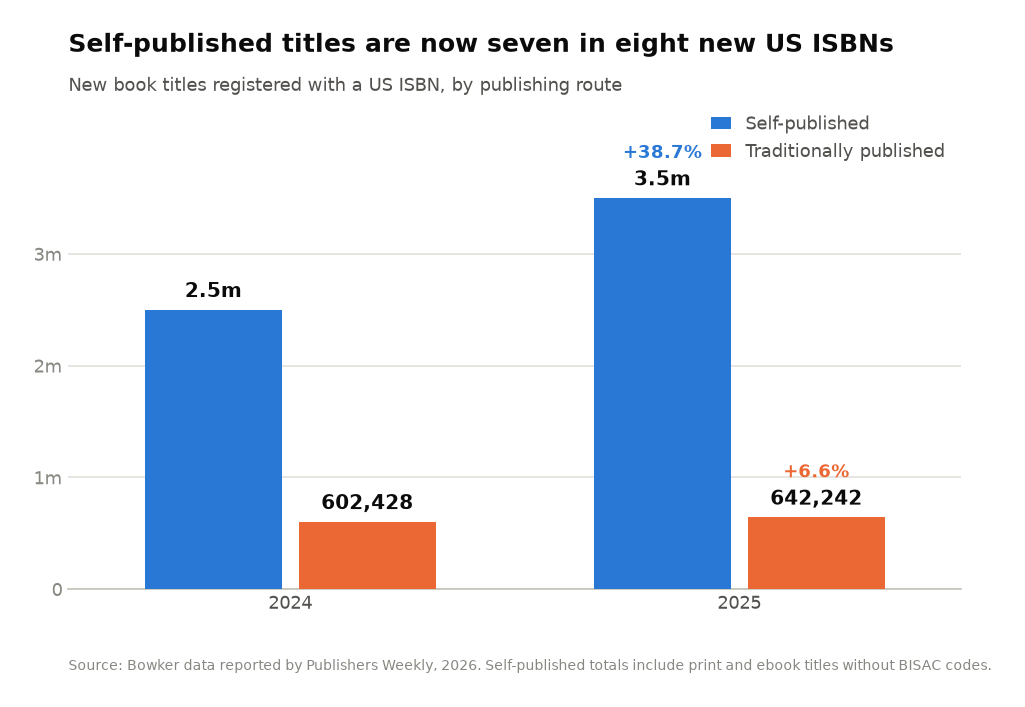
Roughly seven in every eight new US ISBNs now belong to a self-published title. Source: Bowker via Publishers Weekly.
The market for services has grown with it, and so has the number of businesses offering to be your self-publishing company of choice. Authors now juggle print, ebook, audio, direct sales and half a dozen territories, and there is real value in hiring people who know what they are doing. If you are still weighing the routes themselves, start with the hybrid option between self-publishing and a traditional deal. The Publishers Association put total UK publishing revenue at a record £7.4 billion in 2025, with exports at £4.7 billion, or 64% of the total. There is more to manage than there has ever been.
That is precisely why the failure of a single intermediary can be so damaging. The more of your operation one supplier runs, the more of it stops when that supplier does.
What a self-publishing company does with your money
Almost everything below reduces to a single question: when a reader buys your book, whose bank account does the money land in first?
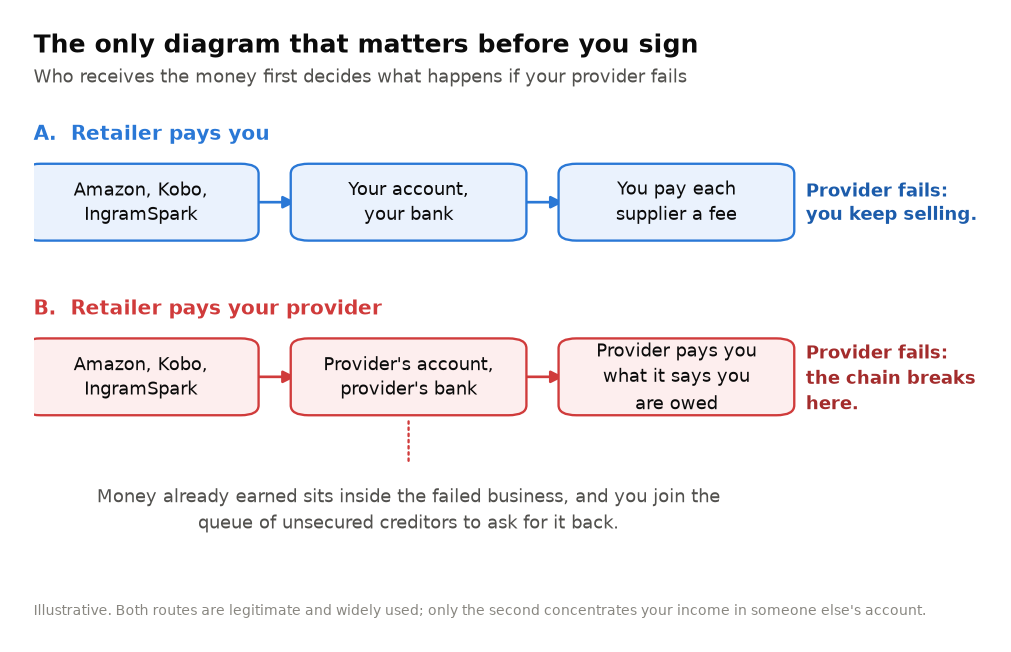
Both arrangements are common and legitimate. Only one of them puts your earnings inside somebody else’s business.
If the retailer pays you, a supplier’s failure costs you a supplier. If the retailer pays your provider, a failure can cost you the supplier, the income and, temporarily, the ability to sell at all.
1. Your copyright and your publishing rights
In the UK the author is normally the first owner of copyright in a literary work, and copyright arises automatically. Nobody needs to be paid to create it for you. But ownership can be narrowed by contract, and a broad grant covering print, ebook, audio, translation, adaptation and world rights turns what was sold to you as a service into something much closer to a publishing deal.
A genuine self-publishing company needs permission to perform specific tasks. It does not need to own your book. The licence should be narrow, non-exclusive, limited to named formats and territories, and it should end when the service ends. The Society of Authors takes a firmer line still: a self-publishing services agreement should contain no grant of rights at all.
If a rights clause is ambiguous, get independent advice. Not an explanation from the salesperson whose commission depends on your signature. Our beginner’s guide to publishing contracts for authors sets out the language to look for before you get that far.
2. Direct access to your retailer and distributor accounts
Your KDP, IngramSpark, Kobo Writing Life or Draft2Digital account should exist in your name or your publishing business’s name, registered to an email address, phone number and recovery method you control, with your bank and tax details attached.
A contractor can help set the account up. A contractor can be granted access where the platform allows it. What a contractor should not be is the only person who can log in. Where a self-publishing company publishes every client’s book through an account it owns, you do not have a publishing business. You have a listing inside someone else’s.
Test it now rather than later: log in yourself, from your own device, and confirm the payment details point at you.
3. Your ISBNs and the publisher of record
An ISBN does not create or protect copyright, but it is the commercial identity of the book. Booksellers and libraries use it to order the right edition from the right publisher. Whoever is named as publisher of record on that ISBN is the party the trade will treat as controlling the title.
If you intend to run your own imprint and move between suppliers freely, buy ISBNs from the official agency for your country and assign them yourself. We have set out what an ISBN is and how to get one separately. Keep the agency login, the purchase records, and a list mapping each ISBN to each format, because paperback, hardback, ebook and audio generally need separate numbers.
A free platform ISBN is not automatically a red flag. It is a reasonable choice for a platform-specific edition. What you are trading away is portability and the right to be named as the publisher.
4. Every production and source file
Do not settle for a printed copy and a low-resolution PDF. You want the final manuscript, the print-ready interior, a validated EPUB, the full-resolution cover with spine and back panel, and the editable source files those were built from. For audio, the mastered files. Alongside them, keep the licences for fonts, stock images and illustrations.
There is a trap here that catches a lot of authors. Commissioned creative work has its own copyright, and under UK Intellectual Property Office guidance the creator of a commissioned work is ordinarily its first copyright owner unless the parties agree otherwise in writing. Paying for a cover does not automatically mean you own the artwork, the layered file, or the right to use it on merchandise. Get that in writing before the invoice is paid, not after.
5. The route by which money reaches you
The safest structure is usually the plainest: retailers and distributors pay your account directly, and you pay each specialist separately for their work.
When a company collects your income first, you have taken on counterparty risk. The money may be legally yours while being operationally theirs. That is the exposure that turned an ordinary business failure into a crisis for the authors caught in it this month.
If a self-publishing company does need to collect on your behalf, ask why, and then ask where the money is held, whether it is held separately from the company’s own funds, how often it is reconciled, what may be deducted, and when it must be paid on. Insist that the contract defines gross receipts, net receipts, refunds, taxes, print costs, distribution fees and reserves in precise terms.
6. Complete sales reports, not summaries
You should be able to open the underlying platform reports yourself rather than receiving a spreadsheet prepared by the intermediary. Retailer dashboards show marketplace, currency, format and royalty detail; a summary shows you what someone else chose to show you.
Export your reports on a fixed schedule and reconcile statements against payments received. Expect timing differences and legitimate deductions. Investigate anything you cannot account for. Print returns deserve particular attention, because returns are deducted from publisher compensation and can leave a negative balance.
7. Metadata, pricing and distribution settings
Metadata is not clerical decoration. Title, subtitle, contributor names, description, categories, keywords, territorial rights, publication date and series information decide whether the right reader ever sees the book.
Keep approval over every field and the ability to change it. The same applies to list price, wholesale discount and returns status. Making a print book more attractive to bookshops also increases your exposure to returns. Enrolling an ebook in an exclusive programme restricts you everywhere else. These can all be sound commercial decisions. They should be your decisions.
8. Contracts for editing, design, audio and marketing assets
A package sold by a self-publishing company may involve half a dozen subcontractors, each generating intellectual property. The agreement should say plainly who owns the edited manuscript, the cover, the illustrations, the typesetting, the audiobook recording, the advertising creative and any website code. It should disclose whether AI tools, templates or licensed stock assets have been used, and what reuse rights come with them.
Extend the same thinking to the operational assets that outlive any one book, starting with your author website. Your domain, hosting, mailing list, analytics, ad accounts and social profiles should be registered in your name with you as administrator, and agencies given only the access they need. An author who owns a handsome website but not the domain or the subscriber list does not control the platform.
9. Termination, takedown and reversion, with realistic expectations
Every contract needs an exit that works when relations have broken down, not only when everyone is being cooperative. It should allow termination on reasonable written notice, on an uncured material breach, and automatically if the provider enters liquidation, administration or receivership. It should set deadlines for returning files, removing listings, transferring accounts and paying final sums.
Ask for all of that. But do not mistake it for a guarantee, because this is the part most guides get wrong.
As Writer Beware has documented in the wake of several publisher failures, a reversion clause that triggers on insolvency is frequently unenforceable in practice. Once a formal process starts, contracts become assets that can be sold to satisfy creditors, and the people running the process answer to the creditor hierarchy rather than to your clause. Authors sit in the unsecured tier, near the back. Reversions granted shortly before a filing can even be challenged as having happened too close to it.
The practical conclusion is uncomfortable but useful. The clause is worth having, and it is worth acting on the moment payments start arriving late, because a reversion negotiated while a company is still trading is worth far more than one you try to enforce after it stops. Where a formal process does exist, creditor claims usually carry a deadline. Find out what yours is early.
10. A tested exit from your self-publishing company
Before signing, ask the blunt question: if this self-publishing company stopped trading tomorrow, could I keep my book on sale?
Then actually map the answer. Which accounts exist and who can log into them. Where the files and licences live. Which distributor feeds which retailer. How payments are routed. Who holds the ISBN record. How a listing would be taken down or rebuilt. Download your reports quarterly, keep a simple register of rights and assets, and leave secure recovery instructions with someone you trust.
The one-page audit
Print this, fill in the middle column honestly, and treat every “them” as a decision you have made rather than an accident.
| Asset or decision | Held by | If they vanish tomorrow |
|---|---|---|
| Copyright and rights licence | You / them | Can you licence the book elsewhere immediately? |
| Retailer and distributor logins | You / them | Can you sign in today without asking anyone? |
| ISBN and publisher of record | You / them | Can you move the title and keep the same identifier? |
| Manuscript and source files | You / them | Could you republish this week without redoing the work? |
| Cover artwork and its licence | You / them | Are you allowed to reuse the cover on a new edition? |
| Bank account receiving royalties | You / them | Is any earned money currently sitting in their account? |
| Sales reporting | You / them | Can you pull raw platform reports, not a summary? |
| Metadata and pricing control | You / them | Can you change a price or a category yourself? |
| Domain, mailing list, ad accounts | You / them | Do you hold administrator access in your own name? |
| Termination and reversion terms | Written / vague | Is there a dated process, or only goodwill? |
What a self-publishing company actually costs
There is one more reason to be careful, and it is financial rather than legal. The 2026 self-publishing price comparison published by WritersWeekly puts full-service packages between roughly $975 and $10,000. The Alliance of Independent Authors’ 2025 income survey puts the median annual income of a full-time indie author at $13,500.
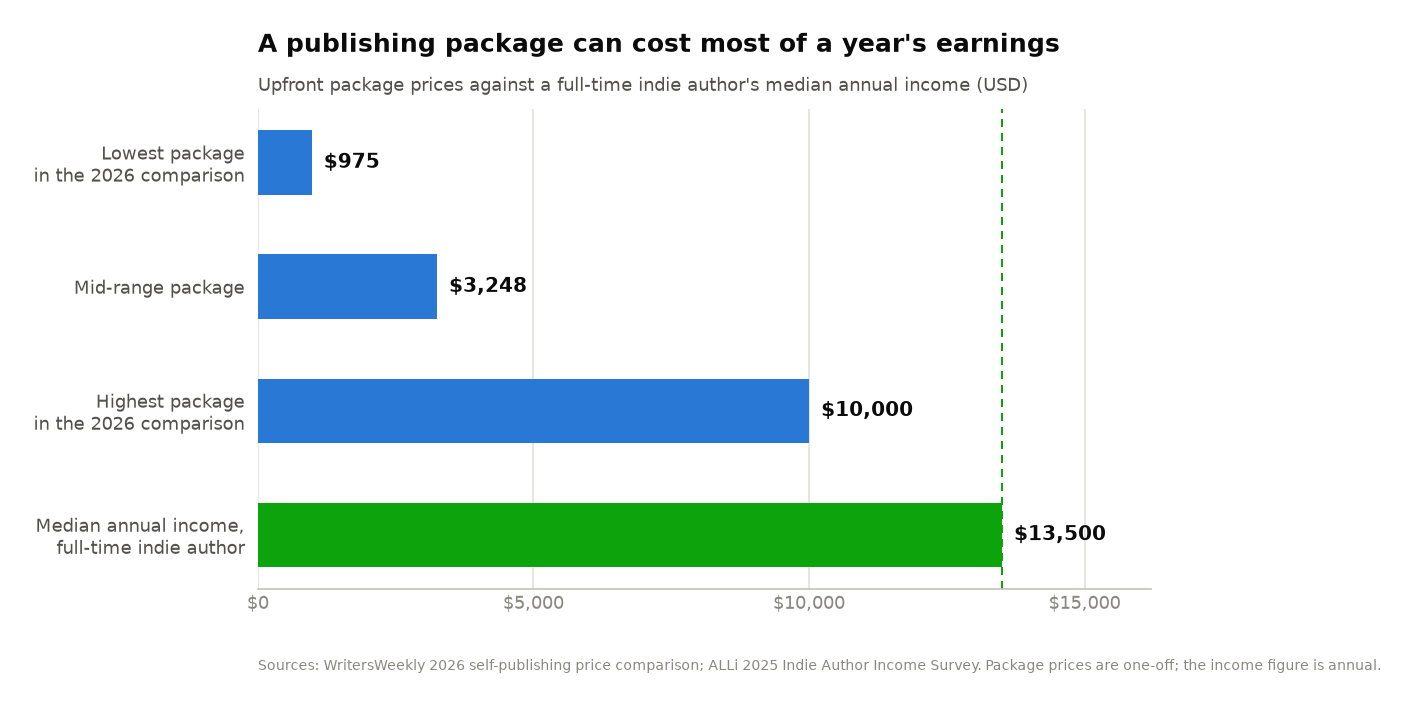
A one-off package price set against an annual income figure. Sources: WritersWeekly 2026; ALLi 2025 Indie Author Income Survey.
A mid-range package is a meaningful share of a good year. The most expensive is most of one. That is not a reason to refuse to pay for skilled work, and cheap is not the same as safe. It is a reason to know exactly what each line item buys, who ends up owning it, and what happens to it if the relationship ends badly.
How to check a self-publishing company before you pay
Due diligence is where control begins. In the UK, search the free Companies House register for the legal name, company number, status, filing history, officers and any insolvency notices, and compare that entity against the name on your contract and invoice. Brand names and legal entities are often not the same thing.
Then talk to authors who used the self-publishing company more than a year ago. Recent testimonials tell you about the sales process; older clients tell you whether statements and payments stayed reliable once the initial work was done. Ask what they paid, what arrived, who owns the accounts, and how quickly questions got answered in year two.
This is also where several of the self-publishing mistakes that can destroy a book begin. Warning signs worth taking seriously: guaranteed bestseller status, pressure to decide today, vague promises of global distribution, refusal to itemise retail deductions, long or exclusive rights grants, no workable termination procedure, and a requirement that all income pass through the provider without transparent reporting. A large price tag is not proof of a bad deal. An unwillingness to put deliverables, deadlines and ownership in writing is much closer to proof.
If your self-publishing company has already failed
Preserve everything first: the contract, invoices, bank records, statements, emails and screenshots of every dashboard while you can still reach them. Establish the exact legal entity behind the self-publishing company and its formal status. Write down what you are owed and for which sales periods.
Do not assume a successor company has taken on the old one’s debts because it bought assets or uses a similar name. Contact your authors’ organisation, and get advice for your own jurisdiction, because insolvency rules differ. Contact the distributors directly to find out who currently controls your listings and what they need in order to transfer or remove them. And resist the urge to upload a duplicate edition in a hurry, because unresolved rights, ISBN or account issues tend to multiply rather than resolve when a second listing appears.
The real meaning of independence
What happened this month is a warning about structure, not a verdict on paid publishing services. Hiring a self-publishing company remains a perfectly reasonable decision. Editors, designers, formatters and distribution specialists earn their fees, and as output climbs past three and a half million titles a year, good ones are worth more, not less.
But convenience is not the same as control. A resilient arrangement leaves you holding the rights, the accounts, the identifiers, the files, the data and the money trail, while the company does the work. Before you sign with any self-publishing company, picture that company disappearing overnight. If your publishing business would disappear with it, the agreement needs to change before the signature does.
This article is general publishing-business information, not legal or financial advice. Contract and insolvency rules differ by country. UK authors can contact the Society of Authors; US authors can contact the Authors Guild.
Sources: The Bookseller, “Authors left in limbo over unpaid royalties after Self-Publishing Partnership collapses” (13 August 2026); Publishers Weekly on Bowker’s 2025 US book output data; Publishers Association, publishing revenue 2025; Alliance of Independent Authors, 2025 Indie Author Income Survey; WritersWeekly 2026 self-publishing price comparison; Writer Beware on publisher insolvencies and reversion clauses; UK Intellectual Property Office guidance on ownership of copyright works. Research checked 14 August 2026.