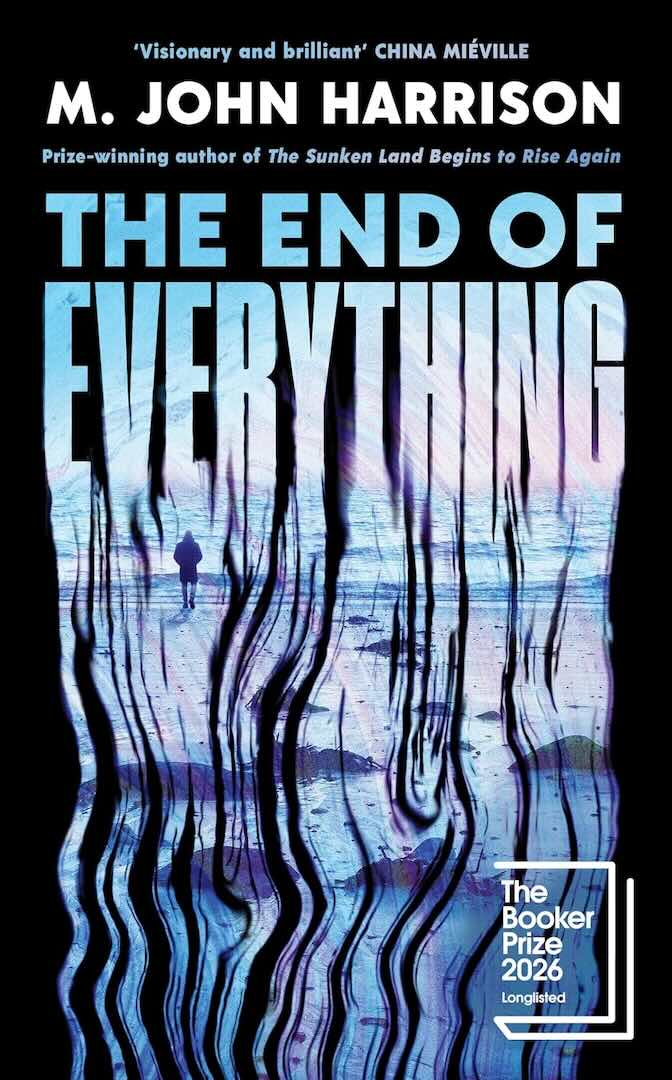
The End of Everything opens with a man walking up off a beach carrying something wrapped in bleached rags. It is about the size of a baby. A woman coming the other way asks him what the sea is like down there today, and he answers, without knowing why he says it, that eventually it will turn into speech. They both laugh, because that is the sort of joke people make now.
The thing in the rags grows. It learns to crawl, then to walk, then to talk, and it is very pleased about all of it. That is the engine of The End of Everything by M. John Harrison, his first novel in six years, and one of the most extraordinary things on the Booker Prize 2026 longlist.
What Is Happening in The End of Everything
Something called the iGhetti has arrived. Nobody knows what it is. Competing theories hold that it came out of dark matter, out of the 2008 banking crisis, or out of the internet, this last being the internet's own preferred explanation. What is known is that it has occupied the City of London, that artillery fires into the Square Mile without visible effect, and that reality around the edges has gone soft in a way people have learned to call a bad patch.
Phillip Tennent is thirty-eight and lives on the Kent shingle, scavenging the artefacts the sea keeps returning: discarded biological components the iGhetti dumped when they arrived. His aunt Marnie is seventy, a painter, in a townhouse under the wing of a crashed airliner, and her memory is going.
That is the situation. There is no plot beyond it, and no explanation is coming. Harrison has spent fifty years refusing to explain, and The End of Everything by M. John Harrison is the purest version of that refusal he has yet produced.
Marnie, and What The End of Everything Does With Her
In the third chapter of the book, a boy of about twelve urinates on Marnie from a roof, then puts his leg through it. She ties his ankle to the bed to stop him escaping, fetches a knife, and cuts his femoral artery. Then she goes back onto the balcony and lies down, annoyed that the aeroplane's shadow has taken the sun.
The prose does not change temperature for any of this. The neighbours come round and suggest she leave. She offers them instant coffee. She is not punished, redeemed, condemned or psychologised, and the novel simply continues.
Marnie is the best character Harrison has written, and this is a writer with thirteen novels behind him. She is funny, vain, imperious about art, tender about a robin she cannot name. She spends the second half of the book driving up the coast looking for somewhere to scatter her nephew's ashes and never finding anywhere good enough. She is also capable of anything. Readers who need to approve of the person they are following will not get past page thirty.
What Works
- The sentences. Gulls are described as the sound of dead pensioners mourning the great vanished battles of Britain. That level of writing is sustained for 250 pages.
- The murmuration. Halfway through The End of Everything, the ghosts of old men rise at dusk from the memorial benches along the coast and are blown out to sea in a flock, and Marnie stands and waves them off by name. It is the single most beautiful passage in any book on this list.
- The satire is precise and never announces itself. The breakers' yard run by two former media entrepreneurs who believe in the total transferability of business skills. The observation that the iGhetti consider all projects inherently good, because they are projects.
- Formal nerve. Three consecutive chapters carry the same title and describe the same crash three times, each version slightly reconfigured. The effect is of a reality that has begun to stutter.
- The artefact. It shoplifts a wardrobe from Oxfam, learns to read in a day, quotes local newspaper adverts with delight, and is by some distance the most likeable presence in the novel.
Where It Stumbles
- Part Two drifts, and knows it. The first half has real forward pressure. The second is a road trip through interchangeable seaside towns, deliberately becalmed. Deliberate is not the same as gripping.
- Hampson is a wall. A long stretch of a minor character's notebooks sits at the centre of the book, and while individual entries are extraordinary, the cumulative effect is of being handed someone else's homework.
- Everyone except Marnie is a sketch. Tennent in particular remains a set of gestures: the car, the temper, the beach. He is the ostensible protagonist and the least present person in the novel.
- The violence has no frame. A child is killed in chapter three and the book declines to have a view. That is clearly the intention. It will still strike some readers as nihilism dressed as restraint, and I do not think that reading is stupid.
The End of Everything Will Not Explain the Mirage
What the book is actually about, insofar as it consents to be about anything, is the difference between an event and an explanation. Everyone in it is generating theories. The internet has one, the militias have one, the middle classes have a polite way of not mentioning it. Hampson has an entire compound of satellite dishes pointed at the wrong part of the sky.
And the closest thing to an answer, when it comes, is a single page suggesting that the iGhetti may be nothing but a mirage: a refraction of something else entirely, on the far side of a horizon we cannot get to, and that we may be a refraction too.
Harrison has been writing that idea for decades. He has never written it this well, or this calmly.
A Word on Content Warnings
The killing of a child, described without emotional framing. Torture and mutilation of living human beings. Cannibalism. Dementia rendered from the inside. Animal distress. None of it is gratuitous, and all of it is delivered in the same level register as a conversation about baked beans, which is precisely what makes it hard.
Who This Is For
Reach for The End of Everything by M. John Harrison if you have ever finished a novel that explained everything and felt cheated. Reach for it if you like prose you have to stop and reread out of admiration. Skip it if you want plot, warmth, resolution, a protagonist to like, or any confirmation that the world makes sense.
The End of Everything does not meet you. It expects you to come to it, and it is entirely unbothered if you do not.
Read These Next
- The Sunken Land Begins to Rise Again by M. John Harrison. His Goldsmiths Prize winner and the obvious companion piece, with the same waterlogged England and the same refusal to resolve.
- Climbers by M. John Harrison. Earlier, more realist, and the one to read if the strangeness here defeats you. His anti-memoir Wish I Was Here is the other essential.
- Annihilation by Jeff VanderMeer. The closest living relative: an incomprehensible zone, a bureaucracy failing to describe it, and prose that keeps its nerve.
- Ice by Anna Kavan. For the same dreamlike catastrophe treated as weather rather than event.
- The Palm House by Gwendoline Riley. Also on this longlist, and an instructive opposite: two very English novels about decline, one of which trusts dialogue completely and one of which trusts nothing.
The Last Word on The End of Everything
There is a moment near the end where Marnie stands on a hill above London watching whatever the iGhetti are doing move across Lewisham like glittering chandeliers, and notices that the sound coming up is not horrible at all. It is something like harmonium music. And she thinks, with great calm, that things had gone wrong long before they arrived, and that it is possible to admit that now.
That is the book. Not an invasion novel, not a disaster novel, but a novel about a country that was already like this and now has something to blame.
The End of Everything by M. John Harrison is eighty-one years of craft doing exactly what it wants, and what it wants includes a long stretch of Hampson's notebooks that reads as a wall rather than a chapter, a second half that deliberately slackens and duly does, and a cast in which nobody except Marnie has a discernible want. I admired almost every page and was warm to very few, and that gap is a real cost rather than a badge of honour.
The sea keeps giving things back. Nobody asked what they were for, and the novel is a good deal more interested in that question than in whether you are still reading. See the rest of the field in our Booker Prize 2026 longlist guide.







