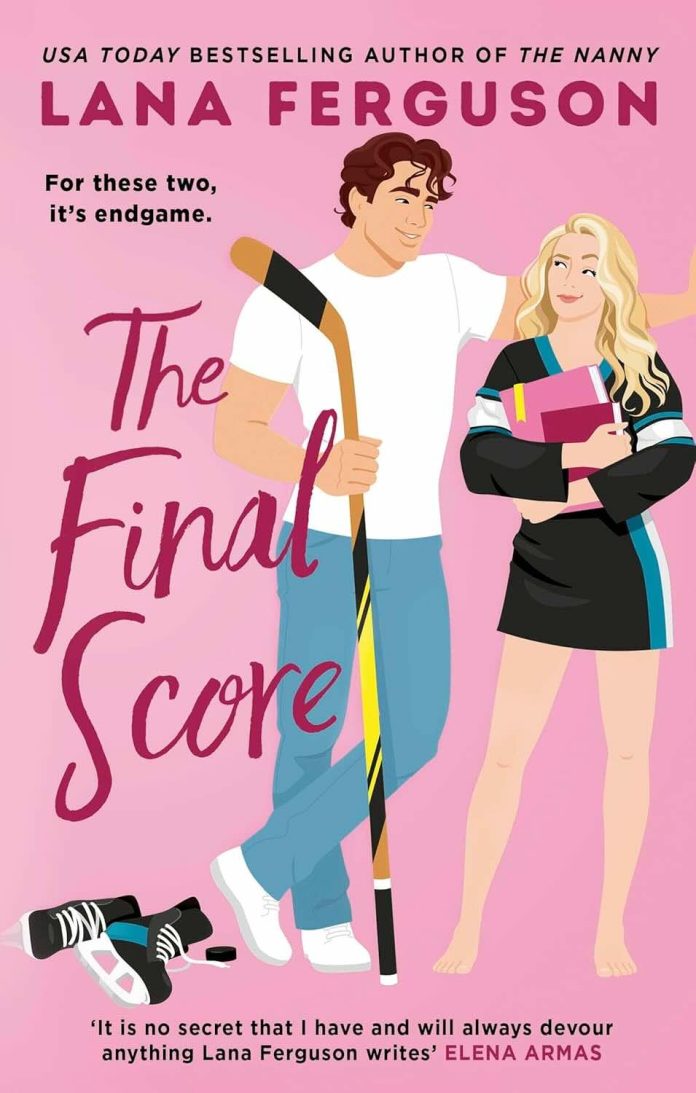
Most sports romances treat the sport as wallpaper. A jersey, a rink, a big win somewhere near the end. This one opens with a man being told he might never play again, and then it makes you sit in that room while he smiles about it anyway.
That opening image, a twelve-year-old boy learning that a held smile makes your cheeks ache, is the thesis of The Final Score by Lana Ferguson. Everything after it is the slow business of prying that smile off her hero’s face.
Face-Off: The Setup, Without Giving the Game Away
Jack Baker plays for the Boston Druids, and he has just clawed his way back onto the ice after an injury he brought on himself doing something spectacularly dumb. The comeback lasts about as long as it takes to say the word. He goes down again, harder, and this time the doctors talk about surgery and permanence. Jack, the strong one for his little sister since their parents died, has no idea who he is without the skates.
Abigail Thompson is finishing a psychology grad program, pulling coffee shop shifts, deleting texts from a father who treats her existence as a public relations problem. When flooding forces her out of her Back Bay studio, the only spare room going belongs to her half brother’s best friend. That would be Jack. The flirt. The loudmouth. Exactly the species of man she has trained herself to avoid.
You already know what proximity is going to do here. That is the contract you sign with a book like this. The pleasure is in watching two people who are both quietly falling apart decide, almost against their will, to hold each other up.
The Players
Jack Baker Is the Best Thing on This Roster
Ferguson has said in her acknowledgments that Jack is her favorite hero she has written, and you can feel it on nearly every page. He is a chronic people pleaser with a beta blocker in his bedside drawer and a panic attack waiting behind the grin. He is also very funny, in a way that never feels like the author reaching for a joke. And he calls a charcuterie board a “shark coochie board” and refuses to be corrected. And he makes nachos as a coping mechanism.
What lifts him above the usual golden retriever hockey hero is how unglamorous his anxiety is allowed to be. He tears his bedroom apart hunting for a pill. He shakes on the floor while Abby counts his breathing. And he says something cruel to the one person who has been gentle with him, because the fear has nowhere else to go, and the book does not let him off the hook for it. Romance heroes are usually granted a tidy, decorative sadness. Jack gets a messy one, and no kiss cures it.
Abby Thompson Is a Harder Sell, and That Is the Point
Abby is prickly, guarded, and openly contemptuous of Jack for the first stretch of the book. Readers who need to like a heroine on sight may struggle. Stay put. She is the daughter a famous man had in secret and then resented for existing, and Ferguson traces that damage with real care. The scenes where Abby drinks tea with the woman her father cheated on to have her are among the strangest and best in the novel.
Her arc is the quieter one. Jack has to learn he is more than a job. Abby has to learn that being loved is a skill nobody ever bothered to teach her, and that letting someone spoil you is not the same as owing them.
Ferguson’s Voice: Banter, Heat, and the Occasional Over-Explanation
The dual first-person present tense is standard issue for the genre, and Ferguson handles it lightly. Jack’s chapters are loose and chaotic. Abby’s are drier, tighter, full of the small internal negotiations of a woman who has decided that wanting things is dangerous.
Dialogue is the engine. Ferguson writes bickering that sounds like two people enjoying themselves rather than two people being written at, and the drift from insult to flirtation to something tender happens so gradually you only clock it in hindsight. The heat, when it arrives, is explicit, frequent, and in character. Jack talks. Abby discovers she likes being talked to. There is a hiking trail scene that will either delight you or send you looking for a different book, and I suspect you already know which one you are.
Where the prose strains is in the interiority. Both narrators explain their own psychology back to us, and because Abby is training to be a therapist, the book hands her lines that read like a workbook rather than a woman. Several emotional beats land twice, once as scene and once as summary. The second pass is rarely needed.
Reading It as a Companion Novel
This follows The Game Changer, and it runs on a nice bit of symmetry. That book gave us Ian and Delilah, where Ian was the best friend falling for Jack’s sister. Now Jack is the best friend falling for Ian’s sister, and he milks the irony for everything it is worth, to Ian’s visible distress.
You can read The Final Score by Lana Ferguson as a standalone. The backstory gets re-laid and the emotional stakes are self-contained. That said, the group scenes carry a warmth you will only half feel without the first book.
What Works
- Jack Baker, unreservedly. Anxious, generous, mouthy, and written with unusual tenderness.
- Mental health treated as ordinary. Medication is normal. Therapy is normal. Nobody is healed by orgasm.
- Dialogue that is actually funny rather than functionally funny.
- Stakes that hurt. A career ending is treated as a real loss, not a speed bump before the epilogue.
- A found family that feels lived in, particularly Aunt Bea and the odd, tender friendship between Abby and her brother’s mother.
- An ending that resolves the injury question honestly instead of miracle-curing it.
Where the Puck Misses the Net
- The middle sags. Once the two of them settle into a rhythm, the book coasts for several chapters on domestic sweetness and bedroom scenes with very little forward pressure.
- The third-act rupture is visible from a long way off, and it resolves along entirely familiar lines.
- Abby’s father is a villain with no interior. He functions as a pressure system, never as a person.
- The hockey is thin. For a novel named after a score, there is startlingly little of the game rendered with any specificity. Come for the men, not the sport.
- The emotional over-explanation noted above, which flattens a few scenes that had already done their work.
Who Should Read This
Best suited for
Readers who like their hockey romance heavy on feelings, high on heat, and low on actual line changes. Fans of brother’s best friend, forced proximity, one-roof tension, and heroes who cry.
Probably skip if
You need a slow burn, a clean read, a heroine who is warm from page one, or a book that actually cares about the sport in its title.
Similar Books Worth Your Time
- Icebreaker by Hannah Grace, for the hockey plus forced proximity plus heat combination.
- The Fiancé Dilemma by Elena Armas, for the same brand of banter and emotional excavation.
- Behind the Net by Stephanie Archer, for a hockey hero carrying more anxiety than he admits.
- The Deal by Elle Kennedy, for the campus-adjacent, high-chemistry version of this dynamic.
- Wildfire by Hannah Grace, if you want the softer, sweeter register.
Lana Ferguson’s Backlist
If The Final Score by Lana Ferguson is your entry point, her previous novels are worth the detour.
- The Nanny, the debut that made her name, warm and unapologetically sex-positive.
- The Fake Mate, her omegaverse fake dating book, and still the funniest thing she has written.
- The Game Changer, her first hockey romance and the direct predecessor to this one.
- Under Loch and Key, the Loch Ness monster one, which should not work and completely does.
- Overruled, rival lawyers, enemies to lovers.
- The Mating Game, her return to shifter territory.
Her next, The Soul Mate, is previewed in the back matter of The Final Score by Lana Ferguson and looks to be another omegaverse outing.
Final Buzzer
The Final Score by Lana Ferguson is not a flawless book. It sprawls in the middle, it under-uses its own sport, and it explains a few things it had already shown beautifully. But it does the hardest thing a romance can do, which is make you believe that two damaged people are actually good for each other rather than simply drawn to each other.
Jack Baker will stay with me. The book around him is uneven. The man at the center of it is not.