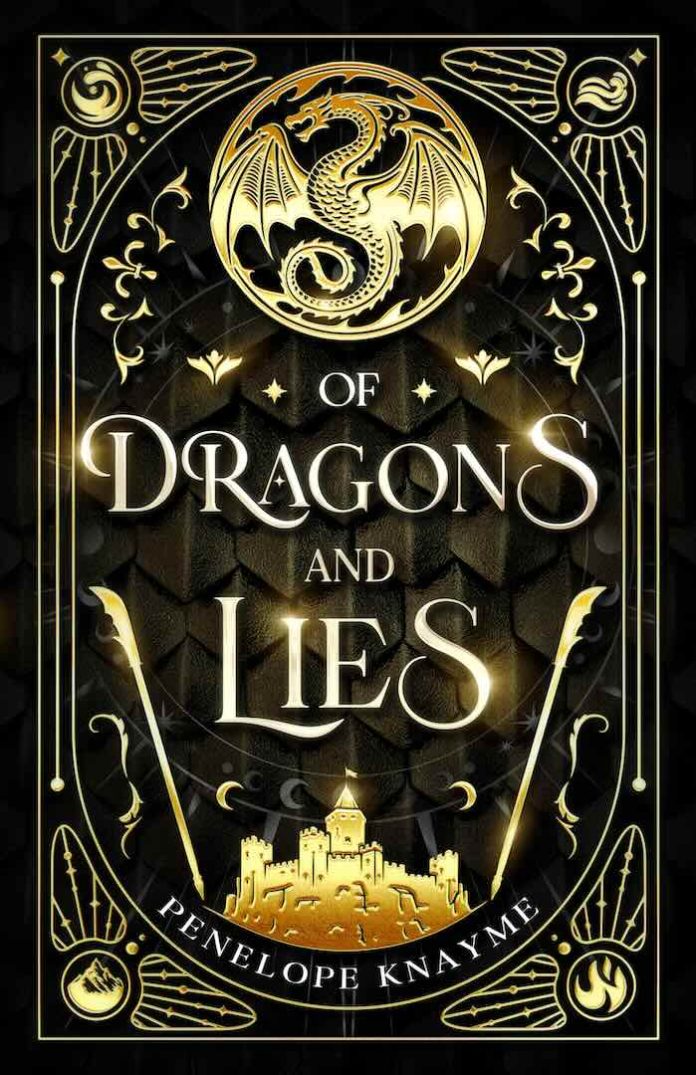
There are debut series openers, and then there are the ones that rewrite your understanding of what fantasy fiction can do. Of Dragons and Lies by Penelope Knayme belongs firmly in the second category. From the first page — a dream drenched in sirens and smoke, in fire that takes rather than warms — you sense that you are not in safe hands. You are in capable ones. That distinction matters enormously.
Knayme, previously known for The Last Petal, steps boldly into epic fantasy with a world and a story that feel both intimately human and cosmically high-stakes. The Unbound Saga has arrived, and it has arrived fully formed.
The World of Aluxia: Built on Beautiful, Breathable Lies
The realm of Aluxia is one of the most politically layered fantasy worlds crafted in recent years. On the surface, it is a structured, elemental society: citizens either wield one of six elements — water, fire, rock, wind, metal, or wood — or they are classified as Sines, magicless individuals who exist at the margins of a system designed to forget them. Governing it all is the Council, six Councilors whose authority is woven into law, ritual, and fear.
Knayme doesn’t simply describe this world. She embeds you in it, revealing its infrastructure the way Maelin experiences it — through confusion, gradual clarity, and dawning, horrifying recognition. The Valkrenn, a fortified keep perched at the southern cliffs where initiates undergo the Binding ritual, functions both as training ground and as crucible. It is a place where you are unmade before you are remade — if you survive.
What elevates the world-building is the detail beneath the detail. The Tithe system, where citizens surrender portions of their own elemental magic to sustain the Silent Wall against dragons, is a quietly devastating metaphor for institutional extraction. The Oracle Fountain, which cannot lie, becomes a dramatic linchpin and a source of genuine tension. Even the glossary and pronunciation guide at the back feel earned rather than decorative — the invented language of Aluxia has a consistency and a logic that rewards close reading.
The Dual POV: Two Minds, One Magnetic Pull
Of Dragons and Lies by Penelope Knayme is structured around two first-person perspectives, and the choice is crucial to why the book works as well as it does.
Maelin Corwin opens the story believing herself a Sine — magicless, invisible, and by the Capital’s estimation, entirely disposable. Her voice is sharp and instinctual. She reads rooms the way fighters read opponents: fast, without sentimentality, looking for the edge that keeps her alive. She is not a wide-eyed girl discovering magic. And she is a young woman who has survived by being underestimated, and the Valkrenn is simply the latest arena that has made that mistake.
Caidrian Varnel is her counterpart and, at first, her predator. Assigned by shadowy powers to investigate Maelin, he enters the Valkrenn with a mission and a secret of his own. His chapters are tightly coiled, written with the clipped precision of someone who cannot afford emotional slippage. He is a mind-reader, fire wielder, and strategist — qualities that make him dangerous and, as the story progresses, quietly, achingly vulnerable.
The slow-burn tension between them is the emotional engine of the novel. Knayme does not rush it. She understands that the most powerful romantic tension lives in restraint, in the space between one character’s guard dropping just slightly and the other noticing. The moments where their minds brush — unbidden, electric, neither of them fully able to stop it — are among the most compelling in the book.
Craft and Writing Style: Prose That Earns Every Sentence
This is where Of Dragons and Lies by Penelope Knayme distinguishes itself from a crowded field.
Knayme writes in short, often breathless sentences that never feel cheap. Her prose rhythms accelerate and contract with the emotional temperature of a scene. Action sequences feel physically real — not choreographed, but messy and urgent and painful in the right ways. Her sensory language is precise: the scent of honey and warm vanilla in the training hall, the copper taste of blood, the way power feels like light cracking through skin from the inside. She draws you into the body of each narrator, not just their thoughts.
What is especially impressive is how differently the two POV voices are calibrated. Maelin’s interiority is reactive and electric. Caidrian’s is controlled, analytical, threaded through with suppression. Reading them back-to-back across alternating chapters creates a kind of stereoscopic effect — you begin to see the same events through two entirely different emotional lenses, and the gap between those lenses is where the real story lives.
The prologue deserves special mention. It plants a haunting image — a dragon falling from the sky, a woman burning, a child hidden in the grass — and it doesn’t explain itself. It trusts the reader to carry that image forward into the story, where it slowly transforms in meaning. That is confident, sophisticated storytelling.
What Makes This Book Stand Out
- The magic system is original and morally loaded. Elemental magic is not simply power — it is taxed, controlled, weaponized by the state. The political dimension of magic is integral, not decorative.
- The found-family dynamics are earned. The group of initiates that forms around Maelin — including the fierce, quick Brea and the steadfast Patrik — develops through shared adversity rather than narrative convenience.
- The antagonists are genuinely complex. The Council members, particularly Selvara, are not monolithic villains. They are ideologues, pragmatists, and opportunists with their own internal logic, which makes them far more unsettling.
- The pacing is disciplined. The book is long, but it does not wander. Every chapter advances either character or stakes or both.
- The emotional stakes are as high as the physical ones. Panic attacks, grief, betrayal, and the long shadow of childhood trauma are handled with care and without melodrama.
- The dragon mythology is fresh. Soryn and the lore surrounding the Vyrranox feel genuinely new, not simply recycled from existing dragon fiction traditions.
For Readers Who Loved…
If Of Dragons and Lies by Penelope Knayme speaks to you, these titles belong on your shelf alongside it:
- Throne of Glass by Sarah J. Maas — for the fierce heroine navigating a system designed to destroy her
- From Blood and Ash by Jennifer L. Armentrout — for the slow-burn romance wrapped in high-stakes political fantasy
- The Cruel Prince by Holly Black — for the razor-sharp court dynamics and dangerous loyalties
- Fourth Wing by Rebecca Yarros — for dragon-bonded magic and enemies-to-lovers tension
- An Ember in the Ashes by Sabaa Tahir — for the dual POV structure, the brutal training setting, and the morally layered world
Final Thoughts
Of Dragons and Lies by Penelope Knayme is the kind of fantasy debut that reminds you why you fell in love with the genre in the first place. It builds a world worth believing in, fills it with characters worth caring about, and then tears the rug out from under them — and you — with surgical precision and impeccable timing.
Penelope Knayme is a writer who trusts her readers. That trust is repaid in full.
The Unbound Saga has only just begun, and if this first installment is any indication, what follows will be extraordinary.







