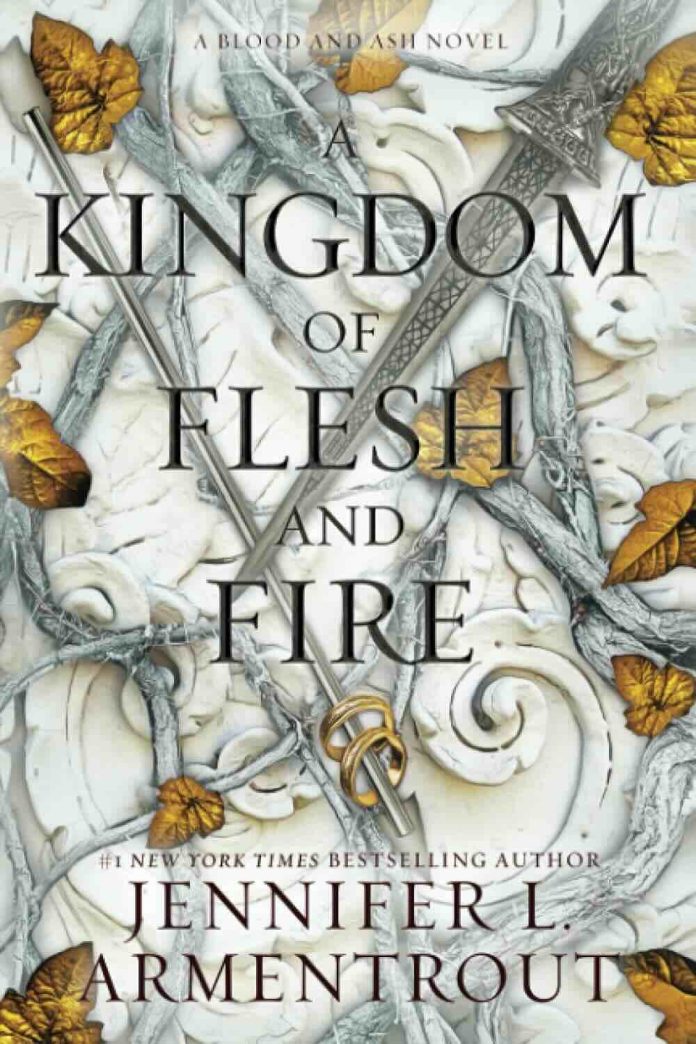
Jennifer L. Armentrout’s sophomore Blood and Ash novel arrives like a storm-tossed ship finally reaching harbor—battered but magnificent, carrying precious cargo that transforms everything we thought we knew. A Kingdom of Flesh and Fire picks up precisely where From Blood and Ash left us gasping, thrusting readers back into a world where love and betrayal dance as intimately as Poppy and Casteel themselves.
Following the earth-shattering revelations of the first book, Poppy finds herself stripped of everything she once believed true. The veil of the Maiden has been lifted, revealing not just her face but the devastating truth about the man she was falling for. Casteel Da’Neer—the Dark One, Prince of Atlantia—stands before her as both captor and confessor, his golden eyes holding secrets that could reshape two kingdoms.
Characters Forged in Fire and Vulnerability
Armentrout’s greatest triumph in this installment lies in her fearless excavation of her protagonists’ emotional archaeology. Poppy’s journey from sheltered Maiden to something far more powerful unfolds with the deliberate intensity of a slow burn that suddenly ignites. Her growing abilities—the healing touch that now glows with otherworldly light, the empathic gifts that threaten to overwhelm—serve as external manifestations of internal transformation.
The author refuses to let Poppy remain a passive vessel for others’ machinations. Instead, she emerges as a force of nature, wielding daggers with the same deadly precision she applies to cutting through Casteel’s carefully constructed facades. Her evolution feels earned rather than convenient, each step forward paid for with blood, tears, and the kind of bone-deep courage that makes heroes.
Casteel himself proves far more complex than the roguish prince archetype might suggest. Armentrout peels back his layers like an onion, revealing trauma that runs marrow-deep and a capacity for both tenderness and calculated manipulation that keeps readers perpetually off-balance. His vulnerability, when it surfaces, hits with the force of a physical blow—particularly in moments where he confesses his inability to forget his responsibilities when with Shea, yet finds himself completely absorbed when with Poppy.
A World That Breathes and Bleeds
The world-building expands like ripples across still water, each revelation creating new waves of possibility. Atlantia emerges not as the monstrous kingdom of Poppy’s indoctrination, but as a realm of painful beauty where golden trees filter sunlight and eleven god-statues stand eternal vigil. Armentrout’s descriptions carry the weight of lived experience—the salt spray of the Seas of Saion, the bone-rattling earthquakes that herald divine awakening, the way power feels like fire in one’s veins.
The mythology deepens with elegant complexity. Wolven who spark with electricity, draken who once soared on dragon wings, the tantalizing hints about Soul Eaters and the true nature of the Ascended—each element adds texture without overwhelming. The author demonstrates remarkable restraint, revealing just enough to satisfy while preserving the mystery that drives readers forward.
Romance That Scorches the Page
The romantic elements burn with an intensity that borders on incandescent. Armentrout writes desire like a living thing—predatory, consuming, and utterly uncompromising. The famous dagger scene early in the novel sets the tone perfectly: violence and passion intertwined so completely that readers question where one ends and the other begins.
What elevates this beyond mere steam is the emotional foundation beneath the physical attraction. Casteel’s confession that he forgets his burdens only when with Poppy carries devastating weight, while Poppy’s struggle to reconcile her feelings with his betrayal creates genuine tension. The marriage proposal—delivered with characteristic arrogance at a table full of people who want her dead—epitomizes Armentrout’s ability to blend humor with high stakes.
The intimate scenes themselves are crafted with the delicate brutality of a master sculptor. They serve the story rather than simply titillating, each encounter revealing character depths and advancing emotional arcs. When Casteel tells Poppy she needs to choose him not just as a political necessity but as a genuine desire, the moment resonates because it’s been earned through hundreds of pages of careful development.
Narrative Strengths and Growing Pains
Armentrout’s prose style continues evolving, finding its most confident voice yet. Her dialogue crackles with wit and authenticity—Poppy’s threats to stab Casteel, Kieran’s long-suffering commentary, the easy banter between companions who’ve bled together. The author’s gift for balancing humor with pathos shines throughout, preventing the heavy themes from overwhelming readers.
The pacing occasionally stumbles under the weight of revelation. Certain exposition-heavy sequences, particularly around Atlantian history and bloodline mechanics, read more like textbook entries than organic discoveries. The middle section, while necessary for character development, sometimes feels stretched thin compared to the breakneck urgency of the opening and climactic sequences.
Additionally, some secondary characters remain frustratingly underdeveloped. Despite their importance to the plot, figures like Alastir and several of the Atlantian court members feel more like chess pieces than fully realized individuals. This becomes more noticeable as the series continues with The Crown of Gilded Bones, The War of Two Queens, A Soul of Ash and Blood, and the upcoming The Primal of Blood and Bone, where deeper character work might have paid dividends.
Themes That Resonate Beyond Fantasy
Beneath the supernatural veneer, A Kingdom of Flesh and Fire grapples with profoundly human concerns. The nature of truth versus comfortable lies permeates every page—from Poppy’s indoctrination as the Maiden to Casteel’s necessary deceptions to protect those he loves. The book asks difficult questions about the price of peace, the cost of justice, and whether love can survive built on foundations of betrayal.
The theme of agency proves particularly compelling. Poppy’s journey centers on claiming autonomy over her own destiny, refusing to be either the passive Maiden or the convenient political tool. Her declaration that she won’t hide her abilities, despite the fear they inspire, represents a profound assertion of selfhood that resonates far beyond fantasy conventions.
A Bridge Between Worlds
As the second installment in what would become a six-book saga, A Kingdom of Flesh and Fire succeeds admirably as both a standalone narrative and series building block. The central romance reaches satisfying resolution while leaving deeper mysteries tantalizingly unresolved. Readers finish knowing Poppy and Casteel’s relationship has found solid ground, but the larger conflicts between Atlantia and Solis remain explosive.
The book’s conclusion, with its divine interventions and earthshaking revelations, sets the stage perfectly for the escalating conflicts that define later volumes. Without spoiling future developments, Armentrout demonstrates admirable restraint in her reveals, trusting readers to appreciate the journey rather than rushing toward destination.
Final Verdict
A Kingdom of Flesh and Fire delivers exactly what fans hoped for while exceeding expectations in unexpected ways. Armentrout has crafted a worthy successor to From Blood and Ash, deepening the emotional complexity while expanding the mythological scope. The romance burns bright enough to illuminate every dark corner of this world, while the fantasy elements provide sufficient complexity to satisfy genre enthusiasts.
For readers seeking similar experiences, consider Stephanie Meyer’s adult fantasy work, particularly books that blend passionate romance with supernatural conflict. Sarah J. Maas’s Throne of Glass series offers comparable emotional intensity and world-building scope, while Elise Kova’s Air Awakens series provides similar romantic tension within a fantasy framework.
A Kingdom of Flesh and Fire stands as proof that sophomore novels need not suffer from the dreaded second-book syndrome. Instead, Armentrout has created a work that honors its predecessor while charting bold new territory. It burns bright enough to warm even the coldest fantasy reader’s heart.
Similar Recommendations:
- Throne of Glass series by Sarah J. Maas
- Air Awakens series by Elise Kova
- Hunt on Dark Waters by Katee Robert
- One Dark Window by Rachel Gillig
- Divine Might series by Jenna Wolfhart







