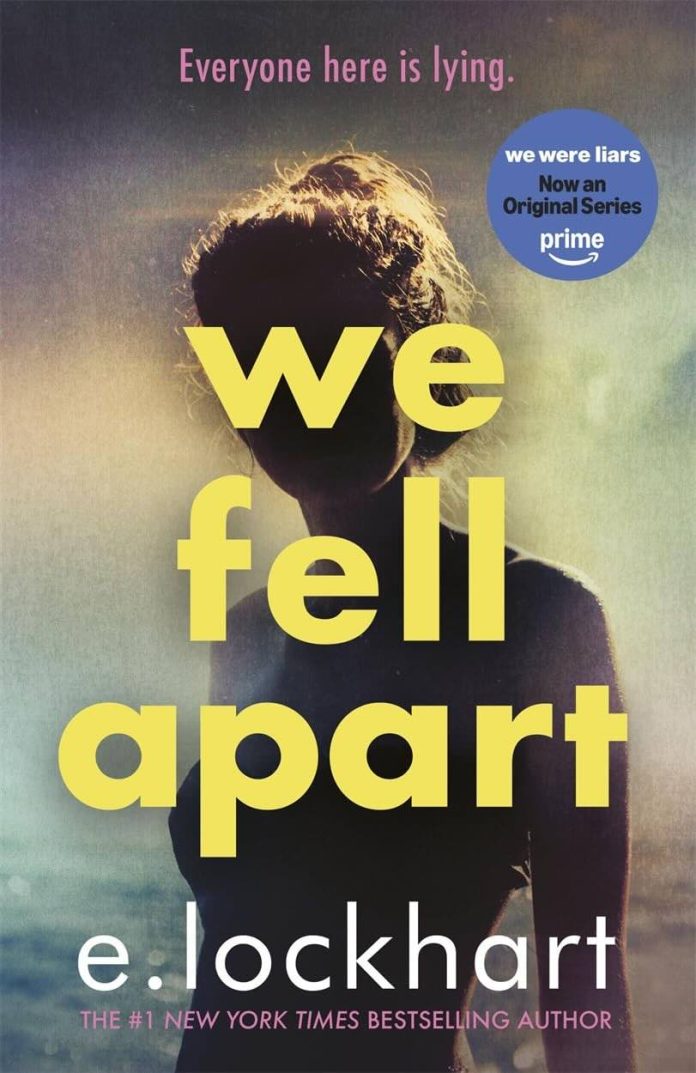
E. Lockhart’s return to the universe of We Were Liars brings readers to a different corner of Martha’s Vineyard, where secrets fester like salt-corroded wood and family dysfunction takes on new, disturbing dimensions. We Fell Apart, the third installment in what has become a trilogy of interconnected standalone novels, proves that the Sinclair family’s capacity for deception extends far beyond Beechwood Island’s burned mansion.
The series began with We Were Liars in 2014, a YA mystery that became a cultural phenomenon with its shocking twist and atmospheric storytelling. Family of Liars, released in 2022 as a prequel, explored the previous generation’s dark secrets. Now, We Fell Apart runs parallel to the original book’s timeline, set in the same summer of 2012, but focuses on Kingsley Cello—revealed to be Kincaid Sinclair, the estranged third brother who escaped the family empire to become a reclusive artist.
When Your Father Is a Ghost
Eighteen-year-old Matilda Klein has lived her entire life believing she was better off without a father. Her mother, Isadora, is a free spirit who moves from country to country, man to man, dragging Matilda along until one day she doesn’t. When Kingsley Cello suddenly contacts Matilda via email, inviting her to Hidden Beach and promising her a painting, it feels like unlocking a secret level in a video game—apt imagery for Matilda, an aspiring game designer whose mind works in weapons, maps, and boss battles.
Arriving at a weathered wooden castle perched on a cliff, Matilda finds not her father but three boys: Meer, her sunny half-brother; Brock, a former child star seeking refuge from his past; and Tatum, a brooding musician whose secrets run deeper than the ocean he swims in daily. Kingsley, they tell her, is delayed in Italy. But as days stretch into weeks, and Matilda becomes increasingly enmeshed in the strange rhythms of Hidden Beach—the indigo dyeing, the midnight swims, the Sharpie drawings on skin—she begins to sense something is profoundly wrong.
Gothic Atmosphere Meets Video Game Logic
Lockhart’s prose style has always been distinctive, but here it reaches new heights of fragmentation and poetry. The narrative unfolds in bursts of imagery and emotion, structured less like traditional chapters and more like levels in a game. Sentences break apart. Reform. Create patterns on the page that mirror Matilda’s fractured understanding of her situation.
The author’s signature technique of using visual breaks, italics, and formatting to create emotional impact works beautifully when describing Kingsley’s paintings—which become characters themselves in the story. When Matilda discovers canvases depicting her as “Melinoe, Bringer of Madness” or as Cinderella covered in ash, these artworks aren’t merely described; they’re experienced through Lockhart’s ekphrastic prose that makes readers feel like they’re standing in a gallery, confronting disturbing truths.
The video game references that pepper Matilda’s narration might seem gimmicky at first, but they serve as more than flavor text. Matilda processes her world through the logic of games—bosses to defeat, puzzles to solve, weapons to collect. This becomes particularly poignant when she must confront the reality that some situations have no win condition, no restart button, no way to respawn and try again.
The Weight of Artistic Legacy and Familial Lies
At its heart, We Fell Apart interrogates what we owe to difficult, damaged people, especially when those people are family or possess genius that the world wants preserved. The central mystery—what’s really happening with Kingsley—raises uncomfortable questions about autonomy, care, and the lengths to which people will go to protect both a loved one and their own interests.
June, Meer’s mother and Kingsley’s partner, practices a philosophy of non-attachment that reads as enlightened on the surface but conceals something more controlling. The boys at Hidden Beach exist in a kind of suspended adolescence, their futures on hold, their secrets locked away in a tower. As Matilda peels back layers of deception, she discovers that everyone has been lying—about Kingsley’s whereabouts, about his condition, about the very nature of the castle itself.
The book grapples with dementia in a way that feels both compassionate and unsettling. Kingsley’s deteriorating mind doesn’t make him simply confused or forgetful; it makes him frightening, unpredictable, and at times cruel. Lockhart refuses to sanitize illness, showing how it warps not just the afflicted person but everyone orbiting them, forcing impossible choices between autonomy and safety, between preserving someone’s wishes and preserving their life.
Where the Story Stumbles
For all its atmospheric strengths, We Fell Apart occasionally buckles under the weight of its own ambition. The pacing drags in the middle section as Matilda settles into the rhythms of Hidden Beach life. Beach days, pool-hopping, and conversations about video games create necessary texture, but the narrative momentum stalls before the revelations accelerate in the final act.
Some readers may find the connection to the Sinclair family feels tacked on—a way to market this as part of a beloved series rather than organic to the story. While the links to We Were Liars provide context and satisfying callbacks for fans, the book works better when it stands alone as Matilda’s story rather than when it’s servicing the broader mythology.
The ending, though emotionally resonant, may disappoint those expecting a twist as shocking as the original book’s. Instead, Lockhart offers something more melancholic: the understanding that some stories don’t have neat resolutions, that death and loss leave ragged edges, that families we choose can be as complicated as the ones we’re born into.
The Verdict: A Worthy, if Uneven, Addition
We Fell Apart succeeds as:
- A standalone mystery that explores family dysfunction through a fresh perspective
- A meditation on art, legacy, and what we leave behind
- A coming-of-age story about a young woman learning that blood doesn’t automatically create obligation
- An atmospheric beach gothic that proves Lockhart can still craft sentences that lodge in your brain like splinters
The novel struggles with:
- Pacing issues in the second act that may test reader patience
- A central mystery whose resolution lacks the jaw-dropping impact of We Were Liars
- Character development for Tatum that sometimes feels inconsistent
- An abundance of setup that occasionally overshadows emotional payoff
Who Should Read This
Fans of the We Were Liars series will appreciate the expanded universe and connections to the Sinclair family. Readers who enjoy atmospheric, literary YA mysteries—think Karen M. McManus meets Emily X.R. Pan—will find much to love in Lockhart’s layered storytelling. Those interested in narratives about complicated families, mental illness, and the bonds we forge outside blood ties will connect with Matilda’s journey.
Books to Read If You Loved We Fell Apart
- The Inheritance Games trilogy by Jennifer Lynn Barnes (for gothic mystery and family secrets)
- We Were Liars and Family of Liars by E. Lockhart (essential reading to fully appreciate the Sinclair connections)
- Genuine Fraud by E. Lockhart (another psychological thriller with a fragmented narrative)
- The Good Apprentice by Iris Murdoch (literary fiction that inspired this novel)
- I Capture the Castle by Dodie Smith (bohemian family in a crumbling castle)
- Rock Paper Scissors by Alice Feeney (twisty relationships and unreliable perspectives)
- The Drowning Game by LS Hawker (isolated setting with dark secrets)
Final Thoughts
We Fell Apart confirms E. Lockhart’s place as one of YA’s most distinctive voices, willing to experiment with form and tackle difficult subjects without easy answers. While it may not achieve the zeitgeist-capturing impact of We Were Liars, it offers a mature, thoughtful exploration of how we construct identity from the fragments of our parents’ legacies. Matilda Klein is a sharp, video-game-obsessed heroine whose journey from seeking paternal approval to understanding that family is what you make of it resonates long after the final page. We Fell Apart reminds us that some castles are prisons, some artists are monsters, and some families are better loved from a distance—wisdom hard-won on a cliff overlooking the Atlantic, where secrets rot like berries left too long in the sun.







