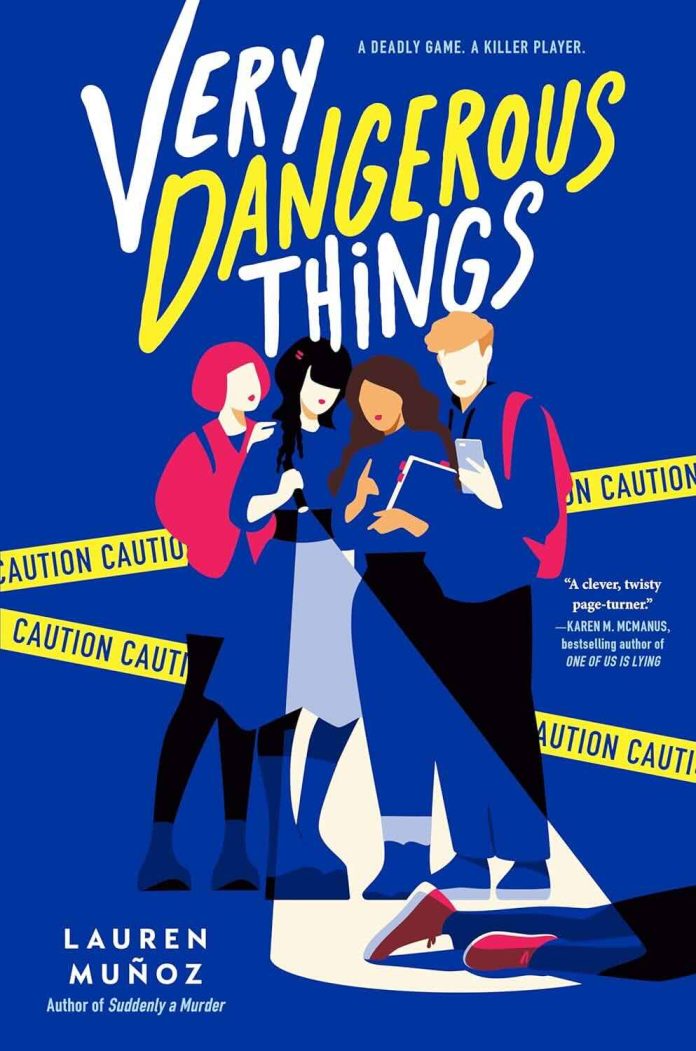
Lauren Muñoz’s sophomore effort, Very Dangerous Things, proves that lightning can indeed strike twice. Following her acclaimed debut Suddenly a Murder, Muñoz returns with a mystery that seamlessly weaves classic detective fiction with sharp contemporary social commentary, creating a narrative that feels both timeless and urgently modern. Set against the atmospheric backdrop of the Dr. James Everett School for Crime and Criminology, this YA thriller transforms the familiar boarding school setting into something far more sinister and compelling.
The premise hooks readers from the opening pages: J. Everett High’s annual murder mystery game—a tradition spanning decades—takes a deadly turn when Xavier Torres, the student chosen to play the victim, is found genuinely murdered in the school greenhouse. What should have been an elaborate academic exercise becomes a real investigation, thrusting crime-obsessed junior Dulce Castillo into a web of deception that threatens everything she holds dear.
Character Development That Cuts Deep
Dulce Castillo: A Detective Worth Following
Muñoz has crafted in Dulce Castillo a protagonist who transcends typical YA mystery archetypes. Named after Lord Peter Death Bredon Wimsey from Dorothy L. Sayers’ classic detective novels, Dulce carries both the intellectual curiosity of her literary namesake and the emotional complexity of a teenager grappling with profound loss. Her mother’s death in a car accident two years prior serves as both character motivation and plot catalyst, creating layers of personal stakes that elevate the mystery beyond simple whodunit mechanics.
What makes Dulce particularly compelling is Muñoz’s refusal to make her conventionally likable. She’s stubborn, sometimes cruel, and driven by grief-fueled anger that feels authentically teenage rather than artificially mature. Her relationship with former best friend Sierra Fox—the prime suspect in Xavier’s murder—crackles with genuine animosity born from betrayal and loss. The author doesn’t rush to heal these wounds or force reconciliation, instead allowing their fractured friendship to remain realistically jagged throughout most of the narrative.
Supporting Cast That Sparkles
The supporting characters avoid the pitfall of feeling like chess pieces moved solely to advance plot. Emi Nakamura, Dulce’s loyal best friend with her Magic 8 Ball and boundless energy, provides both comic relief and genuine emotional grounding. Her chemistry with the mysterious transfer student Zane Lawrence creates romantic tension that feels organic rather than obligatory.
Sierra Fox emerges as perhaps the novel’s most complex character—a girl trapped between family loyalty and personal integrity, whose privileged background can’t shield her from the consequences of past choices. Even Xavier Torres, despite being the victim, feels fully realized through flashbacks and other characters’ memories, avoiding the trap of becoming merely a plot device.
Atmospheric Excellence and Setting as Character
J. Everett High: More Than Just a School
Muñoz transforms the Dr. James Everett School for Crime and Criminology into a character in its own right. The converted mansion with its ivy-covered walls, hidden passages, and greenhouse laboratory creates an atmosphere that’s both cozy and menacing. The author’s attention to architectural detail—from the brass lion knocker to the security cameras—builds a world that feels lived-in and authentic.
The small town of Cape Cherry, Virginia, serves as more than mere backdrop. Muñoz skillfully weaves local politics, family dynamics, and community secrets into the larger mystery, creating a sense of place that grounds the more fantastical elements of the plot. The annual Poisoner’s Festival and the school’s elaborate murder mystery tradition feel like authentic local customs rather than convenient plot devices.
Plot Construction: Intricate Without Being Overwrought
Classic Mystery Structure with Modern Sensibilities
The murder mystery follows traditional Golden Age conventions while incorporating contemporary concerns about privilege, justice, and institutional corruption. Muñoz plants clues fairly, allowing astute readers to piece together elements of the solution alongside Dulce’s investigation. The revelation that Dean Whitaker orchestrated Xavier’s murder to cover up his gambling debts and affair feels both surprising and inevitable—the mark of skilled plotting.
However, Very Dangerous Things occasionally stumbles under the weight of its ambitions. The subplot involving Dulce’s mother’s death and the corrupt sheriff sometimes feels disconnected from the main mystery, though it ultimately ties together in the climax. Some readers may find the coincidences that bring various plot threads together strain credibility, particularly the revelation about Zane’s criminal past and his connection to Sheriff Calhoun.
Pacing That Mostly Delivers
Muñoz maintains strong momentum throughout most of the novel, though the middle section occasionally slows as Dulce grapples with whether to help Sierra. These moments of indecision, while realistic for a grieving teenager, sometimes halt the mystery’s forward progress. The final act, however, more than compensates with genuine tension and clever misdirection that keeps readers guessing until the final pages.
Thematic Depth Beyond the Genre
Justice, Friendship, and the Price of Truth
Beneath its mystery framework, Very Dangerous Things grapples with weighty themes that give the novel substance beyond its genre conventions. The exploration of friendship’s fragility—how trauma and family pressure can destroy bonds between young people—feels particularly authentic. Dulce’s anger toward Sierra for publicly blaming her mother for the car accident that killed her creates a moral complexity that enriches the entire narrative.
The book’s examination of corruption and privilege proves especially relevant. From Mayor Fox’s political maneuvering to Sheriff Calhoun’s evidence tampering, Muñoz doesn’t shy away from depicting how power protects itself at the expense of truth and justice. The way these adult corruptions impact and manipulate teenage relationships adds layers of social commentary that distinguish this from lighter mystery fare.
Writing Style: Golden Age Meets Gen Z
Literary Influences Worn Proudly
Muñoz’s love for Dorothy L. Sayers’ Lord Peter Wimsey novels permeates the text in the best possible way. Each chapter opens with a Sayers quote that illuminates both plot and theme, while Dulce’s detection methods consciously echo classical amateur sleuth traditions. This literary consciousness never feels pretentious; instead, it adds depth and sophistication to what could have been a more straightforward teen thriller.
The prose itself strikes an effective balance between accessible YA voice and the more formal cadences of Golden Age mystery. Muñoz has clearly studied the masters—the way she structures reveals, plants red herrings, and builds atmosphere shows deep understanding of mystery conventions while maintaining her own distinctive style.
Minor Critique: Occasional Overexplanation
While generally strong, the writing occasionally falls into the YA trap of over-explaining emotional states and motivations. Some of Dulce’s internal monologues about her feelings toward Sierra or her mother’s death could trust readers to understand subtext. Additionally, certain plot revelations are telegraphed more heavily than necessary, though this may be intentional to allow younger readers to follow the complex mystery elements.
Comparison to Contemporary YA Mystery
Very Dangerous Things stands favorably alongside other acclaimed YA mysteries, though each offers distinct pleasures:
- Karen M. McManus’s “One of Us Is Lying” – Similar boarding school setting and ensemble cast, but Muñoz’s classical mystery influences create more sophisticated plotting
- Holly Jackson’s “A Good Girl’s Guide to Murder“ – Both feature determined teenage investigators, though Muñoz’s protagonist feels more emotionally complex
- Maureen Johnson’s “Truly Devious” – Comparable in its blend of historical mystery elements with contemporary teen drama
- Jennifer Lynn Barnes’s “The Inheritance Games“ – Similar themes of wealth, corruption, and family secrets, though Muñoz grounds her story more realistically
Final Verdict: A Worthy Successor
Very Dangerous Things succeeds admirably as both a standalone mystery and a worthy follow-up to Suddenly a Murder. Muñoz has clearly learned from her debut, creating tighter plotting and more nuanced character development while maintaining the atmospheric excellence that made her first novel so compelling.
The book works on multiple levels: as a straightforward whodunit for mystery lovers, as a character study of grief and friendship for literary readers, and as social commentary for those seeking deeper meaning. While not without minor flaws—occasional pacing issues and some heavy-handed emotional exposition—the novel delivers genuine surprises, authentic emotion, and satisfying resolution.
Perfect For Readers Who Enjoy:
- Classic mystery traditions adapted for contemporary audiences
- Complex friendships tested by trauma and betrayal
- Atmospheric boarding school settings with gothic elements
- Mysteries that balance fair play cluing with emotional depth
- Strong female protagonists who aren’t immediately likable but earn reader investment
For fans of intelligent YA mystery fiction, Very Dangerous Things represents the genre at its finest—a book that respects both its readers’ intelligence and the classical traditions it draws upon while speaking directly to contemporary concerns about justice, truth, and the complicated nature of human relationships. Lauren Muñoz has established herself as a distinctive voice in YA mystery, one capable of honoring the past while illuminating the present.
This is mystery fiction that doesn’t talk down to its audience, and in an era of increasingly formulaic YA thrillers, that’s a very dangerous thing indeed—dangerous to the competition, that is.







