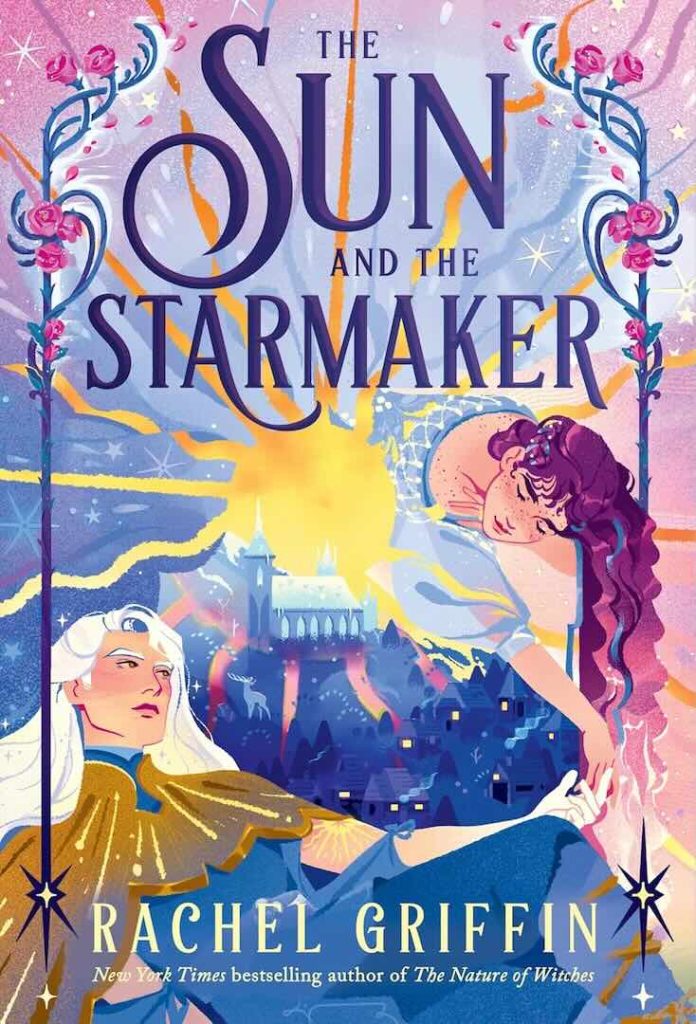
Deep in the snowy embrace of the Lost Range mountains lies Reverie, a village that exists on borrowed light and ancient magic. The Sun and the Starmaker by Rachel Griffin invites readers into a world where dawn arrives not by nature’s hand but through the deliberate act of a solitary sorcerer who trudges across glaciers each morning to hook sunlight over impossible peaks. This is Griffin’s fourth novel, following The Nature of Witches, Wild Is the Witch, and Bring Me Your Midnight, and it represents both a continuation of her signature atmospheric storytelling and a departure into more overtly fairy-tale territory.
A Bride Who Runs, A Sorcerer Who Waits
Aurora Finch’s wedding day should have been the beginning of her carefully planned life with Farren, her childhood sweetheart. Instead, it becomes the day everything she thought she knew dissolves like morning frost under unexpected sunlight. When her sister Elsie falls victim to the deadly Frost—a creeping cold that steals color and life from everything it touches—Aurora finds herself in the frostbitten woods making desperate bargains with the legendary Starmaker himself.
The setup is elegantly simple: Aurora possesses magic she never knew existed, magic that the Starmaker insists will kill her if left untapped. In exchange for healing Elsie and training Aurora in her newfound abilities, Aurora must abandon her impending marriage and move to the ice-covered castle at the mountain’s peak. But simplicity in premise gives way to complexity in execution, as The Sun and the Starmaker by Rachel Griffin weaves together threads of sacrifice, identity, and the weight of destiny against the backdrop of a village suspended between light and shadow.
What follows is a slow-burn romance wrapped in the trappings of a fairy tale, complete with:
- An isolated castle filled with enchanted objects and impossible architecture
- A mysterious, emotionally distant sorcerer harboring centuries of loneliness
- Ancient magic that demands blood, sacrifice, and endless devotion
- A tragic love story between the Sun herself and the first Starmaker that echoes through generations
The Alchemy of Ice and Devotion
Griffin’s greatest strength lies in her ability to craft atmosphere so thick you can feel the bite of mountain air against your skin. Reverie itself becomes a character—a village clinging to existence through sheer magical audacity, where fireflies dance in perpetual twilight and candy stripe phlox serve as living warning systems against encroaching death. The worldbuilding feels both intimate and vast, grounded in the small details of Aurora’s cottage beyond the reach of light and her ingenious system of mirrors that capture and redirect precious sunlight onto shadowed land.
The relationship between Aurora and the Starmaker (whose true name, Caspian, becomes a revelation and a gift) develops with patience that will reward readers who appreciate emotional interiority over action-driven plotting. Their connection builds through shared silences on glaciers, breakfast in candlelit courtyards, and the gradual recognition that both have been living half-lives—Aurora trapped by expectations, Caspian imprisoned by immortality and duty.
Griffin excels at crafting moments of quiet intimacy that carry enormous emotional weight. When Aurora discovers Caspian’s abandoned journal from his youth, or when he reveals his collection of books about plants and stars, these discoveries feel like archaeological excavations of a person buried beneath centuries of solitude. The author understands that falling in love is often less about grand gestures and more about witnessing someone’s unguarded humanity.
The Weight of Wonderful Sadness
Yet for all its strengths, The Sun and the Starmaker by Rachel Griffin stumbles in its middle section, where the pacing sags under the weight of repetitive training sequences and circular conversations about fate and duty. Aurora’s magic lessons on the glacier, while beautifully rendered, begin to feel formulaic—each session following a similar pattern of pain, progress, and poignant observation about the cost of power. The book would benefit from tighter editing in these sections, perhaps condensing several training chapters into more varied encounters with magic’s unpredictable nature.
The novel’s mythology, while rich, occasionally feels underdeveloped in crucial areas. The mechanics of how the Starmaker magic transfers, why the Sun made the choices she did, and the true nature of the Frost receive explanation that sometimes raises more questions than it answers. Readers seeking hard magic systems with clear rules may find themselves frustrated by the fairy-tale logic that governs Reverie’s existence—magic here operates on the currency of emotion and sacrifice rather than structured spellwork.
Similarly, secondary characters like Elsie, Aurora’s brothers Aspen and Evander, and even her mother remain somewhat thinly sketched despite their importance to Aurora’s emotional landscape. Farren, Aurora’s jilted fiancé, transforms from understandable hurt to antagonistic obstacle in ways that feel more plot-convenient than psychologically authentic. Only Tilly, the tragic snow angel searching endlessly for her lost self, achieves the depth of characterization that makes her scenes genuinely moving rather than merely atmospheric.
Between Starlight and Shadow
Where Griffin truly shines is in her exploration of what it means to be seen—truly seen—by another person. Aurora and Caspian’s romance works precisely because it’s built on mutual recognition of each other’s full humanity. Caspian doesn’t need Aurora to save him from his cold exterior; rather, Aurora’s presence reminds him of the person he was before centuries of isolation convinced him that detachment was survival. Similarly, Aurora doesn’t require rescue from her circumstances but rather needs someone who won’t diminish her agency even as they guide her growth.
The novel’s treatment of grief deserves particular praise. When faced with devastating loss in the third act, Aurora’s response feels earned rather than manipulative—she doesn’t collapse into passivity but instead channels her pain into determination. Griffin has clearly written through her own experiences with brain injury and recovery (as detailed in her moving author’s note), and that authentic understanding of how trauma reshapes us infuses the narrative with hard-won wisdom about resilience.
The book’s resolution, while satisfying on an emotional level, may prove polarizing for readers seeking either grittier realism or higher-stakes conflict. Griffin chooses hope over tragedy, connection over isolation, and the fairy-tale ending over the bittersweet one. This is not a criticism—the ending earned genuine tears from this reader—but it’s worth noting for those who might expect a different tonal trajectory given the story’s melancholic middle sections.
A Love Letter to Stories Themselves
Perhaps most striking is how The Sun and the Starmaker by Rachel Griffin functions as meta-commentary on storytelling itself. Aurora is a writer who contributes to Eternal Reverie, the village newspaper, and her journey involves both discovering her own story and helping the Sun remember hers. The novel argues that stories aren’t just entertainment but essential acts of preservation and healing—that by telling and retelling the tales that matter, we keep both memory and meaning alive.
This thematic thread elevates what could have been a straightforward romantasy into something more thoughtful. Griffin seems to ask: What stories do we tell about ourselves? Which narratives do we accept as inevitable, and which do we have the courage to rewrite? When Aurora refuses to accept the traditional trajectory of Starmaker succession—one life ending so another can begin—she’s rejecting the tyranny of how things have always been done in favor of how things could be.
The prose throughout maintains Griffin’s characteristic lyricism without tipping into purple territory. Her sentences have weight and texture, particularly when describing the interplay of light and darkness that defines Reverie’s existence. Chapter titles—”Grave Circumstances,” “Unfortunate Longings,” “Dying Star”—function almost as poetry, preparing readers emotionally for what follows while maintaining narrative surprise.
The Verdict: A Flawed But Luminous Romance
The Sun and the Starmaker by Rachel Griffin won’t be for everyone. Its deliberate pacing, fairy-tale logic, and focus on emotional interiority over external conflict will frustrate readers seeking fast-paced plot or complex political intrigue. The middle section drags, some secondary characters remain underdeveloped, and the worldbuilding occasionally prioritizes atmosphere over clarity.
But for readers willing to surrender to Griffin’s vision—to accept the slow unfurling of a romance built on shared silences and the gradual thawing of frozen hearts—this novel offers genuine magic. It’s a book about choosing life over mere existence, about love as an act of courageous vulnerability rather than passionate consumption, and about the revolutionary act of rewriting stories that no longer serve us.
Like Reverie itself, the novel exists in that liminal space between darkness and light, drawing power from the tension between what is and what could be. It’s imperfect, occasionally frustrating, but ultimately luminous—a story that trusts its readers to find beauty in quiet moments and recognize that sometimes the most radical act is simply refusing to accept that some endings are inevitable.
If You Loved This Journey Through Reverie
Readers enchanted by The Sun and the Starmaker by Rachel Griffin will find similar magic in:
Similar Atmospheric Romances:
- The Bear and the Nightingale by Katherine Arden – For its Russian-inspired folklore, winter magic, and a heroine caught between two worlds
- A Court of Thorns and Roses by Sarah J. Maas – If you enjoyed the fairy-tale retelling elements and slow-burn romance in an isolated magical setting
- Uprooted by Naomi Novik – For another story of a young woman leaving home to train with a powerful, prickly sorcerer
- House of Salt and Sorrows by Erin A. Craig – Similar gothic atmosphere and mysterious magic in an isolated setting
Other Rachel Griffin Novels:
- The Nature of Witches – Griffin’s debut exploring seasonal magic and environmental stakes
- Wild Is the Witch – A Pacific Northwest-set romance with wild magic and found family themes
- Bring Me Your Midnight – Dark academia meets witchcraft in another atmospheric Griffin creation







