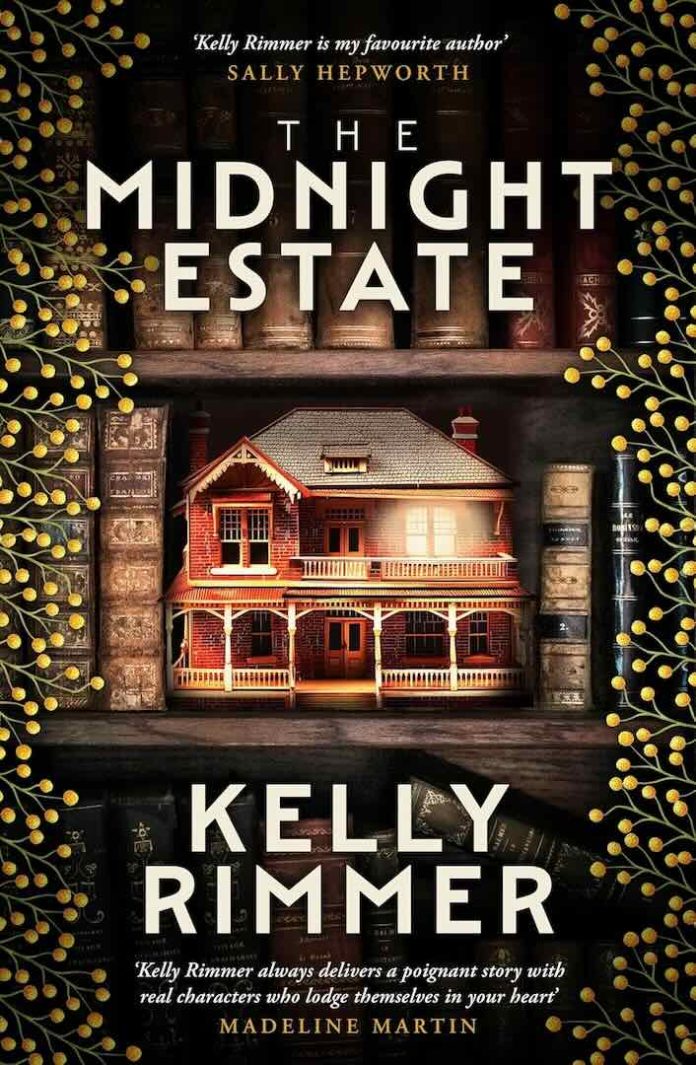
Kelly Rimmer has crafted something genuinely extraordinary with The Midnight Estate, a gothic mystery that weaves together three distinct timelines with the precision of a master craftsperson. Set against the crumbling grandeur of Wurimbirra, a fictional mansion in rural New South Wales, this novel operates on multiple levels that reward careful readers while maintaining accessibility for those seeking pure escapist pleasure.
The novel follows Fiona Winslow, a heritage consultant who returns to restore her uncle’s decaying estate, only to uncover a mysterious book that appears to mirror her own family’s darkest secrets. What begins as a straightforward inheritance story evolves into something far more complex and unsettling, as Rimmer expertly blurs the boundaries between reality and fiction, past and present.
The Architecture of Memory
Rimmer’s structural choices demonstrate remarkable ambition and largely successful execution. The book-within-a-book device—where Fiona discovers “The Midnight Estate” by the mysterious Charity Wilkie—creates a compelling parallel narrative that gradually reveals its connection to the primary storyline. This meta-fictional approach could have felt gimmicky in less capable hands, but Rimmer uses it to explore themes of truth, memory, and the ways families construct and deconstruct their own mythologies.
The three timelines are meticulously interwoven: Fiona’s contemporary restoration project, the 1940s story of Marie and Silas as told in the fictional book, and the gradual revelation of Uncle Tad’s real identity and motivations. Each timeline informs the others, creating a narrative architecture as carefully planned as the mansion itself.
Rimmer’s prose style shifts subtly between timelines, with the contemporary sections maintaining a crisp, professional tone that reflects Fiona’s heritage consulting background, while the historical narrative adopts a more flowing, romantic style befitting its gothic content. This stylistic versatility demonstrates Rimmer’s technical skill and prevents the different timelines from feeling disconnected.
Character Development and Emotional Resonance
Fiona emerges as a compelling protagonist—professionally competent yet emotionally isolated, carrying the weight of family dysfunction while struggling to understand her own heritage. Her relationship with her mother Ginny provides the novel’s emotional core, exploring how trauma can fracture families across generations.
The historical characters, particularly Marie and Silas, are rendered with remarkable depth considering they exist within the book-within-a-book structure. Marie’s journey from an abused wife to a woman reclaiming agency over her life resonates powerfully, especially in Rimmer’s sensitive handling of domestic violence themes. The author avoids exploitation while acknowledging the brutal realities of coercive control.
Silas represents one of Rimmer’s finest character creations—a gentle, bookish man whose kindness becomes both his strength and his vulnerability. His relationship with Marie evolves organically from rescuer to friend to co-conspirator, avoiding romantic clichés while maintaining emotional authenticity.
Uncle Tad, though deceased throughout the contemporary timeline, emerges as perhaps the novel’s most complex figure. Through Fiona’s discoveries and the fictional narrative he created, we see a man grappling with guilt, love, and the burden of keeping secrets. His decision to write the truth as fiction provides the novel’s central conceit and speaks to the power of storytelling as both revelation and concealment.
Gothic Atmosphere and Sense of Place
Rimmer excels at creating atmosphere without relying on supernatural elements. Wurimbirra itself becomes a character—its creaking floorboards, shifting shadows, and accumulated dust serving as physical manifestations of buried secrets. The author’s background in heritage consulting clearly informs her detailed descriptions of the mansion’s architecture and decay.
The rural Australian setting provides an interesting counterpoint to traditional English gothic literature. The isolation of the central-west New South Wales landscape, with its vast paddocks and small-town dynamics, creates a uniquely Australian form of gothic atmosphere. Rimmer effectively uses this geographical remoteness to heighten the sense of secrets buried in empty spaces.
Weather and seasonal changes punctuate the narrative effectively, with winter storms and sudden temperature drops often coinciding with emotional revelations. This environmental storytelling enhances rather than overshadows the human drama.
Thematic Depth and Social Commentary
Beyond its compelling plot, The Midnight Estate grapples with weighty themes that elevate it above simple mystery fiction. The novel examines how historical trauma reverberates through generations, how communities choose to remember or forget uncomfortable truths, and how individuals reconstruct their identities when family mythologies crumble.
Rimmer’s treatment of domestic violence proves particularly nuanced. Rather than sensationalizing abuse, she focuses on its psychological aftermath and the complex process of healing. Marie’s story arc demonstrates how survivors can reclaim agency while acknowledging that recovery is neither linear nor complete.
The novel also explores Australia’s colonial history through its revelation of historical violence against Indigenous people, though this element feels somewhat underdeveloped compared to the domestic violence storyline. The connection between personal and historical trauma deserves more extensive exploration.
Technical Mastery and Minor Flaws
Rimmer demonstrates impressive technical control throughout most of the novel. Her pacing builds tension effectively, with revelations timed to maintain reader engagement without feeling manipulative. The book-within-a-book structure could have become confusing, but clear chapter headings and distinct voice changes help readers navigate between timelines.
Some elements feel less successful. Certain coincidences strain credibility—the discovery of Marie’s engagement ring at the precise moment Fiona reads about it in the book stretches suspension of disbelief. Additionally, some secondary characters, particularly in the contemporary timeline, lack the depth of the main players.
The novel’s conclusion, while emotionally satisfying, resolves perhaps too neatly. The final revelations about family relationships and hidden identities feel somewhat rushed after the careful buildup of the previous chapters.
Literary Context and Comparisons
The Midnight Estate fits comfortably within Rimmer’s body of work while representing a departure from her previous historical fiction. Readers of her earlier novels, including The German Wife and The Warsaw Orphan, will recognize her skill at interweaving personal and historical drama, though this novel’s contemporary framing device marks new territory.
The book invites comparison to Kate Morton’s gothic family sagas, particularly The House at Riverton and The Forgotten Garden. Like Morton, Rimmer excels at creating atmospheric historical mysteries, though Rimmer’s prose style is more direct and less ornate. The book-within-a-book structure also recalls Diane Setterfield’s The Thirteenth Tale, though Rimmer’s approach feels more grounded in recognizable reality.
For readers seeking similar atmospheric mysteries, consider:
- Taylor Jenkins Reid’s “The Seven Husbands of Evelyn Hugo“ for complex family secrets
- Laura Purcell’s “The Silent Companion“ for gothic atmosphere
- Tana French’s “In the Woods” for psychological depth
- Sarah Waters’ “The Little Stranger” for historical gothic elements
Final Assessment
The Midnight Estate represents Kelly Rimmer at her most ambitious and largely succeeds in its complex aims. While certain plot elements strain credibility and some themes deserve deeper exploration, the novel’s emotional core remains powerful throughout. Rimmer’s skill at creating believable characters caught in extraordinary circumstances carries the story through its more implausible moments.
The novel works on multiple levels: as a straightforward mystery for readers seeking entertainment, as a meditation on family trauma for those interested in psychological depth, and as an example of contemporary gothic literature for students of the genre. This versatility suggests a work with genuine staying power.
Readers should approach this novel prepared for a slow burn rather than rapid-fire revelations. The payoff justifies the patient buildup, delivering emotional resonance alongside plot satisfaction. The Midnight Estate confirms Rimmer’s position as a significant voice in contemporary Australian fiction and suggests even greater achievements ahead.
The Midnight Estate provides a compelling reading experience that lingers long after the final page, raising questions about truth, memory, and the stories we tell ourselves about our families that make it essential reading for fans of gothic literary fiction.