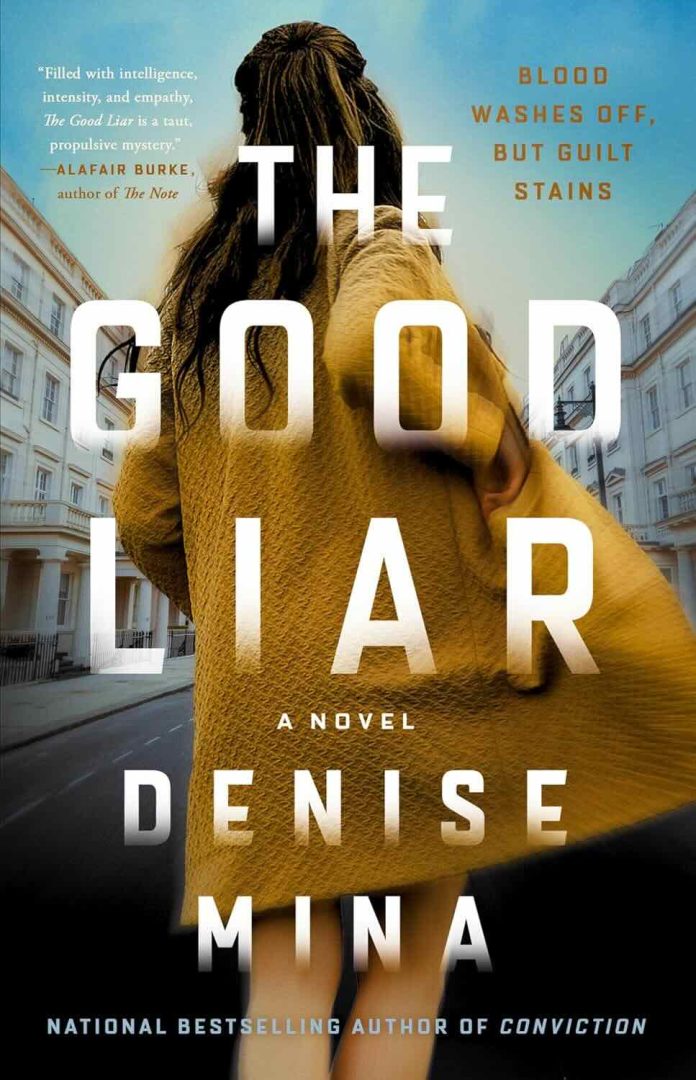
Denise Mina’s The Good Liar arrives like a scalpel to the forensic thriller genre, cutting through comfortable assumptions about justice, truth, and the price of professional success. This isn’t merely another courtroom drama or police procedural—it’s a devastating examination of how institutional corruption can transform even the most well-intentioned experts into unwitting accomplices to injustice.
The novel follows Professor Claudia Atkins O’Sheil, MBE, a blood spatter expert whose revolutionary Blood Spatter Probability Scale (BSPS) has made her reputation and fortune. As she prepares to deliver a career-defining speech about her most famous case—the Chester Terrace murders that saw young William Stewart convicted of killing his father and stepmother—Claudia faces an impossible choice. She has discovered that her groundbreaking forensic technique is fundamentally flawed, and an innocent man sits in prison because of her testimony.
The Architecture of Deception
Mina constructs her narrative with the precision of a forensic scientist, building layers of evidence that slowly reveal a conspiracy far more complex than a simple murder case. The story unfolds over the course of a single evening, using flashbacks and present-moment tension to create a pressure cooker of moral reckoning. This temporal compression serves the story brilliantly, as every tick of the clock toward Claudia’s speech heightens the stakes.
The author’s mastery lies in how she makes the reader complicit in Claudia’s journey from certainty to doubt. We begin firmly believing in the integrity of forensic science and the justice system, only to watch both crumble under the weight of revealed corruption. The Blood Spatter Probability Scale—Claudia’s life’s work—becomes a metaphor for how convincing lies can be when dressed in the authority of science.
What makes this particularly brilliant is Mina’s understanding that the most dangerous lies are those told by people who believe they’re doing good. Claudia isn’t a villain; she’s a victim of her own expertise and the institutional pressures that reward certainty over truth.
Characters Carved from Moral Ambiguity
The protagonist, Claudia O’Sheil, represents a fascinating study in professional guilt and maternal desperation. Mina paints her as simultaneously brilliant and blind, successful yet vulnerable. Her relationship with her drug-addicted sister Gina serves as a parallel narrative about different forms of self-destruction—one through substances, the other through willful ignorance.
Lord Philip Ardmore emerges as the novel’s most chilling creation—not a mustache-twirling villain but a sophisticated manipulator who uses institutional power to orchestrate injustice. His relationship with Claudia blurs the lines between mentorship and exploitation, making her gradual awakening to his true nature all the more powerful.
The supporting cast feels authentically lived-in, from the desperate Kirsty Parry to the doomed Charlie Taunton. Even minor characters like the various lawyers and forensic colleagues feel like real people caught in an institutional web rather than plot devices.
Technical Brilliance Meets Emotional Truth
Mina’s background research into forensic science shows throughout the novel, but she never lets technical detail overwhelm the human story. The Blood Spatter Probability Scale feels genuinely revolutionary and scientifically plausible, making its fundamental flaws all the more shocking when revealed. The author demonstrates deep understanding of how forensic evidence is presented in court and how juries respond to scientific authority.
The depiction of London’s elite forensic and legal communities feels insider-authentic, capturing the casual cruelty of institutional power and the way personal relationships become entangled with professional obligations. The Royal College of Forensic Scientists, with its elegant architecture masking corrupt foundations, serves as a perfect metaphor for the entire system.
Where the Foundation Cracks
While The Good Liar succeeds magnificently as a moral thriller, it occasionally stumbles under the weight of its own complexity. The revelation of Philip’s ultimate conspiracy—involving the Tontine inheritance and his manipulation of both Amelia and the forensic evidence—feels almost too elaborate. Some readers may find the final revelations strain credibility, though the emotional truth of Claudia’s journey remains intact.
The novel’s treatment of addiction through Gina’s character, while compassionate, sometimes feels like a subplot that doesn’t fully integrate with the main narrative thrust. Her relationship with Claudia provides crucial emotional grounding, but the resolution of her arc feels somewhat disconnected from the forensic conspiracy.
Additionally, the time-jumping structure, while generally effective, occasionally makes it difficult to track the chronology of events. The reader must work harder than necessary to piece together the timeline of discoveries and revelations.
The Price of Speaking Truth
What elevates The Good Liar beyond a simple conspiracy thriller is its unflinching examination of the personal cost of integrity. Claudia’s choice—whether to expose the truth and destroy her career and family’s future, or maintain her complicity in the lie—feels genuinely agonizing because Mina makes us understand what she stands to lose.
The novel asks uncomfortable questions about institutional expertise and public trust. In an era of declining faith in scientific authority, Mina’s exploration of how forensic “facts” can be manipulated feels particularly urgent. The Blood Spatter Probability Scale becomes a metaphor for how complex systems can be used to obscure rather than reveal truth.
The ending, with Claudia finally choosing to expose the conspiracy during her speech, provides catharsis without easy resolution. Truth-telling comes at a devastating personal cost, but Mina suggests that some lies become too heavy to carry.
Contextualizing Mina’s Achievement
Within Denise Mina’s impressive body of work, The Good Liar represents a evolution of her ongoing fascination with institutional corruption and moral complexity. Readers familiar with her earlier novels like Conviction and The Long Drop will recognize her ability to find the human story within procedural frameworks, but this novel feels more tightly focused and psychologically intense.
The book stands alongside recent forensic thrillers like Gillian Flynn’s Sharp Objects and Tana French’s Dublin Murder Squad series, but Mina brings a distinctly British sensibility to questions of class, privilege, and institutional power. Her portrayal of elite London circles feels more authentic and less caricatured than many crime novels that attempt similar territory.
For Readers Who Hunger for Substance
The Good Liar will particularly appeal to readers who enjoyed:
- Tana French’s “In the Woods” – for its psychological complexity and unreliable expertise
- Kate Atkinson’s “Case Histories” – for its blend of family dysfunction and criminal investigation
- John le Carré’s “The Constant Gardener” – for its expose of institutional corruption
- Gillian Flynn’s “Sharp Objects“ – for its damaged female protagonist and family secrets
- Louise Penny’s “Still Life” – for its focus on community dynamics and hidden truths
Final Verdict: Truth in All Its Uncomfortable Glory
The Good Liar succeeds as both an intricate crime novel and a meditation on the corrupting influence of expertise divorced from accountability. Mina has crafted a story that trusts its readers to navigate moral complexity without offering easy answers or comfortable villains.
The novel’s greatest strength lies in its refusal to provide simple catharsis. Claudia’s choice to speak truth doesn’t magically fix the damage done or restore William Stewart’s lost years. Instead, it suggests that integrity sometimes means accepting the full weight of our complicity in systems we cannot fully control.
This is crime fiction for adults—not because of its violence or sexual content, but because it demands we confront uncomfortable truths about how expertise can be weaponized and how good people can become trapped in corrupt systems. In an era when public trust in institutions continues to erode, Mina’s exploration of forensic authority and its limitations feels both timely and necessary.
The Good Liar confirms Denise Mina’s position as one of contemporary crime fiction’s most thoughtful and uncompromising voices. It’s a novel that will linger in readers’ minds long after the final revelation, not for its plot twists but for its moral complexity. In a genre often content with simple solutions to complicated problems, Mina has given us something far more valuable: a story that honors the true cost of choosing truth over comfort.