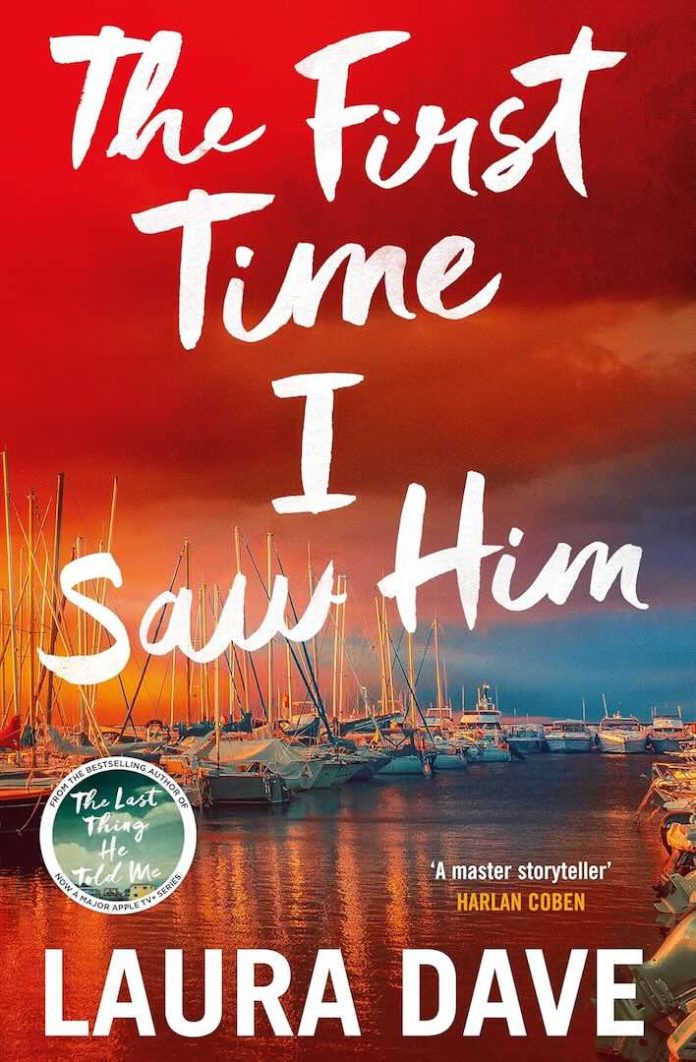
Laura Dave’s literary career has consistently demonstrated her ability to weave emotional complexity into suspenseful narratives, from the wine-country charm of Eight Hundred Grapes to the Hollywood intrigue of Hello, Sunshine. However, it was The Last Thing He Told Me that catapulted her into the stratosphere of thriller writers, becoming a cultural phenomenon that spawned an Apple TV+ adaptation. Now, with The First Time I Saw Him, Dave returns to the Hannah Hall series, picking up precisely where that tantalizing epilogue left us breathless: with Owen Michaels walking back into Hannah’s life after five years of silence.
The decision to write a sequel to such a beloved standalone carries inherent risks. Dave faces the challenge of satisfying readers who found closure in the first book while delivering a narrative that justifies its own existence. The result is a novel that expands the scope of Hannah’s world considerably, trading the intimate domesticity of a Sausalito houseboat for an international chase that spans from Los Angeles to Paris to the cliffside medieval village of Èze in the South of France.
The Architecture of Secrets
Dave’s narrative construction in The First Time I Saw Him is notably more ambitious than its predecessor. Where The Last Thing He Told Me maintained a tight focus on Hannah’s immediate quest to protect Bailey and uncover Owen’s secrets, this sequel operates on multiple timelines and perspectives. We move between Hannah’s present-day flight from danger, Owen’s five-year exile in New Zealand working at a biodynamic vineyard, and Nicholas Bell’s decades-long entanglement with Frank Campano Pointe II’s criminal organization.
This structural complexity serves the story’s central revelation: that Owen and Nicholas have been orchestrating an elaborate plan to secure permanent safety for Hannah and Bailey. The organization that threatened them in the first book remains a menacing presence, now under new leadership following Nicholas’s supposed death. Dave uses this framework to explore how the sins of one generation ripple through the next, and how the choices made in the name of love can become prisons of their own making.
The author demonstrates considerable skill in managing these multiple threads without losing narrative momentum. However, the sheer intricacy of the plotting occasionally works against the emotional immediacy that made the first book so compelling. Readers may find themselves pausing to untangle the web of who knew what and when, particularly regarding Nicholas’s double-dealing with both Owen and Frank.
Character Evolution and Emotional Resonance
Perhaps the most successful element of this sequel lies in the transformation of its central relationships. Bailey, now twenty-two and working as a casting assistant while pursuing her passion for musical theater, has evolved from the guarded teenager of the first book into a young woman who has forged a genuine bond with Hannah. Their relationship feels earned rather than convenient, built on five years of shared grief, growth, and the kind of chosen family that transcends biology.
Dave captures the nuances of their dynamic with particular grace. When danger strikes and they must flee, Bailey’s trust in Hannah’s judgment speaks volumes about the foundation they’ve built. There’s a beautiful moment where Bailey asks, “Are you doing all right?” and Hannah responds, “No no no. No worrying about me. That’s not allowed, kid.” This small exchange encapsulates years of Hannah establishing herself as the protector, the steady force that Bailey can rely upon.
The character who undergoes the most significant transformation, however, is Nicholas Bell. In the first book, he existed primarily as a threatening presence, Kate’s father whose connections to organized crime set the entire tragedy in motion. Here, Dave rehabilitates him into something far more complex: a man who made catastrophic choices, lost his daughter to those choices, and spent his remaining years trying to atone by protecting his granddaughter. His relationship with Hannah evolves from adversarial to something approaching familial love, though Dave never lets us forget the darkness in his past.
The Price of Forgiveness
The novel’s central thematic concern revolves around forgiveness and its costs. Dave poses difficult questions: Can we forgive someone who made choices that endangered us, even if those choices were made out of love? What do we owe the people who try to make amends for irreparable harm? The title itself signals this exploration—that first moment of seeing someone contains both the promise of who they might be and the shadow of what they will become.
Owen’s five-year absence and sudden return force Hannah to confront whether the man she married ever truly existed or if he was always a construction designed to protect her from uncomfortable truths. Dave doesn’t offer easy answers. Owen has genuinely suffered, has worked tirelessly to ensure his family’s safety, but his methods involved deception and abandonment. The reunion between Owen and Bailey at the Picasso Museum, sitting before Ulysses and Sirens, crystallizes this tension. Bailey can barely look at him, yet she takes his hand because love doesn’t require the absence of anger—it persists alongside it.
Nicholas’s arc presents an even more troubling meditation on redemption. He committed crimes, enabled violence, and his involvement in the organization indirectly led to his daughter Kate’s death. Yet Dave asks us to hold two truths simultaneously: Nicholas is responsible for tremendous harm, and Nicholas genuinely loves Bailey and Hannah and would sacrifice everything for their safety. The novel’s ending suggests that perhaps forgiveness isn’t about absolving the past but about choosing what future we want to build.
Where the Thriller Stumbles
While The First Time I Saw Him succeeds as an emotional character study, it occasionally falters as a thriller. The mechanics of the criminal organization—Frank’s family dynamics, the power struggle between Quinn and Teddy, the elaborate surveillance Owen conducted—can feel overly elaborate. Dave works hard to make the criminal element feel realistic and grounded, but at times the plot machinery shows too clearly.
The middle section, particularly the extended sequence in Èze where Hannah and Nicholas confront Frank at his birthday party, stretches credibility in places. The idea that Frank has been secretly working with Nicholas and Owen all along requires significant exposition to justify, and even then, some readers may find it too convenient. Similarly, the various flash drives, encrypted systems, and surveillance feeds begin to feel like devices to move the plot forward rather than organic developments.
The pacing suffers somewhat from these structural choices. After the propulsive opening where Hannah and Bailey flee Los Angeles, the novel settles into a more deliberate rhythm as Dave fills in years of backstory through flashbacks. While this context proves necessary for understanding the final confrontation, it does slow the thriller momentum that drew many readers to the first book.
A Different Kind of Ending
Dave makes a bold choice in how she resolves Hannah’s story in The First Time I Saw Him. Rather than delivering a traditionally triumphant ending where the family rides off into the sunset, she offers something more bittersweet and realistic. Hannah, Owen, and Bailey are together, yes, and they’re safe from the organization’s threats. But Nicholas, whose sacrifice made this possible, must disappear to rural Tuscany, his life forever shadowed by the consequences of his choices. The cost of their freedom is palpable.
This ending feels true to Dave’s vision throughout the series: that the choices we make in the name of love reverberate in ways we cannot control, and that safety often comes with a price. The final image of Hannah turning toward Owen on the boat, the Mediterranean glowing purple beneath them, contains both promise and uncertainty. They have a second chance, but second chances don’t erase first failures.
The Verdict on Returning to Hannah’s World
The First Time I Saw Him is a more complex, ambitious, and in some ways more flawed novel than its predecessor. Dave takes risks with structure, characterization, and theme that don’t always pay off but demonstrate growth as a storyteller. The novel works best when focusing on the intimate relationships between Hannah and Bailey, Hannah and Nicholas, and the fraught reunion between Bailey and Owen. It works less well when mired in the intricate details of criminal organizations and surveillance technology.
Readers who loved The Last Thing He Told Me for its propulsive mystery and clear emotional stakes may find this sequel more demanding. It requires patience with flashbacks, multiple perspectives, and a more diffuse sense of threat. However, those willing to engage with Dave’s deeper exploration of forgiveness, sacrifice, and the complicated ways we love imperfect people will find much to appreciate.
The book functions as a worthy, if imperfect, continuation of Hannah’s journey. It answers the question posed by that first book’s epilogue while opening new questions about what it means to rebuild a life from the fragments of broken trust. Dave’s prose remains elegant and assured, her ear for dialogue sharp, and her ability to ground high-stakes thriller elements in genuine emotional truth intact.
For Readers Who Enjoyed This Journey
Readers drawn to The First Time I Saw Him will likely appreciate:
- The Silent Patient by Alex Michaelides – for psychological suspense woven with unreliable narration
- The Guest List by Lucy Foley – for ensemble cast dynamics and multiple perspectives revealing hidden truths
- The Woman in Cabin 10 by Ruth Ware – for atmospheric thriller settings and protagonists fighting to survive
- The Last Mrs. Parrish by Liv Constantine – for complex female characters navigating deception
- Big Little Lies by Liane Moriarty – for the intersection of domestic drama and mystery
- She’s Not Sorry by Mary Kubica – for stories about families fractured by secrets and disappearances
Final Thoughts
Laura Dave’s return to the Hannah Hall series proves that sequels can expand and deepen our understanding of beloved characters even when they don’t quite match the taut perfection of their predecessors. The First Time I Saw Him is a thoughtful, emotionally rich exploration of second chances that sometimes gets tangled in its own complexity but ultimately delivers on its promise: to show us what happens when we choose to forgive, to rebuild, and to believe that the people we love can become better than their worst choices. It’s a testament to Dave’s skill that even with its flaws, the novel leaves us hoping Hannah, Owen, and Bailey find the peace they’ve fought so hard to earn.







