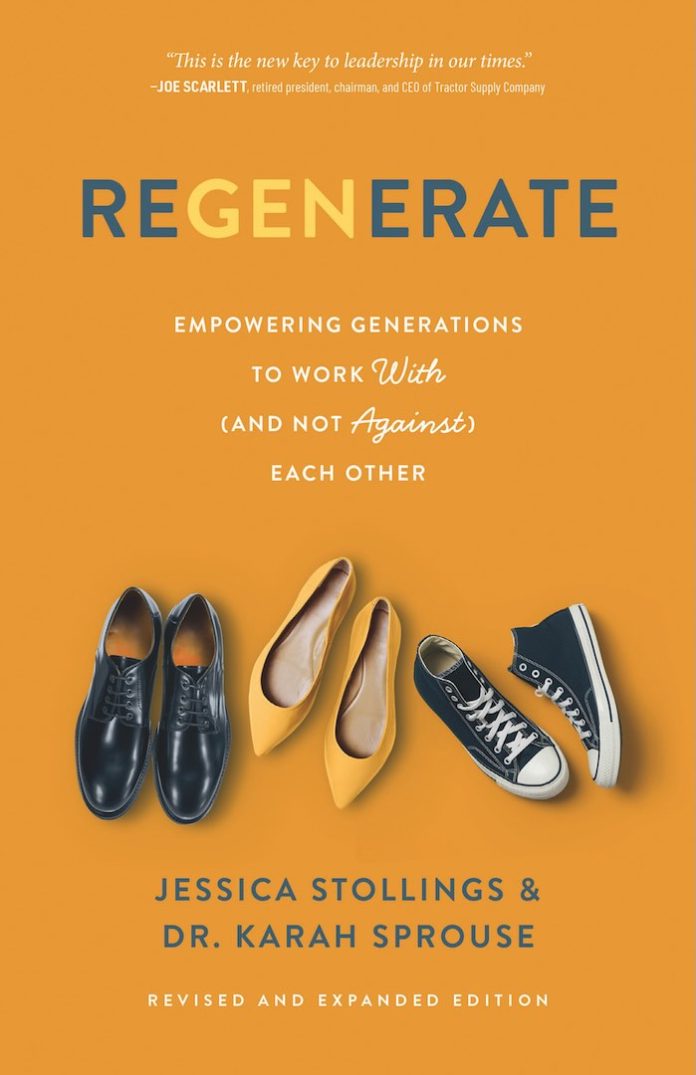
Picture this: a Baby Boomer shows up to a studio interview in his finest suit and a bold red tie. Across the table at a different company, a Gen Zer walks into a job interview wearing his best sneakers. Neither one is being disrespectful. Both believe they are presenting their absolute best. And therein lies the crux of the generational puzzle that ReGenerate: Empowering Generations to Work with (and Not Against) Each Other by Jessica Stollings and Dr. Karah Sprouse sets out to solve.
This revised and expanded edition, building on the original 2019 version authored solely by Jessica Stollings, arrives at an inflection point for the American workforce. With up to five generations sharing office space, conference calls, and Slack channels, organizations face communication friction that no amount of pizza parties can fix. Stollings, a nationally recognized speaker with over two decades of field experience, has partnered with Dr. Karah Sprouse, a former college professor and Gen Z researcher, to deliver something rare in the self-help genre: a book grounded equally in academic rigor and human warmth.
The Architecture of Understanding
The book is thoughtfully divided into two halves. Part I, titled “Understand,” walks the reader through detailed profiles of each generation currently represented in the U.S. workforce, from Traditionalists born as early as 1928 through to a fascinating sneak peek at Generation Alpha, whose oldest members are barely in middle school. Part II, titled “Connect,” provides the actionable framework for bringing these diverse groups into productive alignment.
What immediately sets ReGenerate: Empowering Generations to Work with (and Not Against) Each Other by Jessica Stollings and Dr. Karah Sprouse apart from similar titles is its refusal to traffic in lazy stereotypes. The authors are transparent about the distinction between generational trends and individual identities, cautioning readers early on that studying generations is not about boxing people in but about building bridges of understanding. Each generational profile examines the social and cultural influences that shaped its members during their formative years, from defining historical moments and prevailing media landscapes to communication styles and workplace expectations.
The COVID-19 pandemic receives substantial attention throughout, and rightly so. The authors trace how it reshaped generational dynamics in distinct ways: Millennials faced devastating career disruptions during prime working years, Gen Z navigated the isolating transition from college to career in a virtual vacuum, and Gen Alpha entered their earliest school years through screens, potentially missing critical socialization. This updated perspective is what makes the revised edition feel urgent rather than merely refreshed.
Dr. K’s Research: The Heart of the Matter
One of the most compelling chapters is Dr. Sprouse’s original qualitative study on Gen Z’s workplace assimilation. Having spent over a decade teaching business students at Cumberland University, she secured access to a multinational organization and conducted anonymous interviews across generational lines, probing the four pillars of high-performing teams: communication, collaboration, conflict management, and leadership.
Her findings were revealing. She discovered “collision points everywhere,” even among well-intentioned team members. Older colleagues found Gen Z’s texting-style emails baffling, while Gen Z workers couldn’t understand why a brief, authentic message was perceived as unprofessional. In collaborative settings, some Gen Zers were described as “on fire” with enthusiasm, while others sat silent in group meetings, not because they lacked ideas but because they had never learned the unwritten rules of when and how to speak up.
What makes this research section so valuable is that Dr. Sprouse doesn’t simply present her data and move on. She and Stollings reframe each collision point through what they call a “generational lens,” showing how the same underlying values of authenticity, respect, and wanting to contribute meaningfully live inside every generation, just expressed in radically different ways.
The Seven Steps to ReGenerate
The practical backbone of the book is its seven-step framework for multigenerational collaboration, and it is here that ReGenerate: Empowering Generations to Work with (and Not Against) Each Other by Jessica Stollings and Dr. Karah Sprouse transitions from insightful reading to genuine workplace toolkit:
- Educate — Teach generational awareness as a cultural competency, not a novelty topic
- Appreciate — Transform generational friction into opportunity using a four-part fluency model: Pause, Filter Check, Step Back, and Adapt
- Communicate — Translate messages across generational lines by understanding preferred channels and leveraging the universal power of storytelling
- Cultivate — Create cultures where expectations are clear, norms are revisited with multigenerational input, and onboarding is treated as a long-term process rather than a one-day event
- Coach — Use the Intent, Behavior, Results (IBR) model to deliver feedback that lands well across all age groups
- Adapt — Apply a generational lens to anticipate future workplace shifts and embrace change with curiosity rather than fear
- Share — Design formal processes for knowledge transfer, mentoring, and reverse-mentoring so that institutional wisdom flows in both directions
Each step is anchored by a real client story, a practical tool, and reflection questions. The escape room experiments are particularly memorable: same-generation groups of Boomers, Gen Xers, and Millennials each got stuck in predictable ways, while intergenerational teams initially performed even worse because nobody knew how to combine their different approaches. The lesson was clear: diversity of perspective is powerful, but only when paired with intentional integration.
Writing Style and Accessibility
The tone throughout is conversational without being casual, authoritative without being academic. Stollings and Sprouse write as they apparently speak, with the energy of two people who genuinely enjoy their subject and each other. They refer to themselves affectionately as “J and Dr. K, Elder Millennials,” and their warmth runs through every chapter. The book never condescends to any generation, and the authors are as willing to challenge established leaders to rethink outdated norms as they are to encourage Gen Zers to understand the values beneath a dress code.
The blend of narrative storytelling, research citations, and practical exercises keeps the pacing brisk across twenty chapters. Story-driven readers will find the anecdotes memorable, data-oriented readers will appreciate references to peer-reviewed studies and organizations like Pew Research Center, and action-oriented leaders will gravitate toward the tools they can implement immediately.
Who Should Read This Book
ReGenerate: Empowering Generations to Work with (and Not Against) Each Other by Jessica Stollings and Dr. Karah Sprouse casts a wide net effectively. CEOs navigating cultural transformation, HR leaders redesigning onboarding, managers frustrated by miscommunication, educators preparing students for professional life, and young professionals decoding unwritten workplace rules will all find themselves in these pages. The insights extend beyond the office, too, offering frameworks that apply to families, nonprofits, and communities where different generations must coexist.
What Lingers After the Last Page
Perhaps the most quietly powerful idea in the book is its redefinition of the word itself. To “regenerate” is not to discard what came before but to grow something new from the roots of legacy. The authors close with a dual challenge: they ask emerging generations to seek out the wisdom of their elders, and they ask established generations to share their knowledge with intention and humility. Knowledge transfer, they argue, is the most underutilized opportunity in organizational life.
In a cultural moment where generational discourse often devolves into finger-pointing memes and dismissive labels, this book is a breath of considered, hopeful, research-backed air. It asks the only question that ultimately matters: not who is right, but how we move forward together.
Key Highlights at a Glance
- Research-backed profiles of five workforce generations plus a preview of Gen Alpha
- Original qualitative study on Gen Z workplace assimilation conducted by Dr. Sprouse
- A road-tested seven-step framework with client-proven tools and exercises
- Updated analysis of how COVID-19 reshaped generational dynamics
- Practical models including IBR (Intent, Behavior, Results) and Tony Moore’s Culture in 4D
- Reflection questions and self-assessment checklists at the end of every chapter
- A companion training and coaching program available for organizations
Similar Books Worth Exploring
If this book resonates, consider adding these titles to your reading list for a well-rounded perspective on generational and workplace dynamics:
- The Fourth Turning Is Here by Neil Howe — for deeper historical context on generational cycles
- Multigenerational Workplace by Megan Gerhardt et al. (Harvard Business Review Press) — for an academic complement
- Driven by Difference by David Livermore — for broader diversity and inclusion frameworks
- Culture in 4D by Tony Moore — for building engagement-driven organizational culture
- The 3rd Alternative by Stephen R. Covey — for mastering collaborative problem-solving







 Each Other by Jessica Stollings and Dr. Karah Sprouse.)