In bodies borrowed, souls confined,
A grey girl seeks what fate denied—
Through stolen flesh and shattered pride.
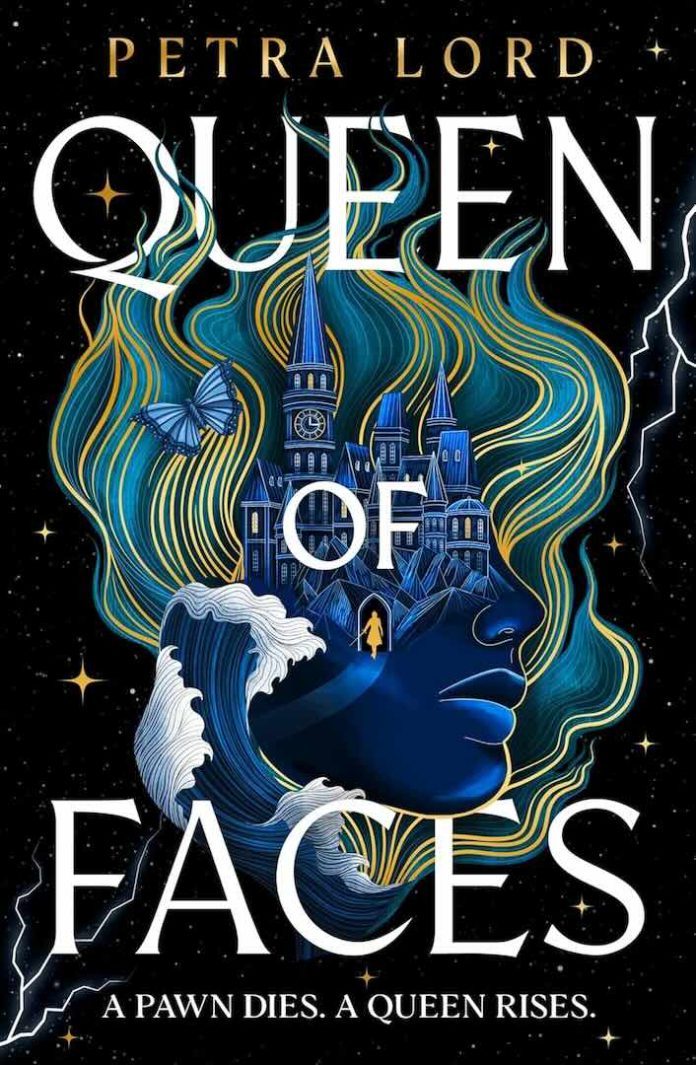
The first thing you need to know about Queen of Faces by Petra Lord is that it refuses to offer you comfort. This debut novel—the inaugural entry in the Queen of Faces series—plunges readers into a world where bodies are commodities, magic is privilege, and survival demands impossible choices. Set against the backdrop of a literally drowning civilization, Lord constructs a dark academia narrative that interrogates identity, power, and the brutal cost of transformation with unflinching precision.
The Architecture of a Decaying World
Anabelle Gage is dying from the inside out. Trapped in a deteriorating male body she never chose—an “Edgar” chassis that marks her as disposable in the eyes of Caimor’s elite—Ana embodies the intersection of gender dysphoria and economic desperation. Queen of Faces by Petra Lord opens with this visceral premise: what would you sacrifice for the body that feels like home? For Ana, the answer becomes increasingly complex as the novel progresses.
Lord’s worldbuilding deserves particular recognition. Caimor exists in a state of managed apocalypse, with rising oceans gradually consuming the lower districts while the wealthy float above the consequences—both literally, in Paragon Academy’s suspended islands, and metaphorically, in their ability to purchase immortality through body-swapping. The magic system operates through four schools (Physical, Sinew, Praxis, and Whisper), each coded by color and philosophical approach. Ana’s Rainbow Veil—her illusion magic—becomes both her greatest weapon and a metaphor for the masks we wear to survive.
The prose alternates between Ana’s desperate, sardonic narration and Westyn Ebbridge’s more controlled perspective, creating a textural richness that mirrors their complicated dynamic. Lord writes action sequences with cinematographic clarity—rooftop chases blur with political machinations, and intimate character moments punctuate explosive set pieces. The pacing rarely falters, though occasional exposition dumps about magical theory can momentarily slow the momentum.
The Moral Labyrinth
Where Queen of Faces by Petra Lord truly distinguishes itself is in its refusal of easy answers. Ana begins as a sympathetic protagonist—a girl literally rotting away, denied admission to Paragon three times despite possessing genuine talent. But Lord doesn’t allow readers to remain comfortable with their allegiances. Ana lies, manipulates, and makes choices that harm innocent people. She works as an assassin. She becomes complicit in systems she claims to oppose.
Similarly, the revolutionary group Commonplace—led by the enigmatic Khaiovhe, known as the Black Wraith—initially appears as freedom fighters challenging Paragon’s monopoly on magical education and body modification. Yet their methods grow increasingly brutal, and their ideological purity proves as dangerous as the corrupt system they seek to topple. Lord asks readers to sit with contradictions: Can you root for a protagonist who commits violence? Can revolutionary goals justify civilian casualties? Is survival itself a form of complicity?
This moral complexity represents the novel’s greatest strength and, for some readers, its potential weakness. Those seeking clear heroes and villains will find themselves disoriented. The narrative demands active engagement with uncomfortable questions rather than passive consumption of a straightforward chosen-one narrative.
Found Family in a Burning World
The relationships in Queen of Faces by Petra Lord crackle with tension and unexpected tenderness. Ana’s team—dubbed “Queen Sulphur” by the criminal underground—consists of outcasts and survivors:
- Westyn Ebbridge (Wes): A former noble trapped in a stolen body, brilliant with a sword but struggling with identity and purpose
- Nima Qasemi: An assassin whose Pith inhabits two bodies simultaneously, bringing both tactical advantage and philosophical questions about selfhood
- Korin Nameless: A Humdrum (non-magical) engineer and former Commonplace prisoner whose quiet competence anchors the group
Their banter provides levies against the narrative’s darkness. Lord excels at writing friendship that develops through shared trauma and mission debriefs rather than manufactured emotional beats. The slow-burn dynamic between Ana and Wes—built on mutual recognition, jealousy, and grudging respect—feels earned rather than imposed. When Wes confesses he envies Ana’s certainty about her identity, it lands with devastating impact because Lord has meticulously constructed their parallel journeys of transformation.
However, the romantic subplot could have been developed more fully. While the tension simmers effectively, readers seeking substantial romantic payoff may find the resolution somewhat understated. This restraint serves the story’s thematic priorities but might disappoint those expecting a stronger romantic arc.
The Weight of Representation
Lord’s author’s note reveals that Queen of Faces by Petra Lord was conceived in 2017 during a hopeful moment for transgender rights, but published in 2025 amid significant backlash. This context deepens the reading experience. Ana’s journey through literal body transformation parallels the metaphorical transformations we all undergo—the shedding of old selves, the painful growth toward becoming.
The transgender themes never feel tokenized or pedagogical. Ana’s dysphoria manifests through her decaying body, yes, but also through her relationship with masks, illusions, and the gap between internal truth and external perception. Lord treats gender identity as one facet of a multidimensional character rather than her sole defining feature. Ana is allowed to be flawed, ambitious, afraid, clever, and morally complicated—fully human rather than a symbol.
The novel also interrogates class through its body-swapping economy. The wealthy purchase designer bodies like fashion accessories while the poor decay in “defective” chassis. This literalization of economic inequality creates pointed social commentary without sacrificing narrative momentum.
Technical Craftsmanship and Minor Stumbles
Lord demonstrates impressive control over a sprawling plot. Multiple conspiracies, betrayals, and revelations layer atop one another, with the Adam Weaver twist hitting particularly hard for those who’ve been paying attention to the subtle clues. The magic system maintains internal consistency even as its rules expand, and the floating architecture of Paragon provides memorable set pieces for the novel’s explosive climax.
That said, Queen of Faces by Petra Lord occasionally suffers from debut novel growing pains:
- Character bloat: Several secondary characters, particularly among Paragon’s faculty and Ana’s targets, blur together and could have been consolidated
- Uneven secondary POVs: While Wes’s chapters add valuable perspective, occasional brief POV shifts to other characters (Sophie, Clementine) sometimes disrupt narrative flow
- Exposition balance: The opening third occasionally pauses action for worldbuilding explanations that, while necessary, can feel front-loaded
The novel’s length (around 600+ pages) will reward patient readers but may test those seeking tighter plotting. Some subplots—particularly involving Paragon’s internal politics—could have been trimmed without sacrificing core themes.
The Verdict: A Promising Beginning
Queen of Faces by Petra Lord announces a distinctive new voice in dark fantasy. Lord combines the moral complexity of R.F. Kuang’s The Poppy War with the queer sensibilities of Tamsyn Muir’s Locked Tomb series, filtered through a distinctly original magical system and setting. The novel refuses easy categorization—it’s simultaneously a heist story, a dark academia thriller, a meditation on identity, and a critique of power structures.
The prose occasionally reaches for poetry and achieves it, particularly in Ana’s moments of reflection on transformation and metamorphosis. Lord understands that real change—whether of body, mind, or society—requires destruction alongside creation. The caterpillar must dissolve in the cocoon before wings emerge.
As the first book in the Queen of Faces series, it establishes compelling mysteries for future volumes while delivering a complete, if occasionally devastating, arc. Readers who appreciate morally grey protagonists, intricate plotting, and worldbuilding that interrogates real-world systems of oppression will find much to love here. Those seeking straightforward heroism or uncomplicated romance should look elsewhere.
If You Loved This, Try:
- The Poppy War by R.F. Kuang – Dark academia meets war fantasy with morally complex protagonist
- Gideon the Ninth by Tamsyn Muir – Queer necromancy, dark humor, found family dynamics
- Babel by R.F. Kuang – Colonialism, revolution, and the violence of institutional power
- Hell Bent by Leigh Bardugo – Dark academia with high stakes and moral ambiguity
- A Deadly Education by Naomi Novik – Survival in a magical school that wants you dead
- The Mask of Mirrors by M.A. Carrick – Identity, illusion magic, and class warfare
Final Thought: Lord has written a debut that trusts readers to navigate complexity. In a genre sometimes content with comfort food fantasy, Queen of Faces serves something sharper—ambitious, flawed, and ultimately rewarding for those willing to engage with its challenges.