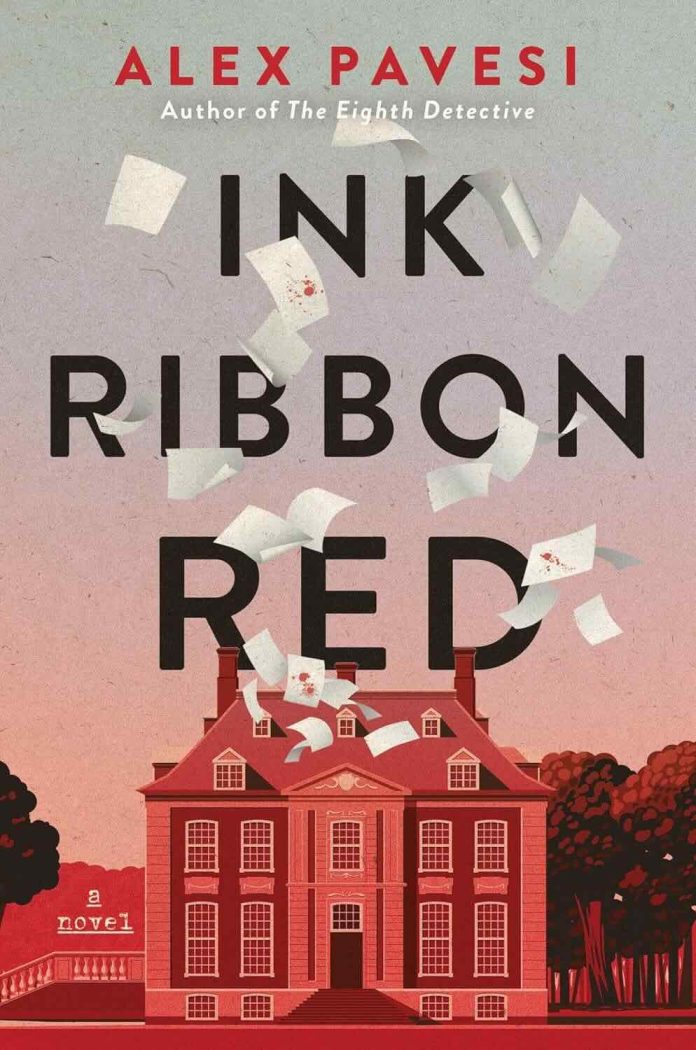
Alex Pavesi returns with Ink Ribbon Red, a sophisticated psychological thriller that transforms a seemingly innocent parlour game into a weapon of mass destruction—targeting friendships, secrets, and ultimately, lives. Following his acclaimed debut Eight Detectives, Pavesi once again demonstrates his mastery of meta-fictional storytelling, though this sophomore effort reveals both the strengths and limitations of his intricate narrative approach.
The premise is deceptively simple: Anatol, a towering thirty-year-old antiques dealer, invites his five closest university friends to his crumbling Wiltshire estate for a birthday weekend. What begins as a familiar gathering of old friends quickly transforms into something far more sinister when Anatol introduces his invention—a game called “Motive Method Death.” Each participant draws names from cocktail glasses and must write a murder story featuring their chosen killer and victim. Points are awarded for realism, but as the friends delve into their fictional murders, they unwittingly expose real secrets, affairs, and grudges that have been festering beneath the surface of their decade-long friendships.
The Mechanics of Psychological Warfare
Pavesi’s greatest strength lies in his understanding of how intimate knowledge can become a weapon. The author skillfully demonstrates how the simple act of writing fiction can strip away the protective layers of social politeness and expose the raw nerves of human relationships. When Marcin writes about insider trading accusations, when Phoebe crafts a tale of adultery, or when Maya explores themes of exploitation, they’re not just creating stories—they’re revealing truths that should have remained buried.
The structure of the novel mirrors its central conceit, with stories-within-stories creating a labyrinthine narrative that keeps readers constantly questioning what’s real and what’s fiction. This technique, reminiscent of Agatha Christie’s more experimental works, serves both as the book’s greatest asset and its most significant weakness. While the meta-fictional elements create genuine intrigue and showcase Pavesi’s technical prowess, they sometimes feel more like intellectual exercises than organic storytelling.
Character Dynamics and Social Commentary
The six friends represent familiar archetypes of British middle-class anxiety, each carrying the weight of unfulfilled expectations and compromised principles. Anatol emerges as a fascinating antagonist—not quite villain, not quite victim—whose grief over his father’s death has twisted into something manipulative and dangerous. His blackmail scheme, disguised as a birthday game, reveals a character who has learned to weaponize intimacy itself.
Janika, the philosophy professor recently returned from Australia, serves as both the story’s detective figure and its moral compass. Her outsider perspective, having missed the initial game, allows her to piece together the true nature of Anatol’s manipulation. However, her character sometimes feels more like a plot device than a fully realized person, existing primarily to explain the intricate web of deception to both the other characters and the readers.
The supporting cast—Dean the civil engineer harboring marital secrets, Phoebe the teacher trapped in London ennui, Maya the artist with a dark past, and Marcin the finance professional with criminal secrets—each bring their own baggage to the weekend. Pavesi captures the particular anxiety of thirty-something friendships, where shared history becomes both comfort and burden.
Technical Craftsmanship and Narrative Complexity
Pavesi’s prose style deserves particular recognition for its precision and controlled elegance. His sentences have a crystalline quality that serves the story’s themes of surface appearances concealing darker truths. The author demonstrates remarkable skill in shifting between different narrative voices, particularly in the embedded murder stories that each character writes. Each fictional tale bears the distinct voice and concerns of its supposed author, creating a convincing illusion of multiple writers.
However, this technical virtuosity sometimes comes at the expense of emotional resonance. The novel’s complex structure, while intellectually satisfying, can create distance between readers and characters. The constant shifting between reality and fiction, while thematically appropriate, occasionally feels like showing off rather than serving the story’s deeper purposes.
Themes of Truth, Fiction, and Moral Compromise
At its core, Ink Ribbon Red explores how well we truly know the people closest to us, and how the stories we tell—both to ourselves and others—can become instruments of revelation and destruction. The book examines the thin line between creative expression and confession, suggesting that fiction might be the most honest form of communication available to us.
The novel also serves as a meditation on moral compromise in modern life. Each character has made choices that have led them away from their idealized selves, and the weekend becomes a reckoning with these accumulated compromises. Pavesi suggests that our secrets don’t just hide our shame—they become the very foundation upon which our relationships are built.
Where the Game Goes Wrong
Despite its clever premise and elegant execution, Ink Ribbon Red suffers from several significant flaws. The pacing becomes uneven in the middle sections, where the complexity of the nested narratives sometimes overwhelms the forward momentum of the story. The revelation of Anatol’s blackmail scheme, while intellectually satisfying, lacks the emotional punch that such a betrayal should carry.
More problematically, the novel’s climax feels both inevitable and unsatisfying. The sudden shift from psychological manipulation to actual violence seems to break the carefully established rules of the story’s world. The deaths that occur feel more like necessary plot mechanics than organic consequences of the characters’ actions and choices.
Literary Connections and Comparative Context
Pavesi’s work fits naturally alongside contemporary psychological thrillers that blur the lines between reality and fiction. Readers who appreciated the narrative complexity of Eight Detectives will find familiar pleasures here, though the emotional stakes feel somewhat lower. The book shares DNA with Ruth Ware’s isolated-location thrillers and the psychological complexity of Tana French’s novels, though it lacks the former’s visceral tension and the latter’s profound character development.
The novel’s exploration of friendship dynamics under pressure recalls The Secret History by Donna Tartt, though Pavesi’s characters lack the magnetic charisma of Tartt’s creation. Similarly, the book’s examination of how well we know our closest friends echoes themes found in Big Little Lies by Liane Moriarty, but without that novel’s sharp social observation and dark humor.
Final Verdict: A Worthy but Flawed Follow-up
Ink Ribbon Red confirms Alex Pavesi as a writer of considerable technical skill and intellectual ambition. His ability to construct complex, nested narratives while maintaining clarity and purpose is genuinely impressive. The book succeeds brilliantly as an exploration of how fiction and reality intersect, and how the stories we tell can become more dangerous than any weapon.
However, the novel’s emphasis on structural cleverness sometimes comes at the expense of emotional authenticity. While readers will admire Pavesi’s craftsmanship and puzzle-solving skills, they may find themselves somewhat distant from the characters and their fates. The book works better as an intellectual exercise than as an emotional journey, which places it firmly in the tradition of British puzzle mysteries rather than psychological thrillers.
For readers who enjoyed the meta-fictional elements of Eight Detectives, Ink Ribbon Red offers similar pleasures with a more streamlined approach. Those seeking a straightforward thriller may find the book’s complexity more frustrating than rewarding, but readers who appreciate literary games and narrative experimentation will find much to admire in Pavesi’s carefully constructed house of mirrors.
Similar Books You Might Enjoy
- The Thursday Murder Club by Richard Osman
- The Seven Husbands of Evelyn Hugo by Taylor Jenkins Reid
- Gone Girl by Gillian Flynn
- The Silent Patient by Alex Michaelides
- In the Woods by Tana French







