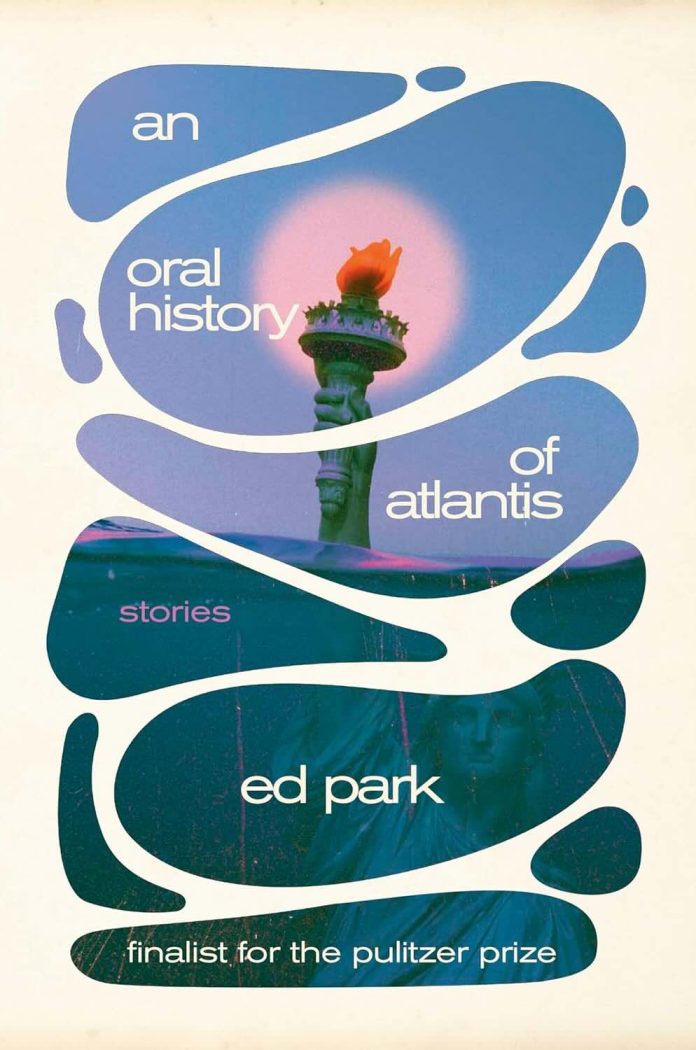
Ed Park’s latest collection, An Oral History of Atlantis, arrives as a testament to the author’s evolving mastery of the short story form. Following his acclaimed novels Personal Days and the Pulitzer Prize-finalist Same Bed Different Dreams, Park returns to shorter fiction with sixteen stories that feel both deeply personal and universally resonant. This collection doesn’t simply tell stories—it constructs entire worlds where the mundane and the surreal dance together in perfect, unsettling harmony.
The book’s title story, positioned strategically at the end, serves as both culmination and key to understanding Park’s broader project. Narrated by a diminutive lighthouse keeper who has “seen things I never wished to see,” it presents a Manhattan slowly sliding into the sea while its narrator obsesses over whale pornography and the mysterious writer Walter Walter. It’s quintessentially Park: deeply strange yet emotionally grounded, combining elements of speculative fiction with razor-sharp observations about urban alienation and human longing.
The Architecture of Memory and Identity
What distinguishes An Oral History of Atlantis from other contemporary short story collections is Park’s sophisticated exploration of how we construct and reconstruct our identities through fragments—passwords, movie roles, translation errors, and half-remembered conversations. In “Slide to Unlock,” perhaps the collection’s most harrowing piece, a man cycles through his digital passwords while being robbed at gunpoint, each combination revealing layers of his emotional history: his daughter’s name backward, his hometown plus birth year, the girl at work he can’t stop thinking about. The story transforms a moment of terror into an archaeology of the self, demonstrating Park’s ability to find profound humanity in the most unlikely circumstances.
“Machine City” operates as a meditation on performance and authenticity, following a college student whose role in a friend’s experimental film begins to blur the boundaries between his character and his actual self. Set in an underground lounge that serves as a “holdover from a ’70s dystopian flick,” the story captures the particular anxiety of young adulthood—that sense that we’re always performing versions of ourselves without knowing which one is real. Park’s depiction of Yale in the early internet age feels both nostalgic and prescient, highlighting how our relationship with technology was already beginning to complicate our sense of authentic experience.
Technical Mastery and Narrative Innovation
Park demonstrates remarkable range across these sixteen pieces, shifting effortlessly between different narrative modes and temporal structures. “Weird Menace” unfolds as a commentary track for a forgotten science fiction film, allowing two aging actors to reflect on lost love and career disappointments while ostensibly discussing their B-movie past. The format shouldn’t work—it’s gimmicky on paper—but Park uses it to create genuine pathos, as the characters’ real lives gradually eclipse their fictional personas.
“A Note to My Translator” opens the collection with a brilliant pastiche of literary correspondence, as a frustrated French author berates his English translator for increasingly bizarre misinterpretations of his novel. What begins as comedy evolves into something more unsettling, as the line between intentional sabotage and creative interpretation becomes impossible to discern. It’s vintage Park: playful yet pointed, using humor to examine serious questions about artistic integrity and cross-cultural communication.
The collection’s emotional centerpiece may be “Seven Women,” a nested narrative structure that follows various interconnected characters across different time periods and locations. Park weaves together stories of editors, musicians, guidance counselors, and food critics with the kind of intricate plotting that recalls Jennifer Egan’s A Visit from the Goon Squad, though Park’s approach feels more organically connected to each character’s psychological reality.
Themes of Displacement and Connection
Throughout An Oral History of Atlantis, Park returns obsessively to themes of displacement—both geographic and existential. Many of his characters are immigrants, expatriates, or simply people who feel unmoored from their own lives. In “The Air as Air,” a veteran struggling with PTSD works at a Captain Clark’s while practicing breathing techniques from a quasi-mystical text called The First and Deepest Breath. The story manages to address serious issues of trauma and recovery without sentimentality, finding hope in unexpected places.
“Thought and Memory” follows a writer on a book tour who becomes obsessed with a woman named Mercy Pang and two talking crows. The story captures the surreal loneliness of promotional tours while weaving in elements of Norse mythology (Thought and Memory are Odin’s ravens) and contemporary anxieties about authenticity and connection. Like much of Park’s work, it operates on multiple levels simultaneously—realistic social observation, mythic resonance, and pure linguistic pleasure.
Minor Criticisms and Occasional Missteps
While An Oral History of Atlantis represents Park at his most confident and assured, not every story achieves the same level of success. “The Gift” and “Watch Your Step,” while competently written, feel slightly mechanical compared to the collection’s strongest pieces. Both rely heavily on plot machinations that don’t quite support the emotional weight Park seems to be aiming for. The spy story elements in “Watch Your Step” particularly feel borrowed from another writer’s toolkit rather than emerging organically from Park’s own sensibility.
Additionally, some readers may find Park’s tendency toward elaborate narrative conceits occasionally exhausting. Stories like “Well-Moistened with Cheap Wine, the Sailor and the Wayfarer Sing of Their Absent Sweethearts”—which imagines seventeen women all named Tina working on an archaeological dig—require significant investment from readers before their emotional payoffs become clear. Park’s intelligence is never in doubt, but sometimes his cleverness threatens to overshadow his compassion.
A Distinctive Voice in Contemporary Fiction
What ultimately makes An Oral History of Atlantis so compelling is Park’s distinctive voice—simultaneously cerebral and heartfelt, postmodern yet deeply humanistic. His characters struggle with recognizably contemporary problems—digital overwhelm, professional disappointment, romantic confusion—but they do so within frameworks that feel freshly imagined. Park has developed into one of our most sophisticated chroniclers of how we live now, particularly how technology mediates our relationships with memory, identity, and each other.
The collection succeeds because Park never allows his formal innovations to become mere intellectual exercises. Even his most experimental pieces remain grounded in genuine human emotion. When the narrator of “Two Laptops” watches his ex-wife through a computer screen, or when the food critic in “Seven Women” realizes she’s reached the end of her paragraph-writing project, these moments feel earned rather than imposed.
Recommendations for Similar Readers
Readers who appreciate An Oral History of Atlantis might also enjoy George Saunders’ CivilWarLand in Bad Decline for its similar blend of humor and pathos, or Jenny Offill’s Dept. of Speculation for its fragmented approach to narrative and domestic life. Karen Russell’s Vampires in the Lemon Grove shares Park’s interest in combining realistic psychological observation with surreal premises, while Jess Walter’s We Live in Water demonstrates comparable skill at finding profound meaning in seemingly ordinary circumstances.
Final Assessment
An Oral History of Atlantis confirms Ed Park’s position as one of the most inventive and emotionally intelligent short story writers working today. While occasionally uneven, the collection’s best pieces rank among the finest contemporary American fiction—stories that manage to be simultaneously innovative and accessible, intellectually rigorous and emotionally generous. Park has created a work that feels distinctly of our moment while remaining timeless in its exploration of human connection and meaning-making.
This is essential reading for anyone interested in how contemporary fiction can address the complexities of modern life without sacrificing either formal innovation or emotional truth. Park has given us a collection that functions both as entertainment and as a kind of anthropological study of how we live, love, and lose ourselves in the twenty-first century.







