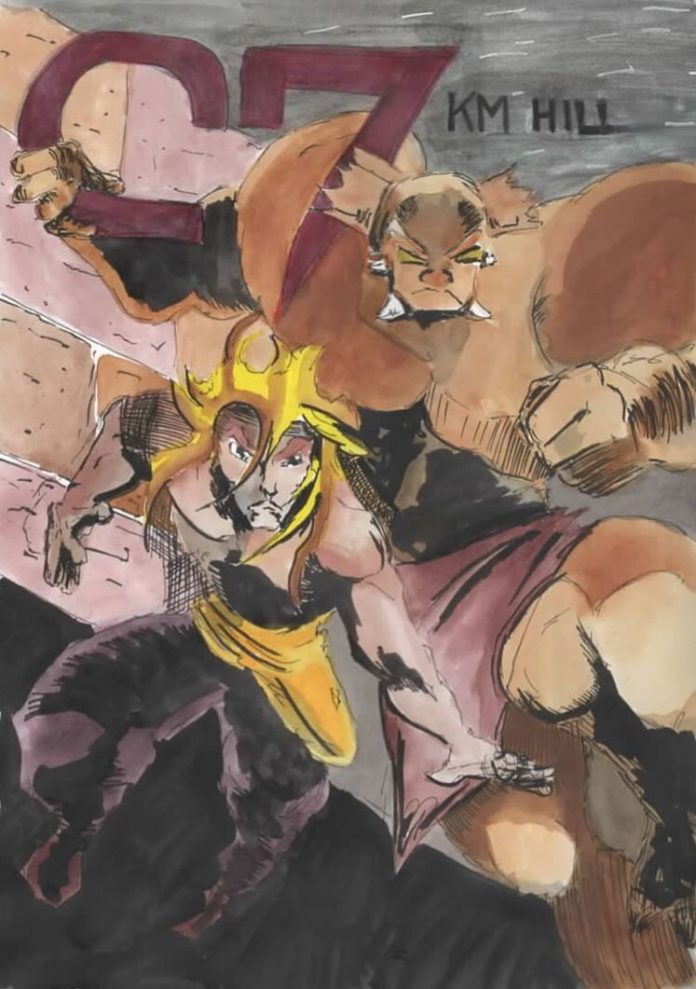
Some books are written. This one feels excavated — dredged up from the seabed of an alien ocean, dripping in watercolor and salt. The C7: Tales of GISOD by KM Hill opens with its young hero being fired into the sea like unwanted cargo, and from that first splash, the story never stops moving. What follows is a dark science-fantasy odyssey across a planet that seems to actively resent the people living on it, told through hand-painted pages that look less like a comic and more like a recovered artifact from another world.
The World: Xen Quisha, a Planet with Teeth
Rot as a Setting, Not a Metaphor
The blurb promises rot, and the book delivers it — but here’s the surprising part: KM Hill makes decay feel alive. Xen Quisha isn’t a backdrop; it’s an antagonist with geography. Under the reign of the Dark Lord Tansluc, the cities have turned hostile, the wilderness crawls with beasts, and criminals have carved private kingdoms out of the wreckage. Hill calls this aesthetic Fantasy Techno-Primal, and the label fits beautifully. Scrapped technology rusts beside tribal weaponry. Ice worms tunnel where machines once ran. Pirates work the coastlines like the ocean owes them money.
What impressed me most is that the world-building never arrives as a lecture. It seeps in — one painted vista, one wary stranger, one strange creature at a time. You learn Xen Quisha the way Gimesh does: by surviving it.
The Hero: Gimesh, the Boy the Sea Spat Out
Gimesh is not a chosen one. He’s a discarded one — booted from a pirate ship, hunted before he understands why, and searching for something as simple and enormous as a place to belong. That’s the quiet engine of this story. Beneath the monster fights and bounty hunters, The C7: Tales of GISOD by KM Hill is about homelessness in the truest sense: a young soul looking for ground that won’t reject him.
His growth across the book is earned rather than granted. He scraps, improvises, fails, and gets back up. There’s a scrappy, He-Man-era earnestness to him that never tips into naivety, and Hill wisely lets Gimesh’s humor — the “yeah, it’s a pile of trash, but it’s my pile of trash” attitude — carry the darker stretches.
The Bond: A Giant Called a Vythor
The heart of the book beats loudest when Gimesh meets a towering Vythor — a horned survivor as visually monstrous as anything hunting them. Their alliance begins in necessity and settles into genuine kinship, and Hill draws the parallel with a light hand: two beings who look nothing alike, both orphaned by the same broken world, both hunting the same thing — home. Their battles side by side are thrilling, but it’s the quieter beats between fights that give the story its warmth. In a book full of claws and cold, this friendship is the campfire.
The Shadow: Dark Lord Tansluc
Every heroic fantasy lives or dies by its villain, and Tansluc is a compelling piece of menace. He does his best work from a distance — dispatching bounty hunters and shapeshifters, seeding obstacles in Gimesh’s path before the boy even understands he’s being hunted. That indirectness is a smart choice. The mystery of why a Dark Lord fears a shipwrecked nobody becomes the story’s pulling thread, and I won’t tug on it here. Discovering the answer is your job, reader.
The Craft: Painted Pages and Sentence Storytelling
Why the Format Works
This is where The C7: Tales of GISOD by KM Hill truly separates itself from the shelf. Instead of conventional panel grids and dialogue balloons, Hill leans into what he calls sentence storytelling — full painted illustrations paired with flowing prose narration. The effect sits somewhere between a graphic novel, an illustrated storybook, and an ancient saga being recited aloud. The watercolor and ink work is textured, moody, and unmistakably handmade; you can practically feel the brush drag across the sea spray and the torchlight.
A few craft elements deserve particular praise:
- The color language. Cold blues and sickly greens dominate the wilds, while warmth is rationed out sparingly — so when it appears, it means something.
- The creature design. Ice worms, shapeshifters, sea beasts — each one looks grown from the planet rather than pasted onto it.
- The pacing. The prose-and-painting format creates a read-aloud rhythm, making chapters feel like tales told around a fire.
- The restraint. Hill trusts his images. When a painting can carry the moment, the text steps back and lets it.
Who This Book Is For
As Book 1 and KM Hill’s debut entry into the GISOD saga, this volume is an origin story in every sense — of a hero, a fellowship, and a series. It will land hardest with:
- Readers who grew up on the original He-Man and mourn that flavor of mythic, toy-box-epic adventure
- Fans of Usagi Yojimbo‘s wandering-warrior storytelling and episodic quest structure
- Art lovers drawn to hand-painted, traditional-media comics in an age of digital gloss
- Anyone who loves found-family stories where the family has horns
If You Loved This, Read These Next
Readers who finish The C7: Tales of GISOD by KM Hill hungry for more painted worlds and primal adventure should try:
- Bone by Jeff Smith — small hero, vast mythic stakes, perfect blend of humor and dread
- Usagi Yojimbo by Stan Sakai — the gold standard of the wandering-warrior graphic saga
- Kamandi: The Last Boy on Earth by Jack Kirby — a lone boy versus a savage, transformed world
- Amulet by Kazu Kibuishi — lush art, dark forces, and a young hero finding their footing
- Battling Boy by Paul Pope — kinetic, mythic, monster-crowded heroism
Final Verdict: A Debut That Earns Its Saga
The C7: Tales of GISOD by KM Hill is that rare small-press gem that swings for mythology and connects. It’s a fast, immersive read with genuine visual soul — a story about a discarded boy, a monstrous friend, and a rotting planet that might still be worth saving. The Dark Lord looms, the fellowship is only beginning to form, and Book 1 closes with the unmistakable feeling that the tale of GISOD is just clearing its throat.
If you want heroic fantasy that feels hand-forged rather than factory-made, put this one on your shelf — preferably where the light can catch those painted pages.