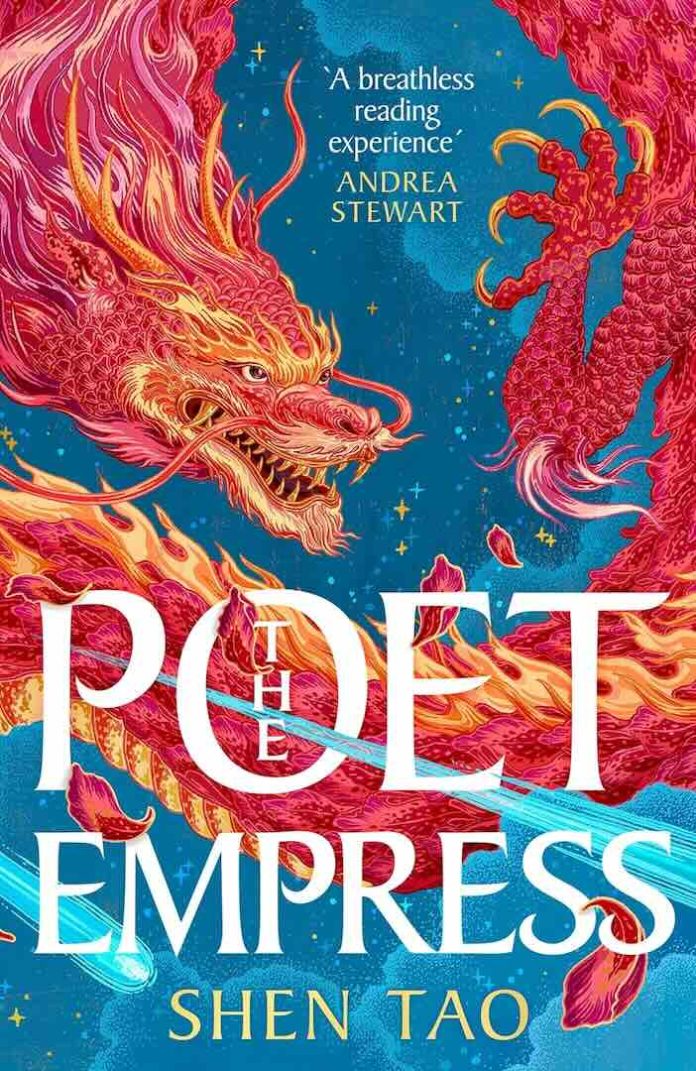
In a world where poetry wields the power to reshape reality and dynasties balance on the edge of blades, Shen Tao’s debut novel delivers a harrowing tale of survival, forbidden knowledge, and the transformative power of literacy. The Poet Empress by Shen Tao introduces readers to Wei Yin, a desperate village girl thrust into the deadly political machinations of the Azalea House, where being chosen as a prince’s concubine might be a death sentence disguised as an honor.
A Heroine Forged in Desperation
Wei Yin’s journey begins not with ambition but with grief. After burying her fifth sibling while her village starves under the weight of an empire-wide famine, she makes a choice that will alter the course of her life: she offers herself to the concubine selection for Prince Terren, the cruel heir known as the Winter Dragon. What follows is not a fairy tale but a brutal education in palace politics, where every smile conceals a dagger and survival requires becoming as dangerous as those who would destroy you.
Tao crafts Wei with remarkable complexity. She is neither a flawless heroine nor a passive victim. Instead, we watch her transform from a frightened village girl who cannot read into a cunning player capable of navigating the treacherous waters of the Inner Court. Her determination to learn literacy—forbidden to women in this world—drives the narrative forward with compelling urgency. Each stolen lesson, each secret scroll, represents not just personal growth but an act of quiet rebellion against a system designed to keep women powerless.
The author excels at showing Wei’s internal struggle between maintaining her moral compass and doing whatever necessary to survive. She makes choices that are sometimes uncomfortable, sometimes questionable, but always understandable given her circumstances. This moral ambiguity elevates the story beyond simple good-versus-evil dynamics into something far more nuanced and truthful.
The World of Literomancy and Palace Intrigue
The Poet Empress by Shen Tao constructs an intricate fantasy world inspired by imperial China, where poetry magic—literomancy—shapes the fate of nations. The magic system is elegantly conceived: poems written with sufficient truth and emotion can become spells, or Blessings, that manifest into reality. Only men who attend school are permitted to practice this art, creating a gendered power structure that feels both fantastical and uncomfortably familiar.
The Azalea House itself becomes a character in its own right, with its eight palaces, six hundred pavilions, and two hundred forty gardens. Tao populates this setting with ghost animals whose fur glows in moonlight, knives hanging from ceilings like crystal chandeliers, and a dragon Crown that must be tamed before an emperor can ascend the throne. These vivid details immerse readers in a world that feels simultaneously wondrous and menacing.
The political landscape proves equally complex, with multiple princes vying for succession, each possessing a unique magical seal that will be amplified a thousandfold if they claim the Crown. The stakes are appropriately epic: will the future be ruled by trade routes, military might, or the ability to end the famine? This framework provides excellent tension throughout the narrative.
Strengths That Shine Like Poetry
The novel’s greatest achievement lies in its treatment of literacy as power. Watching Wei secretly learn to read, painstakingly copying characters by candlelight, creates genuine suspense. Every lesson carries the weight of execution should she be discovered. Tao understands that knowledge is revolutionary, especially for those systematically denied access to it. The scenes where Wei first reads books from the palace archives crackle with the electricity of discovery:
- Her initial struggle with not just characters but concepts—tariff, vassal state, vanguard—that her village upbringing never exposed her to
- The transformative realization that written stories can transport someone beyond their immediate circumstances
- The growing confidence as she moves from student to potential literomancer, crafting her own “heart-spirit poem”
The prose itself occasionally rises to genuine poetry, particularly in chapter titles and Wei’s observations about the natural world. Tao demonstrates facility with language that makes the focus on words and writing feel organic rather than imposed. The attention to sensory detail—the smell of ink and burned incense, the texture of silk against skin, the taste of bitter chrysanthemum tea—grounds the fantasy in physical reality.
Supporting characters add considerable depth. Song Silian, wife to the Crown Prince, becomes Wei’s unlikely mentor in palace survival, teaching her the “concubine’s weapon”—the art of making powerful men believe you pose no threat. The eunuch Yong Hesin, bound by oath to serve whoever holds the Mandate of Heaven, provides fascinating moral complexity. Even Prince Terren, the primary antagonist, receives sufficient backstory and psychological complexity to become a tragic figure rather than a simple villain.
Where the Foundation Shows Cracks
Despite its considerable strengths, The Poet Empress by Shen Tao occasionally stumbles under the weight of its ambitious scope. The pacing proves uneven, particularly in the middle section where palace politics sometimes overshadow character development. Readers may find themselves wishing for fewer court intrigue scenes and more intimate moments exploring Wei’s internal transformation.
The romance elements, while central to the plot, present challenges. Wei’s relationship with Terren necessarily develops under duress—he regularly tortures her, creating a deeply uncomfortable power dynamic that the narrative acknowledges but cannot fully resolve. While Tao handles this with more sensitivity than many similar stories, readers sensitive to depictions of intimate partner violence should approach carefully. The book includes a content warning at the beginning for good reason.
Some plot developments feel telegraphed rather than surprising. Astute readers will likely anticipate certain betrayals and revelations well before Wei does. Additionally, the political maneuvering, while intricate, sometimes becomes difficult to track with multiple princes, factions, and shifting alliances competing for attention.
The ending, though emotionally satisfying in many ways, rushes through resolutions that deserved more time. Wei’s negotiations regarding women’s literacy rights in the palace epilogue feel both triumphant and somewhat abrupt. The transformation from “women cannot read” to “women may practice literomancy” represents a seismic cultural shift that the narrative handles in just a few pages.
Final Thoughts on a Debut That Demands Attention
The Poet Empress by Shen Tao announces the arrival of a talented voice in fantasy literature. Despite its flaws—uneven pacing, occasionally predictable plotting, and an ending that could have used more breathing room—the novel succeeds in its most important ambitions. It tells a compelling story about survival and resistance, about finding power in words when physical strength fails, about the revolutionary potential of education.
Tao’s prose demonstrates genuine care for language and image-making. Her world-building, while drawing on familiar elements of Chinese-inspired fantasy, feels fresh through its focus on poetry magic and the specific constraints faced by women in this society. Most importantly, Wei Yin emerges as a memorable protagonist whose journey from terrified village girl to cunning court operator to advocate for change feels earned rather than convenient.
This debut will particularly resonate with readers who appreciate dark fantasy that doesn’t flinch from depicting violence and abuse, but who also want to see protagonists fight back using intelligence and determination rather than just magical power. It’s a book about the cost of survival and the choices we make when every option comes with blood on it.
If You Loved This, Try These
For readers captivated by The Poet Empress by Shen Tao, consider these similar titles:
- She Who Became the Sun by Shelley Parker-Chan – Another Chinese-inspired fantasy featuring a protagonist who defies gender expectations to claim power
- The Priory of the Orange Tree by Samantha Shannon – Epic fantasy with complex female characters navigating political intrigue and dragon lore
- The Poppy War by R.F. Kuang – Dark fantasy set in a world inspired by Chinese history, featuring a protagonist from humble origins
- The Song of Achilles by Madeline Miller – For those drawn to the lyrical prose and mythological reimagining
- Daughter of the Moon Goddess by Sue Lynn Tan – Chinese mythology-inspired fantasy with poetry magic and palace intrigue







 reshapes reality, and a village girl)