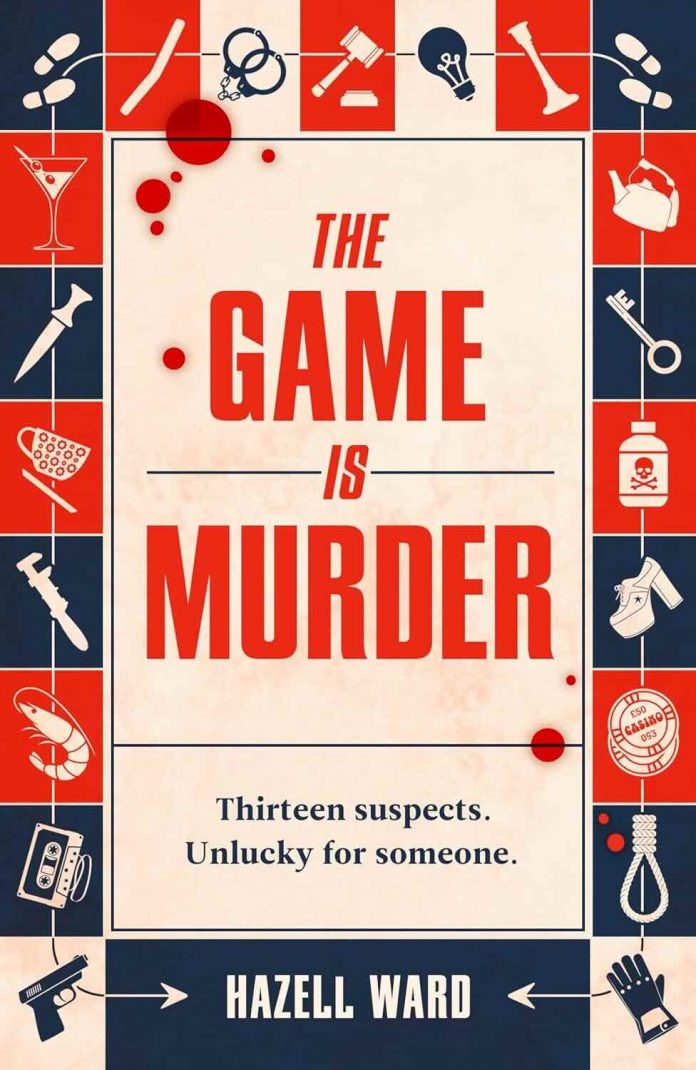
Hazell Ward’s debut novel, “The Game Is Murder,” is the literary equivalent of a magician revealing their tricks while simultaneously pulling off the most audacious illusion you’ve ever witnessed. This isn’t just a murder mystery—it’s a brazen deconstruction of the entire genre that somehow manages to honor and demolish its conventions in equal measure.
The Crime Scene: A Georgian House of Mirrors
The story begins with what appears to be a straightforward premise: you, the reader, are invited to play the Great Detective at a murder mystery party investigating the 1974 case of Sally Gardner’s brutal killing in the basement of 8 Broad Way, London. Lord John Verreman stands accused of murdering his estranged wife’s nanny, and all evidence points to his guilt. Simple enough, until Ward starts pulling the rug out from under every assumption you’ve ever made about reading a mystery novel.
What makes Ward’s approach so unsettling is how she weaponizes reader expectations. The novel’s structure, with its three acts and chapters titled after classic mystery novels, initially suggests a cozy homage to the Golden Age of detective fiction. But Ward has far more subversive intentions. She transforms the reader from passive observer to active participant, then strips away that agency with surgical precision, revealing the contract between author and reader as something far more sinister than we ever imagined.
The Great Detective: Maximillian Enygma and His Unraveling
Ward’s protagonist, Maximillian Enygma, emerges as one of the most compelling anti-heroes in recent mystery fiction. A washed-up private detective struggling with addiction and mental health issues, Enygma embodies the damaged genius archetype while simultaneously critiquing it. His investigation of the Verreman case becomes both a quest for professional redemption and a descent into a metafictional nightmare where the rules of detective fiction become literal constraints.
Enygma’s character development brilliantly mirrors the novel’s thematic concerns. As he delves deeper into the case, citing classic mystery novels with the fervor of a literature professor, we watch him realize he’s trapped in a story with rules he cannot break. His dependency on medication becomes a metaphor for reader dependency on genre conventions, while his increasingly desperate attempts to solve the case reflect our own need for narrative closure.
A Murder Most Meta: Breaking the Fourth Wall with a Lead Pipe
The central murder—Sally Gardner’s death in Lady Verreman’s basement—serves as both genuine mystery and elaborate metaphor. Ward presents us with all the classic elements: the locked room, the suspicious husband, the lead pipe wrapped in elastoplast, and a cast of witnesses with secrets to hide. But the real crime isn’t Gardner’s murder; it’s what Ward does to the reader.
The author’s masterstroke lies in how she gradually reveals the artificial nature of the dinner party setting. The thirteen guests, all named after famous mystery writers and their characters, aren’t just witnesses—they’re literary archetypes forced to play their roles in an endless loop of detection and revelation. When Enygma finally deduces that jury foreman Raymond Postgate is the real killer, it’s less a solution than an indictment of how mystery fiction manipulates both characters and readers.
The Verdict: Guilty of Literary Innovation, Sentenced to Mixed Reception
Ward’s ambitious experiment succeeds brilliantly in several key areas while stumbling in others, which explains its polarizing reception. The novel’s greatest strength lies in its intellectual audacity. By making the reader complicit in the storytelling process, Ward creates a genuinely unsettling experience that lingers long after the final page. Her encyclopedic knowledge of mystery fiction transforms what could have been a shallow pastiche into a genuine love letter to the genre, even as she systematically dismantles it.
The book’s literary devices work particularly well:
- The contract appendices create genuine unease about the reader’s role
- Chapter titles referencing classic mysteries serve as both homage and trap
- The shift from second to third person emphasizes the loss of reader agency
- The nested narrative structure mirrors the Russian doll nature of mystery fiction itself
However, Ward’s experiment occasionally prioritizes concept over execution. The middle section, where Enygma presents evidence during the courtroom scenes, becomes repetitive and overly didactic. While the author’s point about the arbitrary nature of mystery evidence is well-taken, the delivery sometimes feels more like academic thesis than engaging fiction.
The Author’s Gambit: Risk vs. Reward in Genre Fiction
As a debut novelist, Ward demonstrates remarkable confidence in tackling such an ambitious project. Her background as an adult education teacher and current PhD candidate shines through in the novel’s careful construction and deep literary knowledge. Having won the CWA Short Story Dagger in 2023 for “Cast a Long Shadow,” Ward clearly understands the mystery genre from both writer and reader perspectives.
The novel’s self-aware humor prevents it from becoming entirely pretentious. Ward’s narrator frequently breaks character to comment on the absurdity of the situation, and Enygma’s exaggerated Belgian accent (deliberately terrible) provides comic relief while simultaneously mocking Hercule Poirot’s mannerisms. These moments of levity keep the experimental elements from overwhelming the story.
The Evidence Doesn’t Lie: Technical Achievement and Literary Merit
Ward’s prose style adapts cleverly to serve her metafictional purposes. The writing deliberately shifts between styles—sometimes mimicking Golden Age formality, other times adopting noir grittiness, and occasionally breaking into direct authorial commentary. This stylistic flexibility demonstrates Ward’s technical skill while serving the novel’s thematic exploration of genre boundaries.
The mystery itself, when stripped of its metafictional elements, proves surprisingly solid. The Sally Gardner murder has genuine stakes, believable motives, and a solution that plays fair with the reader. Ward hasn’t sacrificed mystery craft for literary experiment; instead, she’s enhanced both by interweaving them so thoroughly.
Similar Cases Worth Investigating
Readers drawn to Ward’s genre-bending approach in “The Game Is Murder” might appreciate:
- “The Seven Deaths of Evelyn Hardcastle” by Stuart Turton – Another innovative take on classic mystery structure
- “The Thursday Murder Club” by Richard Osman – For its self-aware humor about mystery conventions
- “The Sweetness at the Bottom of the Pie” by Alan Bradley – Combines classic detection with modern sensibility
- “In the Woods” by Tana French – Blends literary fiction with mystery elements
- “The Name of the Rose” by Umberto Eco – Academic mystery with metafictional elements
Final Judgment: A Flawed but Fascinating Debut
“The Game Is Murder” succeeds as both homage to and critique of classic mystery fiction, though its experimental nature will inevitably divide readers. Those seeking a straightforward whodunit will find themselves frustrated by Ward’s deliberate subversion of expectations. However, readers willing to engage with the novel’s intellectual challenges will discover a genuinely innovative work that expands the possibilities of mystery fiction.
Ward has created something genuinely unique: a mystery novel that questions the very nature of mystery novels while delivering a satisfying solution to its central crime. The book’s flaws—occasional pretentiousness, uneven pacing in the middle section, and perhaps too much self-referential cleverness—are outweighed by its originality and ambition.
“The Game Is Murder” is a debut that announces a significant new voice in crime fiction, one unafraid to challenge both writer and reader expectations. While not every experiment succeeds, Ward’s willingness to risk failure in pursuit of innovation marks her as an author worth watching. “The Game Is Murder” may not be a perfect mystery, but it’s an essential one for anyone interested in where the genre might go next.
For mystery lovers seeking something genuinely different, Ward has crafted a puzzle box within a puzzle box, where solving the crime is only the beginning of understanding what game you’ve actually been playing all along. Fair warning: you may never read a mystery novel the same way again.







