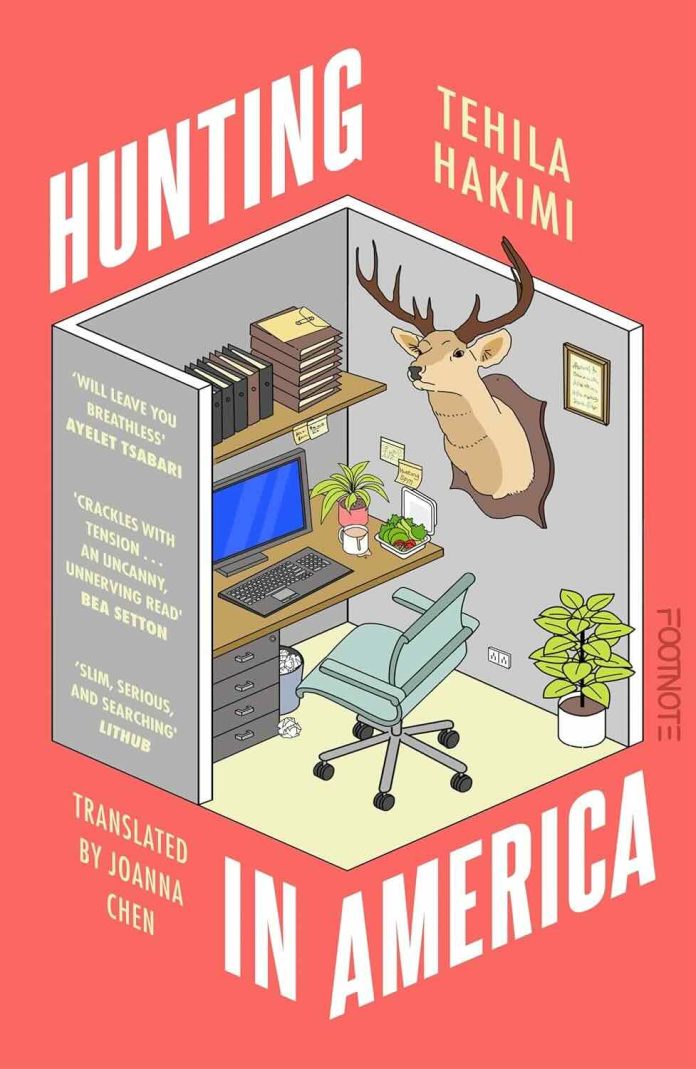
Tehila Hakimi’s debut novel “Hunting in America” emerges like a carefully aimed bullet—precise, devastating, and impossible to forget once it hits its mark. Translated with remarkable skill by Joanna Chen from the original Hebrew, this psychological thriller follows an unnamed Israeli woman who relocates to America for work and discovers an unsettling aptitude for hunting. What begins as corporate team-building evolves into something far darker, as Hakimi weaves a narrative that interrogates the violence inherent in displacement, assimilation, and human nature itself.
The novel’s structure mirrors the hunting seasons it chronicles, divided into sections that follow the protagonist’s deepening immersion into American gun culture. Through her poet’s sensibility—Hakimi is an award-winning poet and recipient of Israel’s National Library’s Pardes Scholarship—she transforms the act of hunting into a meditation on power, survival, and the thin veneer of civilization that separates predator from prey.
Anatomy of Isolation: Character Development in a Foreign Land
Hakimi’s unnamed protagonist serves as a masterfully crafted unreliable narrator whose emotional numbness gradually reveals itself as both symptom and survival mechanism. Her decision to abandon her Israeli identity entirely—refusing Hebrew phone calls, avoiding Israeli colleagues, and eventually planning never to return—speaks to a profound disconnection that predates her American relocation. The character’s systematic erasure of her past creates a void that hunting temporarily fills, offering structure and purpose in an otherwise directionless existence.
The supporting cast, particularly David, her hunting mentor and eventual lover, functions less as fully realized individuals than as projections of the protagonist’s fractured psyche. David’s own tragic history—the accidental shooting death of his son Tom—creates a parallel narrative of guilt and self-destruction that mirrors the protagonist’s journey. Miriam, David’s wife, appears and disappears like a ghost throughout the narrative, her seasonal absences reflecting the cyclical nature of grief and avoidance that defines both marriages in the story.
The Corporate Wilderness: Workplace Dynamics and Power Structures
Hakimi demonstrates particular insight into the subtle violence of corporate culture, drawing parallels between office hierarchies and hunting dynamics. The protagonist’s struggles with American business communication—learning to soften her direct Israeli style, mastering the art of performative pleasantries—reveal how cultural assimilation requires a fundamental restructuring of one’s voice and identity.
The looming threat of job termination creates a constant undercurrent of anxiety that drives much of the plot’s tension. When the company attempts to eliminate her position, the protagonist’s consideration of fake pregnancy as a legal shield demonstrates the desperate calculations that displacement can inspire. These workplace scenes are among Hakimi’s strongest, revealing her understanding of how institutional power operates and how individuals navigate systems designed to exclude them.
Seasonal Rhythms: Structure and Symbolism
The novel’s organization around hunting seasons provides both literal structure and metaphorical framework. Each hunting expedition marks a stage in the protagonist’s psychological deterioration, from her first missed shot to her final, ambiguous confrontation with David. Hakimi uses the changing seasons to reflect internal transformations, with winter’s isolation giving way to spring’s false promise of renewal.
The recurring motif of ammunition counting—cartridges carefully tracked and collected—serves as a metaphor for accountability and evidence. The protagonist’s obsessive attention to these details suggests both her military background and her growing paranoia. When Miriam discovers spent cartridges in their yard, the physical evidence of violence intrudes upon domestic space, foreshadowing the novel’s climactic revelation.
The Poetry of Violence: Hakimi’s Literary Style
Hakimi’s background as a poet manifests in her precise, economical prose and her ability to find beauty in disturbing imagery. Her descriptions of hunting—the recoil of rifles, the whistle of bullets, the thud of falling bodies—achieve an almost lyrical quality that makes the violence simultaneously repellent and hypnotic. This stylistic choice forces readers to confront their own complicity in the protagonist’s actions, as the elegant prose makes even killing seem aesthetically pleasing.
The novel’s fragmented narrative structure, with its numbered hunting expeditions and temporal shifts, reflects the protagonist’s deteriorating mental state. Hakimi skillfully employs white space and abrupt transitions to create a sense of dissociation that mirrors her character’s psychological condition.
Critical Shortcomings: Where the Shot Goes Wide
Despite its considerable strengths, “Hunting in America” occasionally suffers from its own ambitions. The novel’s final act, particularly the mysterious incident involving what the protagonist believes to be a child but turns out to be a young deer, feels rushed and underdeveloped. This crucial scene, which should serve as the story’s emotional climax, instead reads as deliberately obscure in ways that feel more frustrating than illuminating.
The relationship between the protagonist and David, while psychologically complex, sometimes lacks the emotional depth necessary to justify their mutual destruction. Their connection feels more symbolic than genuine, which weakens the impact of the novel’s conclusion. Additionally, some of the corporate subplot feels repetitive, particularly the extended sequences dealing with the protagonist’s job insecurity.
Cultural Translation: Themes of Displacement and Identity
Hakimi’s exploration of cultural displacement resonates particularly strongly in our current moment of global migration and cultural anxiety. The protagonist’s complete rejection of her Israeli identity—her refusal to speak Hebrew, her avoidance of Israeli colleagues, her determination never to return—represents an extreme response to the challenge of bicultural existence. This self-erasure, while understandable given her past trauma (implied but never fully revealed), ultimately proves as destructive as the violence she seeks to escape.
The novel’s treatment of American gun culture avoids simple condemnation in favor of psychological complexity. Hakimi presents hunting not as inherently evil but as a potentially corrupting force that amplifies existing psychological damage. This nuanced approach makes the novel more unsettling than straightforward criticism might have been.
Similar Literary Explorations: Companion Reads
Readers drawn to “Hunting in America” might appreciate several comparable works:
- “The Power” by Naomi Alderman – Another exploration of violence and gender dynamics with similar psychological complexity
- “My Education” by Susan Choi – A nuanced examination of identity crisis and sexual awakening
- “The Friend” by Sigrid Nunez – For its meditation on grief, isolation, and the relationship between humans and animals
- “American War” by Omar El Akkad – Another novel examining violence and displacement in American contexts
Final Verdict: A Disturbing Masterpiece
“Hunting in America” succeeds as both literary thriller and cultural critique, offering a disturbing portrait of how violence perpetuates itself across borders and generations. Hakimi’s poetic sensibility elevates what could have been a simple tale of psychological breakdown into something more complex and haunting. While the novel occasionally stumbles under the weight of its ambitions, its exploration of displacement, identity, and the everyday violence that shapes our lives marks Hakimi as a significant new voice in contemporary literature.
The book’s power lies not in providing easy answers but in forcing readers to confront uncomfortable questions about assimilation, belonging, and the price of reinvention. In our current political climate, with its anxieties about immigration and cultural identity, “Hunting in America” offers a deeply personal perspective on the broader social forces that shape individual lives.
This is essential reading for anyone interested in contemporary Jewish literature, psychological thrillers, or nuanced explorations of cultural displacement. Hakimi has crafted a novel that will linger in readers’ minds long after the final shot is fired, leaving us to wonder whether we are predators or prey in our own carefully constructed lives.







