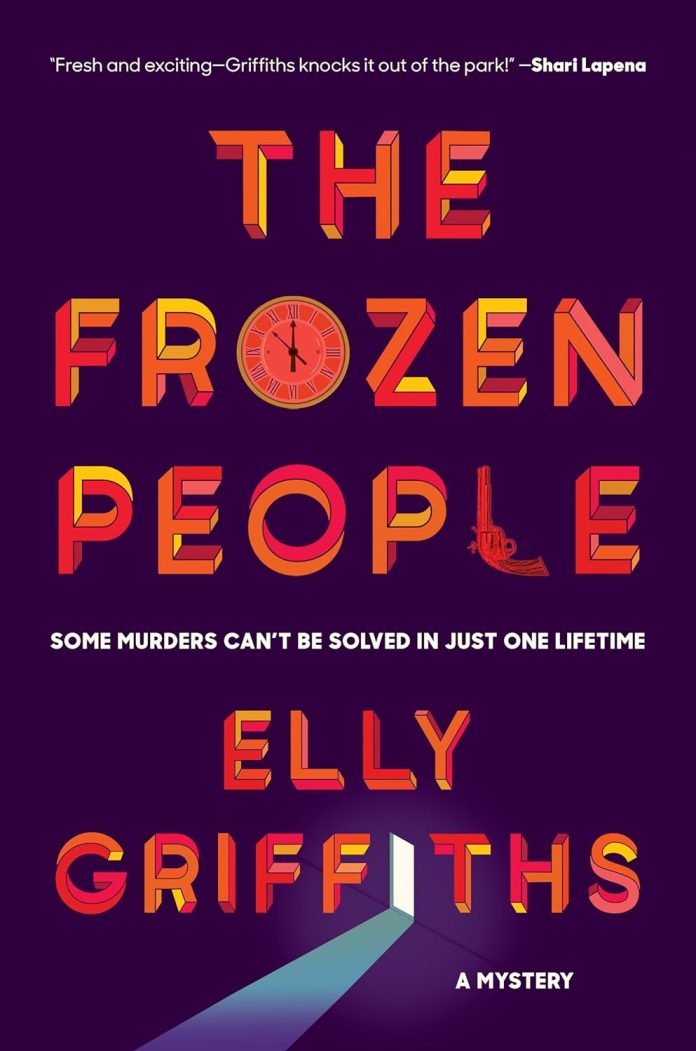
Elly Griffiths has carved an impressive niche in the mystery genre with her beloved Dr. Ruth Galloway series and the Brighton Mysteries, but The Frozen People represents a bold departure into uncharted territory. This inaugural entry in the Ali Dawson series marries the atmospheric tension of Victorian crime fiction with the mind-bending possibilities of science fiction, creating something entirely fresh yet reassuringly grounded in Griffiths’ trademark character development and meticulous plotting.
Detective Sergeant Ali Dawson works for what appears to be an ordinary cold case unit—until we discover their extraordinary secret. When conventional investigation methods fail, Ali’s team can literally travel back in time to gather evidence. It’s a premise that could easily descend into gimmickry, but Griffiths handles the temporal mechanics with surprising restraint, focusing instead on the very human story of a single mother caught between centuries.
A Mystery That Transcends Time
The Central Investigation
The novel opens with Ali being assigned her most ambitious case yet: investigating a murder from 1850. Aristocrat Cain Templeton stands accused of killing women as part of his membership in “The Collectors,” a sinister Victorian society. What begins as a straightforward historical investigation quickly becomes a nightmare when Ali finds herself stranded in 1850, unable to return to her own time.
Griffiths demonstrates remarkable skill in weaving together two parallel murder mysteries. In the present day, Isaac Templeton—Cain’s descendant—is found dead in his Sussex home, and Ali’s son Finn becomes the prime suspect. Meanwhile, in Victorian London, Ali must navigate the treacherous social landscape of 1850 while investigating the original crimes that have haunted the Templeton family for over a century.
Character Development and Emotional Depth
Ali Dawson emerges as a compelling protagonist, neither superhero nor victim but a realistic woman grappling with extraordinary circumstances. Her relationship with her twenty-year-old son Finn provides the novel’s emotional anchor. Griffiths skillfully portrays the fierce protectiveness of a single mother while acknowledging the complex dynamics of raising a child who has become an adult.
The Victorian sections allow Griffiths to showcase her considerable research skills. The 1850 London she creates feels authentically grimy and dangerous, from the snow-covered streets where sheep’s-feet vendors hawk their wares to the claustrophobic boarding house at 44 Hawk Street. Her depiction of Victorian social hierarchies and gender expectations never feels heavy-handed, instead emerging naturally through Ali’s struggles to navigate this alien world.
Cain Templeton himself proves to be one of the novel’s most intriguing creations. Neither obvious villain nor romantic hero, he occupies an unsettling middle ground that keeps both Ali and the reader constantly off-balance. His dinner conversations with Ali crackle with tension that could be sexual, intellectual, or genuinely threatening—sometimes all three simultaneously.
Literary Craftsmanship and Atmospheric Writing
Griffiths’ Evolving Style
Long-time readers of Griffiths’ work will notice an evolution in her prose style. While maintaining the wry humour and keen observation that characterize her other series, she demonstrates greater confidence in handling multiple time periods and more complex narrative structures. Her ability to shift seamlessly between contemporary police procedural and Victorian gothic horror showcases her range as a writer.
The novel’s pacing deserves particular praise. Despite the inherent complexity of a time-travel plot, Griffiths maintains momentum throughout, using Ali’s desperation to return home as an effective driving force. The Victorian sections never feel like historical tourism; instead, every scene advances either the plot or our understanding of the characters.
Sensory Details and World-Building
One of Griffiths’ greatest strengths lies in her ability to ground fantastical elements in convincing sensory detail. Ali’s experience of Victorian London feels viscerally real—the bone-deep cold, the omnipresent smell of horse manure, the discomfort of period clothing. These details serve the dual purpose of immersing readers in the historical setting while emphasizing Ali’s displacement and vulnerability.
The contrast between the sterile modernity of the police station and the chaotic vitality of Victorian London becomes a character in its own right. Griffiths uses these environmental differences to explore themes of progress, class, and gender roles without resorting to heavy-handed social commentary.
Strengths and Innovations
Genre-Blending Success
The Frozen People succeeds where many genre-blending attempts fail because Griffiths never loses sight of the fundamental requirement: telling a compelling story. The science fiction elements serve the mystery rather than overwhelming it. The time travel mechanism remains deliberately vague, allowing readers to focus on the human drama rather than getting bogged down in technical explanations.
The dual timeline structure creates natural opportunities for dramatic irony and parallel character development. Ali’s growing understanding of Victorian gender expectations illuminates her own modern struggles as a working mother in a male-dominated profession.
Supporting Characters
The ensemble cast deserves recognition for bringing both time periods to life. In the present day, colleagues like Dina and John provide workplace banter that feels genuine rather than forced. Their concern for Ali’s wellbeing during her temporal displacement adds emotional weight to the fantastical elements.
The Victorian characters avoid the trap of feeling like museum pieces. Clara, the boarding house maid, emerges as a particularly vivid creation—practical, shrewd, and unexpectedly protective of Ali. Even minor characters like the various lodgers at 44 Hawk Street feel like real people rather than period costume archetypes.
Critical Considerations
Pacing and Structure Challenges
While generally well-paced, the novel occasionally struggles with the inherent challenge of maintaining tension across two time periods. Some Victorian sequences, particularly the dinner party scenes, feel slightly over-extended, though they serve important character development purposes.
The resolution of the time travel mechanics feels somewhat rushed compared to the careful development of the mystery elements. Readers looking for detailed explanations of how temporal displacement works may find themselves disappointed by the deliberately vague approach Griffiths takes.
Character Motivation Complexity
Finn’s subplot in the present day sometimes feels underdeveloped compared to Ali’s Victorian adventures. While his arrest provides crucial stakes for Ali’s actions, his character occasionally feels more like a plot device than a fully realized person. This represents a minor but noticeable weakness in an otherwise well-developed cast.
Historical Context and Research
Victorian Authenticity
Griffiths’ research into Victorian London proves meticulous without becoming overwhelming. Her depiction of the period’s social dynamics, from the rigid class hierarchies to the emerging detective profession, feels authoritative. The inclusion of real historical figures and events grounds the fantasy elements in recognizable history.
The portrayal of women’s limited options in 1850 provides an effective contrast to Ali’s modern independence while avoiding the tendency to portray the past as uniformly oppressive. Characters like Clara demonstrate that even within restrictive social systems, individuals found ways to exercise agency and intelligence.
Contemporary Relevance
Despite its historical setting, the novel addresses thoroughly contemporary concerns. Questions about justice, family loyalty, and professional advancement resonate across the temporal divide. Ali’s struggles to balance career ambitions with maternal responsibilities speak to modern working parents regardless of century.
Series Potential and Future Directions
As the opening volume of a new series, The Frozen People establishes a solid foundation for future adventures. The combination of Ali’s personal growth, the mysterious nature of the time travel technology, and the rich possibilities inherent in accessing different historical periods provides ample material for subsequent books.
The supporting cast, particularly the members of Ali’s unit, suggests interesting directions for future character development. The hint that other time periods might be accessible opens up exciting possibilities for exploring different historical settings and their unique challenges.
Comparison to Griffiths’ Previous Work
Evolution from Established Series
Readers familiar with Griffiths’ Dr. Ruth Galloway mysteries will find familiar elements—strong female protagonists, atmospheric settings, and complex family relationships—while appreciating the new challenges she sets for herself. The supernatural elements represent a significant departure from her typically grounded approach, demonstrating her willingness to take creative risks.
The Brighton Mysteries’ blend of historical detail and contemporary sensibility provides the clearest precedent for this new series, though The Frozen People pushes the historical elements further into the foreground.
Similar Reads and Recommendations
For Fans of Temporal Crime Fiction
Readers who enjoy The Frozen People might appreciate:
- The Time Roads by Beth Bernobich – alternate history mystery
- The Shining Girls by Lauren Beukes – time-traveling serial killer thriller
- Life After Life by Kate Atkinson – temporal variations on a single life
- The First Fifteen Lives of Harry August by Claire North – time loop mystery
- The Time Traveler’s Wife by Audrey Niffenegger – romance with temporal elements
For Historical Mystery Enthusiasts
Those drawn to the Victorian elements should consider:
- The Silent Companions by Laura Purcell – Gothic Victorian horror
- The Essex Serpent by Sarah Perry – Victorian folklore mystery
- The Somnambulist by Jonathan Barnes – surreal Victorian mystery
- The Alienist by Caleb Carr – psychological thriller in 1890s New York
- The Whitechapel Fiend by Cassandra Clare – Victorian supernatural mystery
Final Verdict
The Frozen People represents a confident step into new territory for Elly Griffiths. While not every element reaches perfect execution, the novel succeeds in its primary goal: creating a compelling mystery that uses its fantastical elements to explore fundamentally human concerns.
Ali Dawson proves a worthy addition to Griffiths’ gallery of memorable protagonists. Her journey from frustrated cold case detective to temporal refugee creates genuine emotional investment that transcends genre boundaries. The novel’s exploration of family bonds, professional ethics, and personal agency resonates long after the final page.
Despite minor pacing issues and some underdeveloped subplots, The Frozen People delivers an engaging blend of historical detail, supernatural intrigue, and contemporary relevance. Griffiths demonstrates that genre boundaries exist to be crossed, not respected, when in service of a compelling story.
For readers willing to embrace both the methodical pleasures of police procedural and the mind-bending possibilities of time travel, The Frozen People offers a rewarding reading experience that promises even greater adventures to come. It’s a book that earns its place among the year’s most interesting mystery novels while establishing Ali Dawson as a character worth following wherever—or whenever—her investigations might lead.
The novel ultimately succeeds because it never forgets that the best mysteries, whether set in Victorian London or contemporary Britain, are fundamentally about people making difficult choices under extraordinary circumstances. In that respect, The Frozen People stands as both a successful genre experiment and a thoroughly satisfying read.