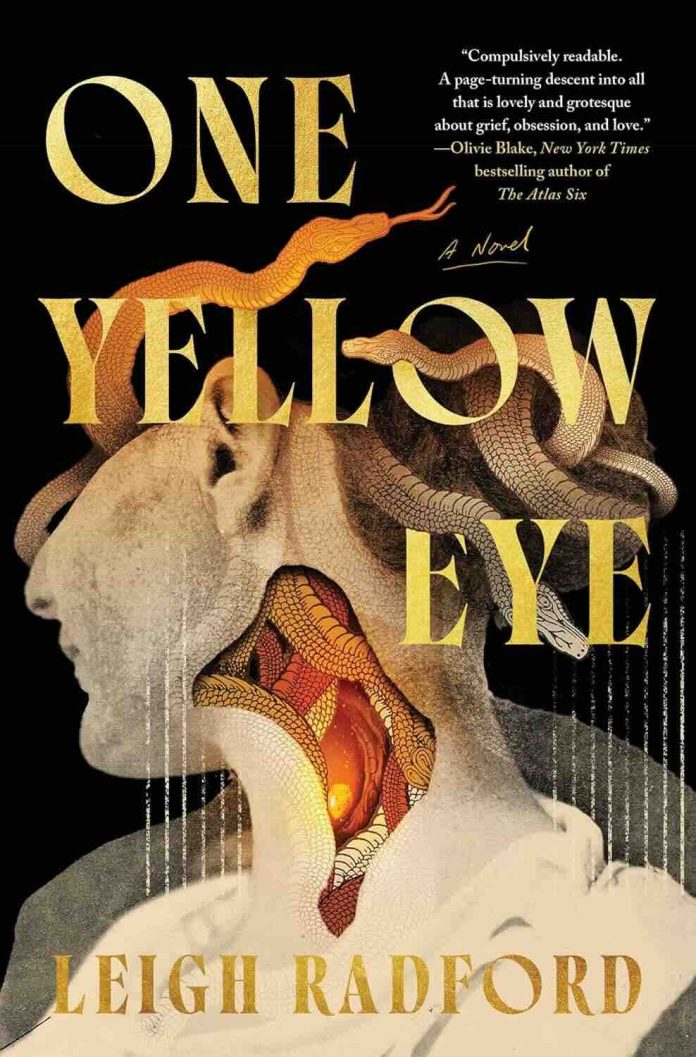
Leigh Radford’s debut novel One Yellow Eye arrives as a breathtaking reinvention of the zombie genre, trading gore for genuine emotion and cheap thrills for complex moral questions. This is not your typical shambling-corpse narrative. Instead, Radford crafts a sophisticated horror story that uses the undead as a lens to examine the lengths we’ll go to for love, and the devastating consequences of refusing to let go.
Set in post-apocalyptic London, the story follows Dr. Kesta Shelley, a brilliant biomedical scientist who has spent months secretly caring for her infected husband Tim in their spare bedroom. While the government has supposedly eliminated all zombies, Kesta has managed to keep Tim “alive” through a combination of sedatives, blood transfusions, and sheer determination. When an opportunity arises to work at the mysterious Project Dawn facility, Kesta sees it as her chance to finally find a cure for the virus that has stolen her husband’s humanity.
The Science of Sorrow
What elevates One Yellow Eye beyond typical zombie fiction is Radford’s background in broadcast journalism and her meticulous attention to scientific detail. The novel’s exploration of virology feels authentic and grounded, particularly in Kesta’s discovery that the zombie virus may be linked to Inclusion Body Disease—a real condition that affects reptiles. This scientific foundation gives weight to the horror, making the impossible feel terrifyingly plausible.
Radford’s prose alternates between clinical precision and lyrical beauty, mirroring Kesta’s dual nature as both scientist and grieving wife. The author’s descriptive passages are particularly striking:
“The little purple jellybeans. An image of a cream-colored snake tied into an impossible knot.”
The book’s title itself comes from a pivotal moment when Kesta discovers a reptilian disease manual in a dusty library, the cover adorned with a snake’s predatory yellow eye—a perfect metaphor for the virus that watches and waits within its victims.
Character Development and Emotional Resonance
Kesta emerges as one of the most compelling protagonists in recent horror fiction. Radford skillfully depicts her transformation from a reserved scientist who “always preferred the company of microbes” to a woman consumed by obsession. Her internal monologue reveals the gradual erosion of her sanity as she struggles to maintain the illusion that Tim is still salvageable.
The supporting cast, including the sympathetic Dr. Dudley Caring and the sharp-tongued lab technician June Cooke, provides necessary grounding for Kesta’s increasingly erratic behavior. Tim himself, despite being largely catatonic, maintains a haunting presence throughout the narrative. Radford manages to keep his humanity visible even as the virus consumes him, making his ultimate fate all the more tragic.
Thematic Depth and Social Commentary
Beyond its horror elements, One Yellow Eye functions as a profound meditation on grief, denial, and the medical-industrial complex. Kesta’s refusal to accept Tim’s death mirrors the stages of grief, while her increasingly dangerous experiments raise questions about medical ethics and the pursuit of knowledge at any cost.
The novel’s exploration of Project Dawn—a secret government facility conducting illegal “Gain-of-Function” research—feels particularly relevant in our post-pandemic world. Radford examines how crisis can be exploited for political and financial gain, and how scientists can become complicit in morally dubious research when driven by desperation.
Narrative Structure and Pacing
The story unfolds through multiple timeframes, gradually revealing the full scope of the outbreak and its aftermath. This structure creates mounting tension as readers piece together the truth about Tim’s condition and Kesta’s increasingly desperate measures. The pacing is deliberately methodical, building dread through accumulating details rather than relying on jump scares.
However, this measured approach may frustrate readers expecting more traditional zombie action. The novel’s focus on character psychology over visceral thrills requires patience and emotional investment that not all horror fans may be willing to provide.
Areas for Improvement
While One Yellow Eye succeeds as literary horror, it occasionally suffers from pacing issues in its middle section. Some sequences in the Project Dawn facility feel overextended, and certain scientific explanations border on exposition-heavy. The novel’s ending, while thematically appropriate, may leave some readers wanting more concrete resolution.
Additionally, some secondary characters feel underdeveloped, particularly Tim’s friend Jess, who appears intermittently but never quite achieves the depth needed to fully support the narrative’s emotional weight.
Writing Style and Atmosphere
Radford’s prose style perfectly matches her protagonist’s clinical mindset while gradually becoming more fragmented and urgent as Kesta’s mental state deteriorates. The author excels at creating atmosphere through subtle details—the constant hum of medical equipment, the antiseptic smell of the makeshift hospital room, the way Tim’s eyes never blink.
The London setting is rendered with convincing post-apocalyptic detail, from abandoned streets to underground laboratories. Radford’s background in broadcast journalism serves her well in depicting the media response to the crisis and the government’s attempts at damage control.
Final Verdict
One Yellow Eye stands as a remarkable debut that transcends genre boundaries. While it may not satisfy readers seeking traditional zombie thrills, it offers something far more valuable: a genuine exploration of love, loss, and the moral complexities of scientific progress. Radford has created a work that lingers in the mind long after the final page, raising questions about the nature of humanity and the price of hope.
This is horror fiction at its most sophisticated—cerebral, emotionally resonant, and deeply unsettling. For readers willing to engage with its challenging themes and deliberate pacing, One Yellow Eye offers a rewarding experience that elevates the zombie genre to new heights.
Similar Books to Consider
If you enjoyed One Yellow Eye, you might also appreciate:
- The Girl with All the Gifts by M.R. Carey – Another scientifically-grounded zombie narrative with emotional depth
- Zone One by Colson Whitehead – Literary zombie fiction exploring trauma and survival
- The Starving Saints by Caitlin Starling – Sci-fi horror with similar themes of obsession and scientific ethics
- Annihilation by Jeff VanderMeer – Biological horror with unreliable narrator
- The Road by Cormac McCarthy – Post-apocalyptic meditation on love and survival
Summary
One Yellow Eye succeeds as both horror novel and literary fiction, though its deliberate pacing and focus on character psychology over action may not appeal to all genre fans. Radford’s debut announces the arrival of a significant new voice in horror fiction, one unafraid to use the undead as a vehicle for examining very human concerns about love, loss, and the terrible things we do in the name of hope.