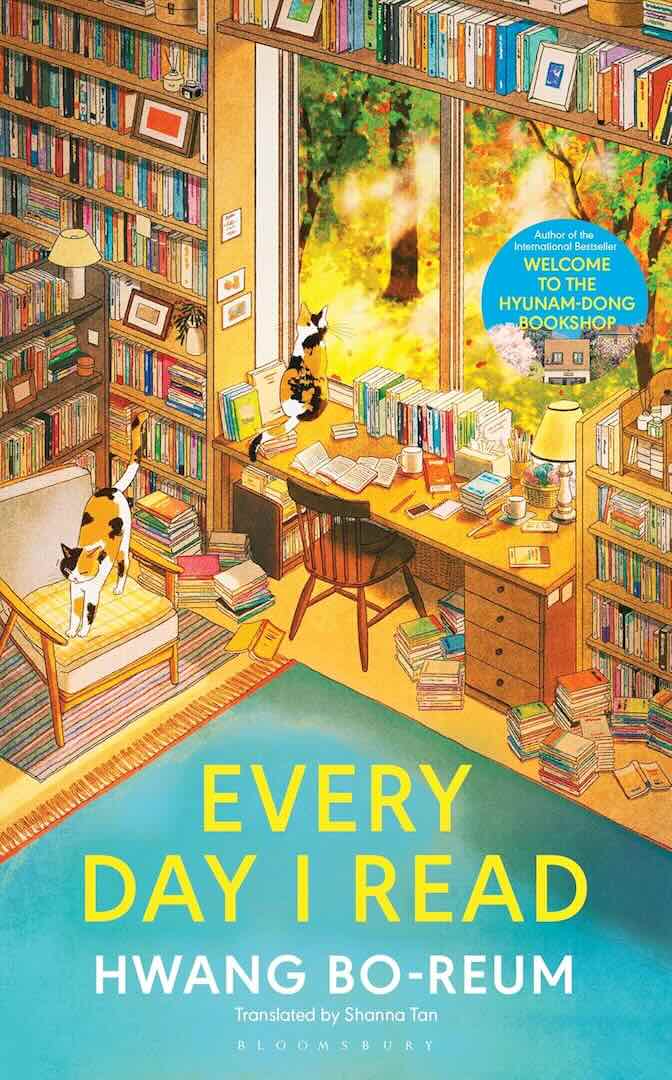
When was the last time you paused to ask yourself why you read? Not what you’re reading, or how many books you’ve finished this year, but the deeper question: what does reading mean in your life? Hwang Bo-Reum’s Every Day I Read: 53 Ways to Get Closer to Books poses this deceptively simple question and spends fifty-three essays gently exploring the answer. Written before her international bestseller Welcome to the Hyunam-dong Bookshop thrust her into the literary spotlight, this collection represents the author at her most vulnerable—a young woman in her early thirties, navigating the uncertainty of leaving corporate life to pursue writing, with books as her constant companions.
An Unconventional Guide to Reading
This isn’t a productivity manual promising to triple your reading speed, nor is it a prescriptive guide dictating which canonical works you must consume to be considered well-read. Instead, Hwang offers something more elusive and valuable: permission to read on your own terms. The fifty-three essays function less as numbered steps and more as intimate conversations with a friend who happens to be deeply, perhaps obsessively, in love with books.
The structure mirrors the fragmentary nature of a reading life—some essays span several pages while others offer brief reflections. Topics range from the practical (“Use a Timer App,” “Always Have a Book With You”) to the philosophical (“Read to Overcome Despair,” “Read Books That Preserve Your Sense of Self”). This deliberate variety creates a mosaic effect, where each piece contributes to a larger portrait of what it means to build a life around reading.
What distinguishes Hwang’s approach is her refusal to romanticize reading as purely escapist pleasure or intellectual achievement. She writes with refreshing honesty about the times she’s abandoned books mid-sentence, forgotten entire plots shortly after finishing, and bought more books than she could possibly read. In “You Don’t Always Have to Finish It,” she challenges the completionist impulse that plagues many readers, while “Are Books Useful?” tackles the uncomfortable question of whether all this reading serves any practical purpose.
The Texture of Thought
Hwang’s prose carries the gentle cadence of someone thinking aloud, circling around ideas rather than rushing toward conclusions. She frequently weaves quotes from philosophers, novelists, and fellow bibliophiles into her reflections, creating a dense intertextual fabric that demonstrates rather than merely describes what a reading life looks like. When discussing the difficulty of concentration in “Choose Books, Not the Internet,” she draws on Nicholas Carr’s The Shallows to explore how digital consumption reshapes our neural pathways. Her treatment of these sources feels conversational—she’s introducing you to books the way a friend might recommend a favorite café.
The Korean cultural context adds particular texture to these essays. References to subway reading culture, the Suneung university entrance exams, and the specific pressures of Korean corporate life ground her reflections in lived experience. For readers unfamiliar with these contexts, the specificity enhances rather than limits the universality of her observations. The anxieties of late-night overtime, the weight of societal expectations, and the quiet rebellion of prioritizing books over conventional success translate across cultural boundaries.
Where the book truly excels is in its examination of reading’s relationship to identity formation. In “Read When You’re Happy, When You’re Anxious and in the Moments in Between,” Hwang explores Erich Fromm’s distinction between “having” and “being,” using it to interrogate her decision to leave stable employment. The essay doesn’t offer neat resolutions; instead, it sits with the discomfort of choosing an uncertain path. This willingness to remain in tension, to resist the impulse toward easy answers, characterizes the collection’s most powerful moments.
The Weight of Accumulation
The collection’s primary limitation stems from its very structure. Fifty-three essays on reading, regardless of their individual merits, inevitably create redundancy. Certain themes—the importance of reading widely, the value of underlining favorite passages, books as refuge during difficult times—recur across multiple essays. By the final third, readers may find themselves skimming rather than savoring, having already absorbed the core messages.
The author’s reading diet, while impressively international and spanning multiple genres, occasionally reveals gaps that affect her analytical depth. Her engagement with Korean literature is rich and specific, but discussions of Western philosophy sometimes feel surface-level, relying on well-worn quotes from commonly referenced works. When she writes about Aristotle’s concept of happiness or Kafka’s demand that books should be “axes for the frozen sea inside us,” one wishes for more critical interrogation rather than reverent citation.
Additionally, Hwang’s position as someone who can afford to quit a well-paying job to read and write full-time goes largely unexamined. While she acknowledges financial precarity in passing, the collection doesn’t fully grapple with the class privilege that enables such a choice. For readers working multiple jobs or managing caregiving responsibilities, the suggestion to “always have a book with you” or dedicate entire days to reading during holidays may feel less like gentle encouragement and more like an impossible luxury.
The translation by Shanna Tan navigates the challenge of rendering Korean into English with general success, though occasional phrases feel slightly stilted, perhaps too literal in their adherence to the original Korean sentence structure. These moments are infrequent enough not to disrupt the overall reading experience, but they do create minor friction.
Finding Your Reading Rhythm
Despite these limitations, Every Day I Read – 53 Ways to Get Closer to Books offers genuine value for readers at various stages of their relationship with books. For those who’ve fallen away from reading, Hwang’s gentle encouragement to start with bestsellers or give up on books that don’t resonate provides permission to re-enter the reading life without shame. Her practical suggestions—using timer apps to build focus, keeping a reading list, organizing bookcases thoughtfully—feel achievable rather than overwhelming.
More established readers will find affirmation in Hwang’s celebration of reading’s less measurable rewards. Her essay on collecting quotes speaks to anyone who’s filled notebooks with favorite passages, while her reflections on book clubs and discussing books with friends validate reading as inherently social even when done in solitude. The collection works best when dipped into rather than consumed in marathon sessions, mirroring the very reading practice it advocates.
The book’s greatest contribution lies in its counter-cultural stance. In an era obsessed with optimization and measurable outcomes, Hwang insists that reading’s value can’t be quantified. She writes against the tyranny of productivity, suggesting that slow reading, rereading, and even forgetting what we’ve read all have their place in a meaningful reading life. This argument feels increasingly necessary as algorithmic recommendations and reading challenges transform books into content to be consumed and tracked.
For Fellow Travelers on the Reading Path
Readers who resonate with Hwang Bo-Reum’s meditative approach in Every Day I Read – 53 Ways to Get Closer to Books might also appreciate:
- How to Read and Why by Harold Bloom—offers a more canonical and scholarly exploration of reading’s purpose
- The Uncommon Reader by Alan Bennett—a novella imagining the Queen of England discovering a passion for reading
- Ex Libris: Confessions of a Common Reader by Anne Fadiman—essays on the quirks and pleasures of bibliomania
- Reading Lolita in Tehran by Azar Nafisi—memoir exploring literature’s power under political oppression
- A Velocity of Being: Letters to a Young Reader edited by Maria Popova and Claudia Bedrick—diverse voices on why reading matters
A Quiet Companion
Every Day I Read – 53 Ways to Get Closer to Books won’t revolutionize your reading practice or introduce you to obscure literary treasures. What it offers instead is quieter and perhaps more valuable: companionship in the solitary act of reading. Hwang writes with such genuine affection for books that her enthusiasm becomes contagious. You’ll likely finish this collection with a renewed appreciation for the small miracle of words on a page and a stronger desire to defend your reading time against the world’s endless demands.
The book works as a gentle reminder that building a reading life isn’t about achieving some external standard of literary accomplishment. It’s about finding books that speak to your specific confusions, delights, and sorrows—and making space for those conversations to unfold. In our relentlessly productive age, Hwang’s invitation to simply read, without agenda or ambition, feels like a radical act of self-preservation.







